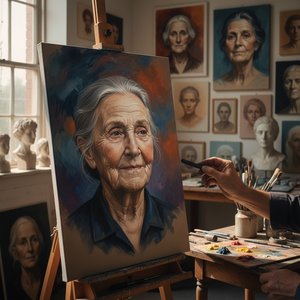
Jerry Hicks: Weaver of Light and Landscape
The work of Jerry Hicks, a British artist who flourished for nearly eight decades, is characterized by an almost luminous quality – a deep engagement with light, color, and the evocative power of the English countryside. Born in London in 1927, Hicks’s artistic journey was shaped by a confluence of influences: early exposure to the Slade School of Fine Art, a period spent touring as a musician and entertainer, and ultimately, a profound connection to the natural world. His paintings aren't merely representations of landscapes; they are imbued with a palpable sense of atmosphere, capturing fleeting moments of beauty and tranquility that invite contemplation. Hicks’s career spanned over seven decades, marked by consistent dedication to his craft and a remarkable ability to translate the subtleties of light and texture onto canvas.
Hicks's formal training at the Slade School of Fine Art provided him with a foundational understanding of artistic principles, but it was his experiences beyond academia that profoundly shaped his unique style. His years as a traveling musician – performing in circuses and theaters across Europe – instilled in him an appreciation for visual spectacle and a keen eye for composition. This background is evident in the dynamic brushwork and vibrant color palettes found throughout his oeuvre. He later combined this with his love of judo, which influenced his work’s dynamism and movement.
A pivotal moment in Hicks's artistic development occurred when he settled in Bristol, a city that would become synonymous with his work. He joined the Royal West of England Academy (RWA), a prestigious institution known for its commitment to supporting contemporary British artists. It was here that he began to establish himself as a significant figure in the regional art scene, exhibiting regularly and gaining recognition for his distinctive style. His connection to Bristol extended beyond the RWA; he became actively involved in civic organizations, contributing to the city’s cultural landscape through his artistic endeavors and community engagement.
The Language of Light and Color
Hicks's paintings are fundamentally studies in light and color. He possessed an extraordinary ability to capture the shifting qualities of daylight – the dappled shade beneath trees, the golden glow of a sunset, the silvery sheen on water. His technique involved layering thin washes of paint to create atmospheric effects, building up depth and luminosity through meticulous observation and skillful application. He frequently employed impasto—thickly applied paint—to render textures like foliage and stone, adding tactile richness to his compositions. The influence of Impressionism is readily apparent in his use of broken color and loose brushwork, yet Hicks’s style possesses a unique character that transcends simple stylistic imitation.
His subjects – often landscapes of the West Country, portraits of prominent figures, and still lifes—were treated with an almost reverential attention. He wasn't interested in creating photographic likenesses; instead, he sought to convey the essence of his subjects through color, light, and mood. He frequently depicted scenes from everyday life – a bustling cafe scene (“La Nuit”), a quiet morning by the sea (“Morning, La Guérite”)—transforming these familiar settings into moments of profound beauty.
Notable Works and Influences
Among Hicks’s most celebrated works are “Morning, La Guérite,” a luminous depiction of a coastal scene bathed in golden light; “La Nuit,” a vibrant portrayal of an outdoor cafe scene brimming with life; and numerous portraits of notable figures from Bristol's cultural and academic circles. His work for the Royal West of England Academy included depictions of University officials, including Professor Graeme John Davies, Vice-Chancellor of the University of Liverpool, and Sir Charles Frank, Nobel Prize winner. His artistic output also encompassed murals and stage designs, demonstrating his versatility as an artist.
While Hicks’s work is firmly rooted in British tradition, it was influenced by a diverse range of sources. He admired the Impressionists—Monet, Renoir, and Pissarro—for their mastery of light and color, and he drew inspiration from the landscapes of Constable and Turner. Furthermore, his interest in judo – which he practiced to a high level – informed his approach to composition and movement, evident in the dynamic energy of many of his paintings.
Legacy and Recognition
Jerry Hicks passed away in 2014 at the age of 87, leaving behind a significant body of work that continues to be admired for its beauty, sensitivity, and technical skill. His paintings are held in public collections across the United Kingdom, including the Royal West of England Academy, Bristol Guild, and Victoria Gallery & Museum. He was awarded an MBE in 1997 for his contributions to sport and community life in Bristol. Hicks’s legacy extends beyond his artistic achievements; he is remembered as a dedicated teacher, a passionate advocate for the arts, and a true son of Bristol.