


x
Her soru için yalnızca bir doğru cevap bulunmaktadır.
James Edgell Collins, a name perhaps less celebrated than some of his Victorian contemporaries, nevertheless occupies a significant niche in the history of British portrait painting. Born in 1820, Collins dedicated his artistic life to capturing the likenesses of military figures and prominent citizens, creating a body of work that offers a fascinating glimpse into the social fabric of 19th-century Britain. While biographical details remain somewhat sparse, the sheer volume and quality of his paintings attest to a successful and prolific career spanning several decades.
Information regarding Collins’s early training is limited; however, it's reasonable to assume he received formal instruction in London, the heart of British artistic activity during his formative years. The prevailing style of portraiture at the time was heavily influenced by Sir Thomas Lawrence and Joshua Reynolds – artists who prioritized elegance, refinement, and a degree of idealization. Collins’s early works demonstrate an absorption of these principles, characterized by meticulous attention to detail in costume and setting, and a flattering representation of his sitters. He quickly established himself as a skilled craftsman capable of rendering textures with remarkable realism, particularly excelling in the depiction of military uniforms and insignia.
Collins’s most enduring legacy lies in his portraits of British military personnel. The Victorian era was one of imperial expansion and national pride, and a strong demand existed for paintings commemorating officers and soldiers who served in conflicts across the globe. Collins expertly catered to this market, producing numerous regimental portraits that were often commissioned by families or displayed in mess halls. These works weren’t merely likenesses; they were statements of status, valor, and belonging. He possessed an exceptional ability to convey not only physical resemblance but also a sense of character and authority. The precision with which he rendered the details of uniforms – from the gleaming buttons to the intricate braid – speaks to his dedication to accuracy and his understanding of military symbolism.
While best known for his military subjects, Collins also painted portraits of prominent civilians. These commissions allowed him to broaden his artistic range and demonstrate his versatility. He captured members of Parliament, local dignitaries, and successful businessmen, often depicting them in their homes or offices, surrounded by symbols of their wealth and influence. These paintings offer valuable insights into the material culture and social aspirations of the Victorian middle class. His ability to adapt his style to suit different subjects—from the stern formality required for a military officer to the more relaxed pose appropriate for a civilian patron—highlights his professionalism and sensitivity as an artist.
James Edgell Collins’s work provides a compelling visual record of Victorian society. His paintings are not simply historical documents; they are works of art that reveal the values, beliefs, and aesthetic sensibilities of their time. Though he may not be a household name today, his meticulous technique, keen eye for detail, and dedication to capturing the likenesses of those who shaped his era ensure his place in the pantheon of British portrait painters. His paintings continue to be sought after by collectors and institutions, offering a tangible connection to a fascinating period in history. The enduring appeal of his work lies in its ability to transport viewers back in time, allowing them to encounter the faces – and stories – of those who lived during the age of empire and industrial progress.
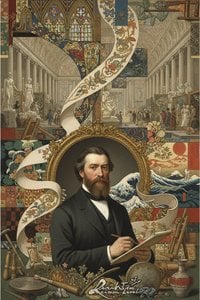
Explore the captivating world of Eugène Lami, a pivotal 19th-century French painter. Discover his eclectic style blending Romanticism & Academic traditions in history, fashion, and literary illustrations. Learn about his legacy today!

Explore the life & art of James Sant (1820-1916), renowned Victorian portraitist to Queen Victoria. Discover his captivating depictions of childhood, landscapes, and aristocratic society. Learn about his legacy & find fine art reproductions.

Explore the rich history of family portraiture through art! Discover masterpieces from across centuries & learn how artists captured kinship, intimacy, and societal values. Expert insights for collectors & enthusiasts.


En son sanat haberlerinden, özel tekliflerden ve dekorasyon fikirlerinden haberdar olun.
Projenizden bize bahsedin; sanat uzmanlarımız size özel 3 sanat eseri önerisi sunsun.
Size Özel 3 Seçeneği Ücretsiz Olarak Hazırlayalım!


