A World Between Worlds: The Botanical Surrealism of Jacques Martin-Ferrières
Jacques Martin-Ferrières occupies a unique and enchanting space in contemporary art, a realm where the meticulous detail of botanical illustration dances with the boundless imagination of surrealism. His canvases are not merely depictions of flowers or landscapes; they are portals to dreamlike ecosystems, imbued with a quiet mystery and an almost palpable sense of wonder. While biographical details surrounding Martin-Ferrières remain somewhat elusive – he is an artist who allows his work to speak volumes where personal narrative fades – the power and consistency of his vision have established him as a significant voice in modern painting. He invites viewers into meticulously crafted worlds, prompting contemplation on the delicate balance between reality and fantasy, nature’s inherent beauty, and the hidden languages woven within its forms.
Early Influences and Artistic Development
The seeds of Martin-Ferrières' artistic style were likely sown in a deep appreciation for both scientific observation and romantic aesthetics. While formal training details are scarce, his work exhibits a mastery of botanical rendering reminiscent of historical illustrators – artists who painstakingly documented plant life with unparalleled accuracy. This technical foundation is crucial; it’s not simply *that* flowers appear in his paintings, but *how* they appear—with an almost hyperreal clarity that grounds the fantastical elements. However, this precision isn't employed for purely scientific purposes. It serves as a counterpoint to the swirling, ethereal backgrounds and unexpected juxtapositions that define his surrealist leanings.
- Early exposure to botanical illustration likely influenced his precise rendering style.
- A fascination with Romanticism’s emphasis on emotion and imagination is evident in his dreamlike compositions.
- The artist's deliberate ambiguity regarding personal history suggests a preference for allowing the work itself to define its meaning.
It’s possible to trace echoes of artists like Max Ernst, with his frottage techniques and exploration of subconscious imagery, or even Giorgio de Chirico’s unsettling metaphysical landscapes. Yet, Martin-Ferrières doesn't simply replicate these influences; he synthesizes them into something distinctly his own – a style that feels both familiar and utterly original. His early works often featured isolated botanical specimens against stark backgrounds, gradually evolving towards the complex, layered compositions for which he is now known.
Themes of Nature, Dreamscapes, and Symbolic Language
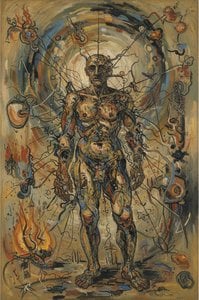
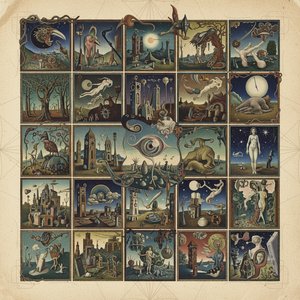
The central theme running through Martin-Ferrières’ oeuvre is undoubtedly nature, but not as a passive subject to be observed. His plants are active participants in their own worlds, often appearing anthropomorphic or imbued with symbolic weight. Flowers aren't just beautiful; they represent growth, decay, transformation, and the ephemeral nature of existence. The landscapes he creates are rarely identifiable as real places; instead, they function as internal terrains – dreamscapes populated by exotic flora and bathed in otherworldly light.
Recurring motifs include luminous orbs, intricate root systems that seem to connect everything, and a sense of suspended animation. These elements contribute to the paintings’ overall atmosphere of quiet contemplation and subtle unease. The artist frequently employs
symbolism, though its interpretation remains open-ended. A particular flower might evoke notions of fragility, while a tangled network of roots could represent interconnectedness or hidden depths. This ambiguity is intentional; Martin-Ferrières invites viewers to project their own emotions and experiences onto his work, creating a deeply personal connection with each piece.
Major Achievements and Artistic Style
Martin-Ferrières’ success lies in his ability to create paintings that are both visually stunning and intellectually stimulating. His works have garnered attention for their technical brilliance, imaginative scope, and evocative power. While he doesn't adhere to any strict artistic movement beyond the broad umbrella of surrealism, his style is instantly recognizable – a unique blend of botanical precision, dreamlike atmosphere, and symbolic depth.
His paintings often feature a meticulous layering technique, building up textures and colors to create a sense of depth and luminosity. He masterfully manipulates light and shadow, drawing the viewer’s eye into the intricate details of his compositions. The color palettes are typically muted and harmonious, with subtle gradations that enhance the overall feeling of tranquility and mystery. “At the Garden,” for example, exemplifies this style – a captivating scene where exotic flowers bloom amidst an ethereal landscape, inviting viewers to lose themselves in its dreamlike beauty.
Historical Significance and Contemporary Relevance
Jacques Martin-Ferrières’ work occupies a significant position within contemporary art by offering a refreshing alternative to more overtly conceptual or politically charged styles. In a world increasingly dominated by digital imagery and fleeting trends, his paintings provide a space for quiet contemplation and a renewed appreciation for the natural world. He reminds us of the beauty that exists beyond our immediate perception, inviting us to explore the hidden languages woven within nature’s forms.
His art resonates with contemporary concerns about environmentalism and the fragility of ecosystems, though he avoids explicit didacticism. Instead, his paintings offer a more subtle form of advocacy – a celebration of nature's inherent beauty that inspires awe and encourages a deeper connection with the planet. Martin-Ferrières’ legacy lies not in making grand statements but in creating worlds that linger in the imagination long after they are viewed—worlds where the boundaries between reality and fantasy blur, and the secrets of nature are revealed one delicate petal at a time.