The Soul of the Miniature: The Life and Legacy of George Washington Brownlow
In the delicate, intimate world of nineteenth-century miniature painting, few names evoke as much quiet reverence as George Washington Brownlow. Born in 1835 in Newcastle, England, Brownlow emerged during a period when the art of the small-scale portrait and genre scene served as a profound window into the emotional landscape of the Victorian era. While his life was tragically short—concluding in 1876—the breadth of his impact remains etched in the fine details of his work. His artistic journey was not merely one of technical progression, but a deep, spiritual exploration of identity, heritage, and the romanticized beauty of the natural world.
Brownlow’s early development was characterized by an extraordinary ability to compress vast, sweeping narratives into diminutive frames. Though he is often associated with the English tradition, his work frequently turned its gaze toward the rugged, evocative landscapes of Scotland and the legendary figures that inhabited its folklore. This fascination with Scottish themes allowed him to weave elements of myth and history into his compositions, creating works that felt much larger than their physical dimensions. His mastery of atmospheric perspective—the ability to use light and tonal modulation to suggest depth and distance—allowed him to capture the mist-shrouded lochs and heather-strewn moorlands with a breathtaking, almost tactile accuracy.
Technical Mastery and Narrative Depth
To observe a Brownlow miniature is to enter a dialogue with meticulous detail. He possessed a rare technical discipline, honed through years of studying the nuances of light and shadow. His oeuvre, which includes significant genre scenes and figure studies, demonstrates a profound commitment to capturing what many critics called the psychological nuance of his subjects. Whether he was depicting a quiet cottage interior or a dramatic encounter between historical figures, Brownlow utilized a sophisticated palette to evoke specific moods—from the somber, reflective tones of a lonely landscape to the vibrant, energetic brushwork found in his more narrative-driven pieces.
His artistic development was deeply influenced by the Romantic tradition, absorbing the lessons of masters who prioritized emotion and the sublime. This influence is most evident in his ability to imbue inanimate settings with a sense of living history. His works often featured recurring motifs that spoke to the cultural zeitgeist of his time:
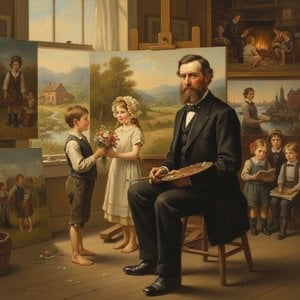
- The Ettrick Shepherd Boy: A poignant exploration of innocence and the formative power of maternal connection.
- Scottish Landscapes: Rugged, atmospheric vistas that served as more than mere backgrounds, acting instead as characters within his stories.
- Historical Portraits: Evocative depictions of figures like Robert Burns, where the artist sought to capture the intellectual fervor and spiritual depth of the poet.
A Lasting Impression on Victorian Art
The historical significance of George Washington Brownlow lies in his role as a bridge between the formal portraiture of the past and the more emotive, narrative-driven genre painting of the late Victorian period. Even as the popularity of miniatures began to wane in favor of larger canvases, Brownlow’s work maintained a unique relevance through its sheer intimacy. He understood that the smallest of surfaces could hold the greatest of truths, making his art an essential part of the era's visual vocabulary.
Though he passed away at the age of forty-one, leaving behind a legacy that continues to be rediscovered by collectors and historians alike, his contribution to the fine arts remains undiminished. His ability to blend the precision of a miniaturist with the sweeping soul of a Romantic painter ensures that his work continues to resonate, offering a window into a vanished world of mist, myth, and meticulous beauty.
Soru ve Cevaplar
George Washington Brownlow adlı sanatçının eserlerini kronolojik sırayla nerede görebilirim?
Sanatçının Eser Kronolojisi sayfası, George Washington Brownlow eserlerini tarihe göre, yıl yıl sıralanmış bir şekilde sunar.
George Washington Brownlow’in kariyeri hangi dönemlere ayrılıyor?
George Washington Brownlow'in kariyeri, sanatçının Sanat Yolculuğu sayfasında dönemlere ayrılmış bir zaman çizelgesi olarak sunulmaktadır: eserlerin kariyer dönemlerine göre gruplandırıldığı yatay bir kronoloji.
George Washington Brownlow en çok hangi renkleri kullandı?
George Washington Brownlow sanatçısının Palet Genomu, sanatçının eserlerinin renk profilini sunan bir sayfadır.