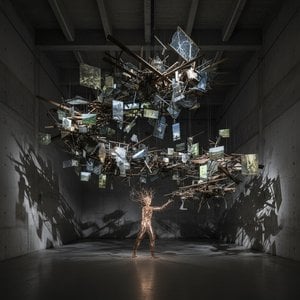
Georg Herold: Sculpting the Absurd, Excavating Meaning
Born in Jena, Germany, in 1947, Georg Herold’s artistic journey is a compelling narrative of rebellion, experimentation, and a profound interrogation of societal norms. His early life, marked by an escape from East Germany and subsequent studies at prestigious art academies in Munich and Hamburg, laid the groundwork for his distinctive approach – one that deliberately disrupts traditional artistic conventions through the use of unconventional materials and provocative imagery. Influenced profoundly by figures like Sigmar Polke, Franz Erhard Walther, Albrecht Dürer, Marcel Duchamp, and Dadaism, Herold’s work isn't simply about creating objects; it’s a sustained exploration of perception, power dynamics, and the very nature of art itself.
Herold’s formative years were spent immersed in a vibrant artistic community in Hamburg. This environment fostered a spirit of iconoclasm, a rejection of established hierarchies and a willingness to challenge conventional notions of beauty and value. He forged close relationships with contemporaries like Günther Förg, Martin Kippenberger, and Albert Oehlen – artists who shared his commitment to pushing boundaries and questioning the status quo. This collective energy fueled a period of intense experimentation, characterized by a playful yet unsettling blend of humor, irony, and social critique.
The Alchemy of Everyday Materials
A defining characteristic of Herold’s oeuvre is his masterful manipulation of seemingly mundane materials – bricks, mattresses, vodka bottles, buttons, socks, and even caviar. These aren't simply found objects; they are carefully selected and meticulously arranged to create sculptures, installations, and paintings that possess a surprising depth and complexity. This deliberate choice reflects a core tenet of his artistic philosophy: to elevate the ordinary into the extraordinary, revealing hidden narratives within the commonplace.
His technique is often described as an “alchemy” – transforming discarded or overlooked items into potent symbols. Consider works like "There is nothing left—There is no right" (1992), a deceptively simple installation featuring two identical gray doors, each bearing a starkly contrasting inscription. The ambiguity of the choice invites viewers to confront their own biases and assumptions about morality and direction. Similarly, his caviar paintings – spiraling patterns meticulously constructed from tiny, numbered eggs – are both visually arresting and conceptually challenging, prompting reflection on value, consumption, and the arbitrary nature of artistic significance.
Sculptural Narratives and Conceptual Layers
Herold’s sculptures frequently operate as layered narratives, inviting multiple interpretations. “Genetischer Eingriff in die Erbmasse bei Frau Herold” (1985), for instance, depicts a DNA double helix constructed from wire descending upon a wooden base, subtly interrupted by fragments of wood – a visual metaphor for the complexities and disruptions inherent in family lineage and inheritance. The work’s unsettling beauty lies in its ability to simultaneously evoke scientific precision and surreal unease.
His installation “Knstlerische Medizin, Patho-Ontologie (Cabinet patho-psychologique)” (1995) further exemplifies this layered approach. Filled with meticulously labeled glass bottles and jars containing pseudoscientific concoctions, the piece satirizes both the pretensions of scientific authority and the irrationality of human belief. Herold’s work consistently challenges viewers to question what they see, prompting them to consider not just the surface appearance but also the underlying conceptual framework.
Recognition and Legacy
Georg Herold's impact on contemporary art is undeniable. His willingness to embrace unconventional materials and confront difficult social issues has earned him international recognition. His work has been exhibited in major museums worldwide, including the Museum of Modern Art New York, the San Francisco Museum of Modern Art, and the Stedelijk Museum Amsterdam.
Beyond his individual achievements, Herold’s legacy lies in his persistent questioning of artistic conventions and his unwavering commitment to exploring the intersection of art, politics, and culture. He remains a vital voice in contemporary art, reminding us that even the most ordinary objects can hold profound meaning when viewed through a critical and imaginative lens. His work continues to provoke, challenge, and inspire, solidifying his place as one of Germany’s most significant artists of the late 20th and early 21st centuries.