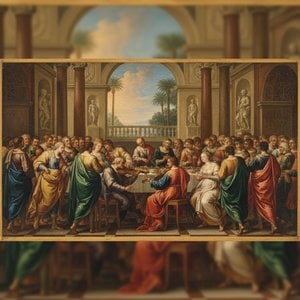
A Life Painted in Verona – The World of Francesco Morone
Francesco Morone (c. 1471 – May 16, 1529) stands as a pivotal figure within the artistic landscape of 15th-century Verona, a city renowned for its rich cultural heritage and burgeoning Renaissance spirit. His life’s work, largely centered around his native city, reveals a trajectory marked by apprenticeship, independent development, and a profound engagement with both traditional Venetian styles and emerging humanist ideals. Born into a family deeply rooted in the Veronese art world – his father, Domenico Morone, was himself a respected painter – Francesco inherited not only artistic talent but also a legacy of craftsmanship and a connection to established artistic networks. His story is one of gradual emancipation from his father’s shadow, culminating in a distinctive style that secured him a place among the most significant artists of his time.
Early life details surrounding Morone are somewhat fragmented, relying heavily on accounts from contemporaries like Vasari and other art historians. He was born into a family of painters, with his father Domenico Morone being a prominent figure in Verona’s artistic scene. Domenico's workshop served as Francesco’s initial training ground, where he likely absorbed fundamental techniques and developed an understanding of the prevailing artistic trends of the era. Crucially, he also formed a lasting friendship and collaborative relationship with Girolamo dai Libri, a fellow artist who profoundly influenced his development. This partnership fostered a dynamic exchange of ideas and styles, contributing to Morone’s evolving artistic vision.
The Foundations: Apprenticeship and Early Works
Francesco's early career was largely defined by his apprenticeship under his father, Domenico Morone. This period involved assisting in the completion of various commissions, gaining invaluable experience in fresco painting, panel painting, and altarpiece decoration. While Domenico’s style leaned towards a more conservative, Mantegna-influenced approach, Francesco gradually began to assert his own artistic voice. A significant milestone in this process was his 1496 collaboration with his father on the altarpiece for the Sanctuary of the Madonna delle Grazie in Arco – a work that marked his first independent signature and signaled a departure from purely familial influence. This piece, though initially viewed as largely shaped by Domenico’s hand, demonstrated Francesco's nascent ability to create compelling compositions and imbue them with emotional depth.
Further evidence of this burgeoning independence emerges in 1498, when he signed his own independent work: a Crucifixion for the Avanzi Chapel of the Church of San Bernardino in Verona. This painting is considered a pivotal moment, representing Francesco’s transition from assistant to recognized artist. The work showcases a more dynamic and expressive approach compared to his father's style, hinting at the influences he was absorbing from Venetian artists like Giovanni Bellini and the emerging humanist ideals that were shaping Renaissance art across Italy.
Masterpieces of Verona: Frescoes and Religious Scenes
Morone’s most celebrated works are undoubtedly his frescoes decorating the sacristy of Santa Maria in Organo, Verona. Completed between 1505 and 1507, these panels represent a culmination of his artistic development and a testament to his skill as a fresco painter. The cycle depicts scenes from the lives of Christ and the Virgin Mary, rendered with remarkable detail, vibrant colors, and a profound sense of spirituality. Vasari famously lauded these frescoes as “the most beautiful… that there was in all Italy,” recognizing their technical mastery and emotional resonance. The figures are imbued with a palpable humanity, reflecting Morone’s growing ability to capture psychological nuance and convey complex emotions.
Beyond the sacristy frescoes, Morone produced several significant works throughout his career, including the decoration of the Sagramoso Library in the San Bernardino convent (1502-1504), a testament to his versatility. His later works, such as the 1517 depiction of Saint Francis, demonstrate a shift towards a more contemplative and melancholic style, possibly influenced by his personal circumstances and the prevailing religious climate of the time. His final paintings are characterized by a quiet dignity and a profound sense of spirituality.
Influences and Legacy
Morone’s artistic development was shaped by a complex interplay of influences. His early training under Domenico Morone exposed him to the Mantegna-influenced style prevalent in Verona, while his collaboration with Girolamo dai Libri broadened his horizons and introduced him to new techniques and perspectives. The Venetian school of painting – particularly the works of Giovanni Bellini – exerted a significant impact on his color palette and compositional approach. Furthermore, Morone’s work reflects the broader humanist ideals that were transforming Renaissance art, emphasizing human emotion, narrative clarity, and a renewed interest in classical antiquity.
Francesco Morone's legacy is firmly rooted in Verona. His frescoes continue to captivate viewers with their beauty and emotional depth, while his paintings serve as invaluable examples of 15th-century Veronese art. He remains an essential figure in the history of Italian Renaissance painting, a testament to the enduring power of artistic skill, innovation, and personal expression.