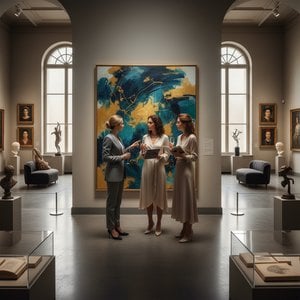
Eva Y.-H. P. Lee: Bridging Science and Art – A Singular Vision
Eva Yu-Hua Pan Lee (李潘玉華), born in Taipei, Taiwan in 1950, is a fascinating figure whose journey from molecular biology to artistic expression represents a compelling fusion of disciplines—a testament to intellectual curiosity and creative exploration. While initially focused on unraveling the complexities of cellular processes at UC Berkeley and later contributing to groundbreaking research at UCSD and UCI, Lee’s passion for visual storytelling ultimately led her to transform into a celebrated artist whose work delves into profound themes of nature, perception, and the interconnectedness of life.
Early Life & Education: Seeds of Scientific Inquiry
Lee's formative years were marked by academic rigor and a dedication to understanding the natural world. Obtaining degrees from National Taiwan Normal University in 1972 and 1979 provided her with a foundational knowledge base, equipping her for advanced studies at UC Berkeley where she earned her doctorate in cellular and molecular biology in 1984. Her involvement as a teaching assistant and research associate at Lawrence Berkeley Laboratory honed her analytical skills and fostered an appreciation for collaborative scientific endeavors—experiences that would undoubtedly shape her artistic sensibilities later on.
From Lab Bench to Canvas: The Emergence of Artistic Expression
The pivotal moment arrived when Lee transitioned from the laboratory to the studio, embarking on a creative path that initially seemed disparate yet ultimately revealed itself as deeply rooted in her scientific background. Influenced by movements like Futurism and Fluxus, she began experimenting with unconventional techniques—often incorporating mixed media and exploring abstract forms—to convey concepts related to biological systems and ecological processes. Her artistic explorations weren’t merely decorative; they served as a conduit for communicating complex scientific ideas in accessible and emotionally resonant ways.
Notable Achievements & Artistic Style: Exploring Biological Landscapes
Lee's artistic output stands out for its distinctive style, characterized by meticulous detail combined with bold color palettes and evocative compositions. Recurring motifs—such as interwoven patterns reminiscent of DNA strands or stylized depictions of plant life—reflect her fascination with the intricacies of biological structures and their role in shaping our environment. Her work has garnered recognition from institutions like EVA International (Limerick City) and the U.S. Department of the Interior Museum, showcasing her commitment to artistic excellence and fostering dialogue between science and art. Furthermore, she serves as chairwoman of Genetex, demonstrating her dedication to advancing scientific research and innovation.
Legacy & Significance: A Harmonious Synthesis
Eva Y.-H. P. Lee’s career exemplifies the transformative potential of interdisciplinary pursuits—a conviction solidified by her membership in Taiwan's Academia Sinica and her ongoing contributions to scientific advancement. Her artistic endeavors aren’t simply a personal passion; they represent a broader effort to communicate complex ideas through visual mediums, enriching our understanding of both biology and art history. Lee’s work continues to inspire artists and scientists alike, reminding us that creativity and intellectual rigor can coexist harmoniously—yielding insights that transcend conventional boundaries.