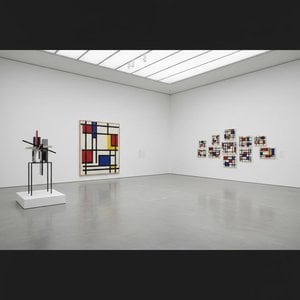
Dorothea Rockburne: Architect of the Abstract
Born in Montreal, Canada, in 1929 – a year that would soon be etched into history – Dorothea Rockburne’s artistic journey is one of profound intellectual curiosity and relentless geometric exploration. Her work isn't merely abstract; it’s a tangible manifestation of mathematical principles and astronomical observations, rendered with an almost obsessive precision. From the outset, Rockburne sought to translate complex concepts—the elegance of equations, the vastness of space—into visual form, creating paintings that seem to shimmer with hidden order.
Rockburne's formative years were deeply shaped by a unique confluence of influences. A pivotal encounter occurred during her studies at Black Mountain College in the late 1950s, where she engaged with mathematician Max dehn, a figure who would profoundly impact her artistic philosophy for life. Dehn’s rigorous approach to mathematics—his focus on infinity and the interconnectedness of systems—resonated deeply within Rockburne's developing aesthetic. This intellectual kinship extended beyond academia; she also benefited from mentorships with artists like Franz Kline, Philip Guston, John Cage, and Merce Cunningham, each contributing a distinct layer to her artistic vocabulary. These diverse relationships fostered an environment where experimentation and conceptual rigor were equally valued.
The Geometry of Observation
Rockburne’s paintings are characterized by their intricate geometric structures—often built from layers of thin, translucent acrylic paint applied with meticulous control. The process itself is almost sculptural; she builds up the surface through repeated applications, scraping, and manipulating the paint to create a complex interplay of color and texture. This layering technique isn't simply decorative; it’s integral to her exploration of mathematical concepts. She frequently employs techniques reminiscent of mannerism, utilizing fragmented forms and distorted perspectives to challenge traditional notions of representation. The resulting images are not easily deciphered at first glance—they demand close observation and a willingness to engage with the underlying structure.
The influence of astronomy is particularly evident in her work. Rockburne has spoken extensively about her fascination with celestial mechanics, using the patterns and rhythms of the cosmos as inspiration for her compositions. The repetition of shapes, the sense of infinite space, and the interplay of light and shadow all evoke a feeling of looking out into the vastness of the universe. She often describes her process as “mapping” astronomical phenomena onto the canvas, translating complex data into visual equivalents.
A Recognition of Legacy
Rockburne’s dedication to both art and mathematics culminated in a doctorate degree from Bowdoin College in 2016, a testament to her lifelong pursuit of knowledge. This achievement solidified her position as a truly interdisciplinary artist—one who seamlessly integrates intellectual rigor with creative expression. Her work has been exhibited extensively throughout North America and Europe, earning her recognition within the American Academy of Arts and Letters and the National Academy of Design.
More than just an abstract painter, Dorothea Rockburne is a visual explorer, charting new territories in the realm of geometric abstraction. Her paintings are not simply objects to be viewed; they are invitations—invitations to contemplate the beauty and complexity of mathematics, astronomy, and the human capacity for creative understanding. Her continued practice ensures that her unique vision will continue to inspire and challenge viewers for generations to come.
Further Exploration
- Key Influences: Max dehn (Mathematics), Franz Kline, Philip Guston, John Cage, Merce Cunningham, Mannerism
- Technique: Layered acrylic paint application, scraping, meticulous geometric construction
- Themes: Mathematics, Astronomy, Geometry, Repetition, Infinity, Spatial Relationships
Soru & Cevap
Dorothea Rockburne adlı sanatçının eserlerine dair istatistikleri nerede bulabilirim?
Dorothea Rockburne için bu web sitesi üzerindeki sanatçının eserlerine dair istatistikleri sunan bir İstatistikler sayfası bulunmaktadır.
Dorothea Rockburne hangi tarihi dönemde eser vermiştir?
Dorothea Rockburne, Modern döneminde çalışmalarını sürdürmüştür. Bu dönem, sanatçının faaliyetlerini tarihsel bir bağlama oturtur.
Dorothea Rockburne adlı sanatçının eserlerini anahtar kelimelere göre keşfedebilir miyim?
Dorothea Rockburne sanatçısının Anahtar Kelimelere Göre sayfası, sanatçının eserlerini anahtar kelimelerine göre gruplandırır.