


Lene Schneider-Kainer: A Journey Through Art and Exile
Lene Schneider-Kainer (1885 – 1971), a Jewish-Austrian painter, remains a captivating figure in the art world, celebrated for her evocative illustrations and watercolor works that often explored themes of travel, eroticism, and cultural encounter. Born in Vienna amidst a vibrant artistic milieu—the daughter of renowned painter Sigmund Schneider—her life was profoundly shaped by both personal passion and tumultuous historical events, culminating in a remarkable journey across continents and a legacy marked by resilience and creative expression.
Lene’s early artistic education laid the foundation for her distinctive style. She began her studies in Vienna, absorbing the classical influences of the city's esteemed institutions. Subsequently, she pursued further training in Munich, Amsterdam, and Berlin, each location contributing to a broadening understanding of artistic techniques and approaches. This diverse educational background fostered a remarkable versatility, allowing her to seamlessly blend traditional methods with innovative experimentation. Her debut at the Gurlitt Gallery in 1921 marked a significant milestone, introducing her work to a wider audience and establishing her as a promising new voice within the German art scene.
One of Lene’s most notable collaborations was with Lukian, resulting in the illustrated edition of “Hetärengespräche” (Dialogues of Courtesans). This project showcased her exceptional talent for capturing nuanced emotion and atmosphere through illustration. The series, accompanied by a thoughtful afterword by Sabine Dahmen, offered a glimpse into Lene’s ability to translate literary themes into visually arresting images. Beyond this specific collaboration, her work frequently explored the complexities of human relationships, often with a subtle eroticism that challenged conventional artistic norms of the time.
The rise of Nazism in 1938 irrevocably altered Lene's life and career. Forced to flee Austria, she sought refuge in Bolivia, a country far removed from her European roots. Despite facing immense challenges—including displacement, cultural adjustment, and the ever-present threat of persecution—Lene continued to paint and exhibit her work with unwavering determination. This resilience speaks volumes about her artistic spirit and commitment to her craft. Her relocation to Bolivia also coincided with a period of intense personal reflection, as evidenced by her memoirs documenting her extensive travels.
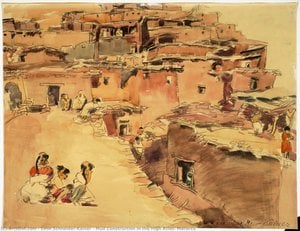
Lene’s journey took her through a remarkable series of locations, each leaving an indelible mark on her art. She spent years traversing Russia, Persia, India, Burma, Thailand, Vietnam, Tibet, Hong Kong, and China, meticulously documenting her experiences through painting, photography, and sketching. These travels were not merely expeditions; they were profound encounters with diverse cultures, customs, and perspectives. Her artwork from this period—such as “Banaras,” a vibrant watercolor capturing the bustling energy of an Indian temple scene—offers a unique window into the world she discovered.
Key artworks like "Portrait of an Asian Man" (1971) exemplify her ability to capture the essence of individuals and cultures with sensitivity and insight. These pieces, alongside others such as “Woman from Elaobad tribe,” demonstrate her mastery of watercolor techniques and her keen eye for detail. Her work is held in prestigious collections worldwide, including those featured on WahooArt.com and within institutions like the Museum Frieder Burda in Germany and the Wedgwood Museum in the United Kingdom.
Lene Schneider-Kainer’s legacy extends far beyond her artistic achievements. She stands as a poignant symbol of the challenges faced by Jewish artists during the Nazi era, embodying both creativity and survival. Her story serves as a reminder of the importance of preserving cultural heritage and celebrating the contributions of individuals who have overcome adversity. Her work continues to resonate with audiences today, offering a glimpse into a fascinating period of art history and a testament to the enduring power of human expression.




![[portrait Of An Asian Man]](/media/artworks/images/thumbnails/0c/07/0c072461a0844896a7138071ed65aec8.jpg)


![[child In A Wooden Cart]](/media/artworks/images/thumbnails/77/2c/772c053e74b645c5b1843213cc64b948.jpg)
![[sailboats, Amsterdam]](/media/artworks/images/thumbnails/78/32/783267e6febd4324a06863e4063a5ece.jpg)





