
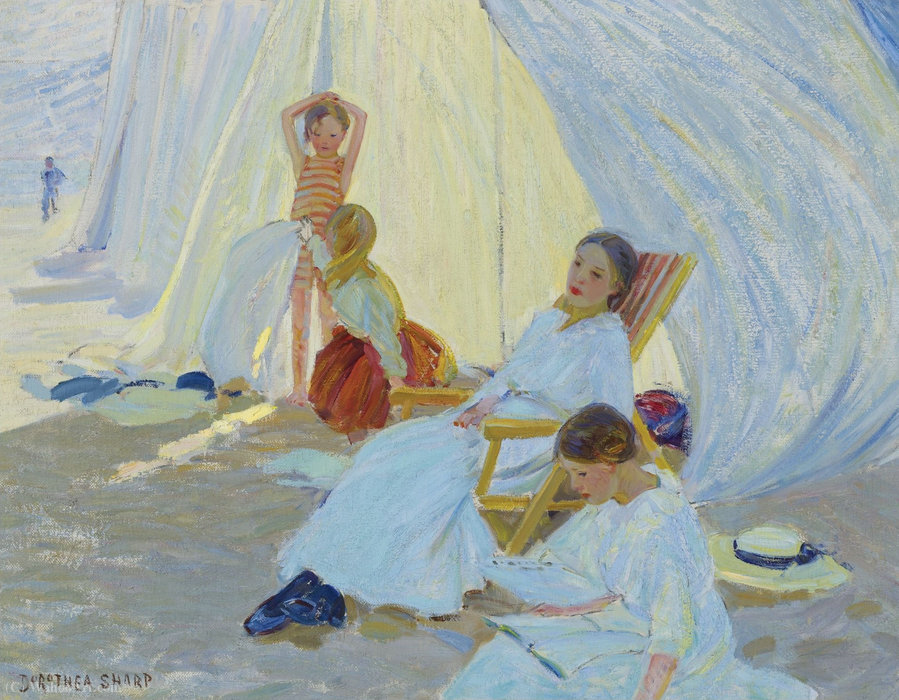
Dorothea Sharp, 1874 – 1955

Dorothea Sharps målningar: De 2 mest kända verken, rankade

Dorothea Sharps mest kända målning är A Day at the Sea. Vår katalog listar 2 verk av Dorothea Sharp; de 2 nedan är de som världen betraktar mest, var och ett med sitt årtal, museet som förvarar det och varför det är betydelsefullt.

Rankade efter vår popularitetspoäng, som kombinerar sökningar, besök och beställningar för varje verk. Uppdaterad november 2026. Varje mästerverk på denna sida kan beställas som en handmålad oljereproduktion av museikvalitet eller som ett konsttryck i den storlek du väljer.

Porträtt av Dorothea Sharp
Dorothea Sharp · 1874 – 1955
Född · död
1874 – 1955, Dartford
Verk i vår katalog
2
Mest kända
A Day at the Sea

De 10 mest kända målningarna av Dorothea Sharp

A Day at the Sea av Dorothea Sharp
1

A Day at the Sea

Oil

In A Day at the Sea by Dorothea Sharp, we find ourselves observing a quiet moment of leisure on a sunlit shore. The painting focuses on a group of women enjoying their time together at the beach, capturing a sense of relaxed companionship. There are four main figures positioned within the scene, each contributing to the atmosphere of a shared afternoon by the water.

Handmålad oljereproduktion från $199 36 × 28 cm
Sunday picnic av Dorothea Sharp
2

Sunday picnic

Oil

Sunday picnic is a work by Dorothea Sharp. Born in Dartford, United Kingdom, in 1874, the artist was the eldest of five children born to James Sharp and Emily Jane (née Sturge). Though she was christened Lydia Mary, she chose to be known by the name Dorothea throughout her life.

Handmålad oljereproduktion från $199 33 × 31 cm

De motiv Dorothea Sharp målade mest av

De fyra motiv som förekommer oftast bland dessa mästerverk, med det främsta exemplet på varje.

Frågor om Dorothea Sharps målningar

Vilken är Dorothea Sharps mest kända målning?Visa svaret

A Day at the Sea

Hur många målningar har Dorothea Sharp skapat?Visa svaret

Vår katalog innehåller 2 verk av Dorothea Sharp.

Vad målade Dorothea Sharp oftast?Visa svaret

Woman (2) och Handbag (2), av totalt 2 verk på denna sida.

Vilket medium använde Dorothea Sharp mest?Visa svaret

Oil: 2 av 2 verk på denna sida.

Kan jag köpa en reproduktion av en Dorothea Sharp-målning?Visa svaret

Ja. Varje målning på denna sida kan beställas som en handmålad oljereproduktion av museikvalitet eller som ett konsttryck i den storlek du väljer, direkt från målningens egen sida.

Om Dorothea Sharp

Dorothea Sharp: A Life in Impressionistic Hues

Early Life and Education

  • Born in Dartford, Kent, United Kingdom in 1874, Dorothea Sharp began her artistic training relatively late, at the age of 21.
  • She funded her education with an inheritance of £100 from an uncle, allowing her to attend the Richmond Art School under C.E. Johnson RI.
  • Further studies at the Regent Street Polytechnic brought her work to the attention of George Clausen and David Murray, who recognized her talent.

Artistic Development & Influences

  • A pivotal moment in Sharp’s artistic journey was her time in Paris, where she encountered the works of the Impressionists, particularly Claude Monet.
  • Monet's influence led her to adopt a highly impressionistic and spontaneous style that characterized her work for the rest of her life. She embraced capturing fleeting moments and the effects of light.
  • Her early work showed promise, but it was through embracing Impressionism that she found her distinctive voice.

Career & Recognition

  • Sharp became an associate of the Society of Women Artists in 1903 and a full member in 1908, later serving as its Vice-President for four years.
  • She was elected to both the Royal Society of British Artists (1907) and the Royal Institute of Oil Painters (1922), demonstrating her growing reputation within the art world.
  • Exhibited regularly at the Royal Academy from 1901 to 1948, showcasing a consistent body of work.
  • Held her first solo exhibition at the Connell Gallery in 1933, receiving critical acclaim and being hailed as “one of England’s greatest living woman painters” by Harold Sawkins, editor of *The Artist* magazine.

Themes & Style

  • Sharp's oeuvre is primarily known for two key themes: evocative landscapes and naturalistic studies of children at play.
  • Her landscapes often depict scenes from her travels, including locations in Europe (Cassis), Bosham, and St Ives, Cornwall.
  • Her depictions of children are particularly charming, capturing their spontaneity and joy with a delicate touch. She avoided overly sentimental portrayals, focusing on natural interactions.
  • Her style is characterized by loose brushwork, vibrant colors, and an emphasis on light and atmosphere, hallmarks of Impressionism.

Later Life & Legacy

  • In the 1920s and 30s, Sharp continued to travel and paint, forming a lifelong friendship with fellow artist Marcella Smith in St Ives, Cornwall.
  • She was made an honorary member of the St. Ives Society of Artists (StISA) in 1928.
  • Dorothea Sharp passed away on December 17, 1955, at the age of 81.
  • While not as widely recognized today as some of her contemporaries, Dorothea Sharp remains a significant figure in British Impressionism, celebrated for her sensitive portrayals of everyday life and her mastery of light and color.