Claus Sluter: Pioneer of Northern Realism
Claus Sluter (c. 1350-1406) stands as one of the most influential sculptors of his era, marking a crucial juncture between Gothic and Renaissance artistic traditions in Northern Europe. Born in Haarlem, Netherlands—a burgeoning center for artistic innovation—Sluter’s career unfolded against the backdrop of the Burgundian court, shaping him into a sculptor whose distinctive style would resonate through subsequent generations. His legacy rests not merely on quantity but on quality: Sluter achieved remarkable precision and emotional depth within his monumental works, establishing himself as a champion of what historians termed “Northern Realism.”- Early Life & Training: Precise biographical details remain elusive, yet evidence suggests Sluter received training in Haarlem’s guild workshops, absorbing the stylistic conventions of Gothic sculpture prevalent at the time. The inscription of his name in the Brussels stonemasons' guild register around 1379/1380 confirms his professional engagement and underscores the importance of craftsmanship within medieval artistic culture.
- Service to Philip the Bold: Sluter’s formative years culminated in a pivotal apprenticeship with Jean de Marville, court sculptor to Philip the Bold, Duke of Burgundy—a position that propelled him into the orbit of Burgundian patronage and artistic ambition. From 1385 to 1389, he honed his skills amidst the opulent courts of Dijon, absorbing influences from both Gothic formalism and emerging Renaissance ideals.
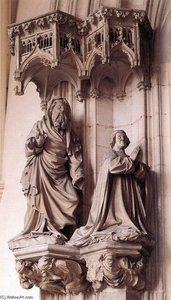
- The Well of Moses: Sluter’s magnum opus—the Well of Moses—completed between 1395 and 1403—represents a watershed moment in sculptural history. Commissioned for the Champmol Carthusian Monastery, just outside Dijon, this ambitious project embodies Sluter's mastery of Northern Realism. The sculpture’s hexagonal fountain base supports a complex arrangement of figures depicting Old Testament prophets and kings, meticulously crafted to convey profound spiritual meaning.
Northern Realism: A Distinctive Style
Sluter’s artistic vision distinguished itself from prevailing Gothic conventions through an unprecedented commitment to anatomical accuracy and emotional expression. Unlike many of his contemporaries who adhered to stylized representations, Sluter sought to capture the human form with remarkable realism—a characteristic that would become synonymous with “Northern Realism.” This stylistic approach was particularly evident in depictions of Christ on the cross and Mary Magdalene kneeling at its foot, where Sluter skillfully conveyed sorrowful emotion through subtle musculature and nuanced facial expressions.- Technique: Sluter employed a masterful technique utilizing Carrara marble—a material favored by Renaissance sculptors—to achieve unparalleled surface smoothness and tonal gradation. This meticulous attention to detail reflects the influence of Florentine sculpture, signaling Sluter’s engagement with humanist ideals and artistic innovation.
- Symbolism & Typology: The Well of Moses exemplifies Sluter's profound understanding of biblical symbolism and typology. Each prophet and king embodies a specific Old Testament figure foreshadowing Christ’s sacrifice—a concept central to Christian theology and powerfully conveyed through the sculpture’s spatial arrangement and expressive gestures.
Legacy & Historical Significance
Despite the unfortunate destruction of the Well of Moses in 1736, Sluter's influence endured throughout subsequent centuries. Fragments from the original cross—now housed in Dijon Museum—remain invaluable artifacts documenting his artistic prowess and stylistic innovations. Furthermore, Sluter’s nephew, Claus de Werve, continued his artistic lineage, ensuring that Sluter’s legacy persisted within the Burgundian sculptural tradition. Claus Sluter's contribution to art history is undeniable: he ushered in a new era of realism and emotional depth, solidifying his position as one of the foremost sculptors of his time—a true pioneer of Northern Renaissance artistry.Notable Works
- Well of Moses (Champmol Monastery)
- Cross of Dijon
- Virgin and Child