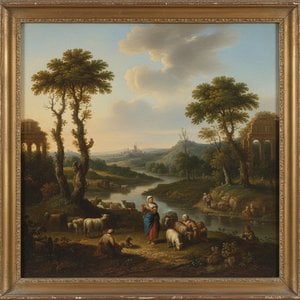
Abraham Rademaker: A Dutch Master of Urban Landscapes and Architectural Prints
Abraham Rademaker (1677 – 1735) occupies a prominent position within the annals of Dutch Golden Age art, primarily celebrated for his painstaking depictions of cityscapes and architectural drawings—images that captivated audiences and served as catalysts for countless prints. Born in Lisse, Netherlands, Rademaker’s artistic journey unfolded over several decades during which he honed a remarkable skillset encompassing Italianate landscapes alongside an astonishing productivity in urban scenes—a genre particularly attuned to the aesthetic sensibilities of his time.
Early Life and Artistic Foundations
Details concerning Rademaker's formative years remain elusive, yet archival records confirm that he received instruction in Haarlem, where he established himself as both artist and printmaker. Haarlem’s vibrant printing industry functioned as a fertile breeding ground for collaborative artistic endeavors—a circumstance undeniably shaping Rademaker’s artistic vision and fostering connections with fellow craftsmen who shared his passion for visual representation. This environment encouraged experimentation and innovation, mirroring the broader cultural dynamism of the era.
A Distinctive Style Defined by Observation
Rademaker's artistic hallmark resides in his unwavering commitment to meticulous observation—a characteristic vividly apparent in his cityscapes. These artworks capture the majesty of structures like Delft’s Jesuit Church with breathtaking precision, reflecting a profound understanding of architectural principles and techniques. He skillfully manipulated perspective methods to instill depth and realism into his canvases, channeling the influence of Renaissance artistic ideals—a testament to his intellectual curiosity and artistic prowess.
The Legacy of Architectural Prints
Rademaker's enduring fame stems principally from his prints—remarkable reproductions of architectural drawings executed with unparalleled accuracy. These images played a crucial role in disseminating information about urban planning initiatives throughout Holland, showcasing the splendor of Dutch cities and cementing Rademaker’s reputation as a pioneer in documenting visual reality. His contribution to artistic documentation is undeniable, mirroring the broader ambition of artists during this period to capture and disseminate knowledge through innovative mediums.
Influences Shaping Artistic Expression
Rademaker's artistic sensibilities were profoundly impacted by the prevailing artistic currents of his time—particularly the dramatic chiaroscuro employed by Caravaggio and the idealized landscapes championed by Claude Lorrain. These influences instilled within him a capacity for conveying emotion and grandeur, enriching his artistic repertoire and elevating his work to heights of expressive power. His engagement with these masters demonstrates an awareness of artistic tradition and a willingness to assimilate new stylistic approaches.
Concluding Reflections: An Artist Enduring Through Time
Though Rademaker’s oeuvre may not rival the expansive output of some contemporaries, his prints endure as invaluable resources for reconstructing the visual culture of 18th-century Holland—a testament to his dedication to craftsmanship and a symbol of Dutch artistic excellence. Furthermore, investigations into Delft's cultural heritage at Gemeentearchief reveal connections to the iconic Delft Blue pottery tradition—a reflection of the broader artistic landscape in which Rademaker flourished and whose legacy continues to inspire artists today. His work stands as an enduring emblem of Dutch artistic heritage.