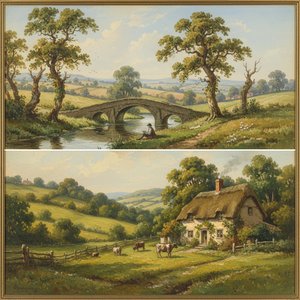
William Henry Pyne: A Pioneer of Watercolor and Victorian Illustration
William Henry Pyne (1769 – 1843) stands as a remarkable figure in British art history—a writer, illustrator, painter, and prolific contributor to the burgeoning Victorian aesthetic. Born in London amidst the intellectual ferment of the Enlightenment, Pyne’s artistic journey began with formal training at the Drawing Academy of Henry Pars, establishing him firmly within the artistic circles of his time. His early exposure to classical ideals would profoundly shape his distinctive style, characterized by meticulous observation and a masterful command of watercolor technique.
- Early Career & Royal Academy Debut: Pyne’s debut at the Royal Academy in 1790 marked a pivotal moment, initiating a career dedicated to capturing the beauty of the English landscape and portraying human subjects with remarkable realism. His landscapes—particularly those depicting dramatic vistas and atmospheric effects—were immediately recognized for their expressive power.
- The Costume of Great Britain: Perhaps Pyne’s most enduring legacy rests upon “The Costume of Great Britain,” a monumental undertaking published in 1805. Collaborating with Rudolph Ackermann, he embarked on an ambitious project to document the diverse social strata of Victorian England through meticulously rendered watercolor paintings and detailed engravings. This work not only achieved commercial success but also cemented Pyne’s reputation as a visual chronicler of his era.
Pyne's artistic vision extended beyond mere representation; he sought to convey emotion and narrative within his compositions. His watercolors, imbued with subtle tonal harmonies and delicate brushstrokes, exemplify the Romantic spirit—a fascination with nature and an appreciation for psychological depth. He skillfully employed watercolor’s luminous qualities to illuminate scenes of everyday life, capturing the nuances of human interaction and conveying a sense of immediacy.
- Royal Watercolour Society & Artistic Patronage: Recognizing the importance of fostering artistic innovation, Pyne co-founded the Royal Watercolour Society in 1804, championing watercolor as a medium for artistic expression. His influence extended beyond his own work; he served as an advisor to artists and contributed generously to educational initiatives.
- Beyond Watercolor: Architectural Engravings & Literary Collaborations: Pyne’s talents weren't confined solely to watercolor painting. He excelled in architectural engraving, producing stunning depictions of royal residences—most notably “The History of the Royal Residences,” a lavish illustrated book featuring 100 engravings of Windsor Castle, St James’s Palace, Carlton House, Kensington Palace and Hampton Court Palace. Furthermore, he engaged in literary collaborations with Ackermann, crafting engaging prose pieces for journals and publishing novels like "The Twenty-ninth of May," exploring themes of social observation and artistic sensibility.
Despite achieving considerable acclaim during his lifetime, Pyne’s career was marred by financial difficulties culminating in imprisonment due to debt. He died impoverished in 1843, leaving behind a substantial body of work that continues to inspire admiration for its technical virtuosity and humanist vision. His son, George Pyne, followed in his father's footsteps as a watercolorist and writer on drawing perspective, ensuring the legacy of William Henry Pyne’s artistic contributions endured into the Victorian period. Today, Pyne’s watercolors reside in prestigious collections like the Royal Collection and the British Museum—testaments to his enduring influence on British art and culture.