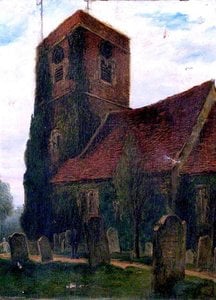
William Freeman, 1838 – 1918

Slike autora William Freeman: 23 najpoznatijih dela, rangiranih

Najpoznatije delo umetnika William Freeman je Market Place, Kingston, Surrey. Uz View from a Park in Surbiton, Surrey (1883) i Malden Church, Surrey (1905), to su tri dela koja svi prepoznaju. Naš katalog sadrži 30 dela umetnika William Freeman; ovih 23 ispod su dela koja svet najčešće posmatra, svako sa navedenom godinom nastanka, muzejom u kojem se čuva i razlogom zašto je značajno.

Rangirano prema našem koeficijentu popularnosti, koji kombinuje pretrage, posete i porudžbine za svako delo. Ažurirano новембар 2026. Svako remek-delo na ovoj stranici može se naručiti kao ručno oslikana uljana reprodukcija muzejskog kvaliteta ili kao umetnička štampa, u dimenzijama koje odaberete.

Portret William Freeman
William Freeman · 1838 – 1918
Rođen · umro
1838 – 1918
Radovi u našem katalogu
30
Najpoznatije dela
Market Place, Kingston, Surrey

10 najpoznatijih slika umetnika William Freeman

Market Place, Kingston, Surrey čiji je autor William Freeman
1

Market Place, Kingston, Surrey

Oil

The scene captures a bustling street in Kingston, Surrey, where the architecture of a growing town meets the daily rhythm of its inhabitants. Two parallel streets, lined with buildings of varying heights, create a skewed perspective that draws the eye into the depth of the urban landscape. The composition focuses on the quiet energy of pedestrian life, with figures sketched with minimal detail amidst shops and awnings. It is a…

Rukom oslikana uljana reprodukcija od $256 37 × 27 cm Isti veličine kao original $263 41 × 30 cm Naručite u originalnim dimenzijama →
View from a Park in Surbiton, Surrey (1883) čiji je autor William Freeman
2

View from a Park in Surbiton, Surrey

1883 · Watercolor

The air feels heavy with the scent of damp earth and the quiet anticipation of a passing cloud. In this corner of Surbiton, Surrey, the world slows to a rhythmic crawl. A lone figure stands near a wooden fence, perhaps lost in thought or simply watching the way the light shifts across the grass. The landscape unfolds in a series of gentle, natural layers, where the lushness of the park…

Rukom oslikana uljana reprodukcija od $181 37 × 27 cm

William Freeman, slike od 11 do 23

Najpoznatija dela William Freeman po godinama

23 godina rada umetnika William Freeman, od 1883 do 1905, godinu po godinu: najpoznatija dela svake godine, po hronološkom redu.

  1. 1883
    View from a Park in Surbiton, Surrey (1883) čiji je autor William Freeman
    #2 od 23

    View from a Park in Surbiton, Surrey

    Godine: 45

    The air feels heavy with the scent of damp earth and the quiet anticipation of a passing cloud. In this corner of Surbiton, Surrey, the world slows to…

  2. 1902
  3. 1905
  4. 1905
  5. 1905
  6. 1905
  7. 1905
  8. 1905
  9. 1905
  10. 1905
  11. 1905
  12. 1905
  13. 1905
  14. 1905
  15. 1905
  16. 1905
  17. 1905
  18. 1905

Pitanja o slikama umetnika William Freeman

Koje je najpoznatije delo umetnika William Freeman?Prikaži odgovor

Market Place, Kingston, Surrey. Sledeći su View from a Park in Surbiton, Surrey (1883) i Malden Church, Surrey (1905).

Koja su 10 najboljih slika umetnika William Freeman?Prikaži odgovor

Market Place, Kingston, Surrey, View from a Park in Surbiton, Surrey, Malden Church, Surrey, Ewell Church Tower, Surrey, All Saints' Church, Kingston, Surrey, Malden Church, Surrey, 'The Anglers', Portsmouth Road, Kingston, Surrey, London Road, Kingston, Surrey, Portsmouth Road, Kingston, Surrey i Clarence Street, Eden Street and London Road, Kingston, Surrey. Gornji rang prikazuje godinu i muzej za svako od njih.

Koliko je slika stvorio/la William Freeman?Prikaži odgovor

Naš katalog sadrži 30 dela umetnika William Freeman, datiranih od 1883 do 1905.

Kada je William Freeman naslikao svoja najpoznatija dela?Prikaži odgovor

U periodima 1905: 16 od ukupno 23 dela na ovoj stranici datiraju iz tog vremena, od čega je Malden Church, Surrey.

Koja su najranija i najnovija poznata dela William Freeman?Prikaži odgovor

Najstarije delo na ovoj stranici je iz View from a Park in Surbiton, Surrey (1883), a najnovije iz Malden Church, Surrey (1905).

Mogu li da kupim reprodukciju slike od William Freeman?Prikaži odgovor

Da. Svaku sliku sa ove stranice možete naručiti kao ručno oslikano ulje na platnu muzejskog kvaliteta ili kao umetnički print, u veličini koju odaberete, direktno sa stranice te slike.

O William Freeman

The Quiet Observer of Surrey: The Life and Legacy of William Freeman

In the soft, diffused light of the late Victorian era, a period defined by both rapid industrial expansion and a deep-seated nostalgia for the pastoral, the works of William Freeman (1838–1918) offered a sanctuary of stillness. Born in Kingston upon Thames, Surrey, Freeman was more than a mere chronicler of his surroundings; he was a poet of the English landscape. His life and art were inextricably linked to the rolling hills, meandering rivers, and quaint villages of his home county, capturing a world that felt both permanent and delicately fleeting. Through his mastery of watercolor, Freeman invited viewers into a realm where the textures of stone, grass, and water were rendered with a devotion that bordered on the spiritual.

While the biographical records of Freeman’s early years remain somewhat veiled in the mists of time, his artistic foundation appears to have been built upon the rigorous academic traditions of London. It is widely believed that he pursued formal training at the Royal Academy School, an experience that undoubtedly instilled in him a disciplined command over composition and anatomical precision. This academic rigor did not, however, stifle his sensitivity to nature. Instead, it provided him with the technical vocabulary necessary to translate the subtle nuances of the Surrey countryside onto paper. One can detect the echoes of great topographical masters like John Ruskin in his work—a shared commitment to a realism that sought to honor the inherent truth of the natural world.

A Mastery of Light and Texture

Freeman’s artistic development was characterized by an unwavering dedication to detail, distinguishing him from the burgeoning Impressionist movement that sought to capture the ephemeral flicker of light. Where others saw motion and blur, Freeman found beauty in the static and the specific. His technique involved a meticulous application of watercolor, utilizing tonal gradations to create a palpable sense of depth and atmosphere. To gaze upon one of his landscapes is to experience a profound sense of place; he did not merely paint a view, but rather the very essence of the Surrey air and the weight of its ancient landscapes.

His approach to the medium allowed for an extraordinary tactile quality in his work. In his depictions of local architecture and street life—such as his evocative 1905 rendering of the Junction between London Road & Richmond Road—he achieved a remarkable balance between the bustling energy of Edwardian England and the enduring stability of Victorian structures. His ability to render the following elements with such precision remains his greatest technical achievement:

  • The interplay of light and shadow across undulating hills and woodland edges.
  • The delicate textures of nature, from the dampness of riverbanks to the ruggedness of stone walls.
  • Architectural fidelity, capturing the character of Kingston’s streets with historical accuracy.
  • Atmospheric depth, using subtle washes to suggest the presence of mist or the clarity of a summer afternoon.

Historical Significance and Enduring Charm

As the 19th century gave way to the 20th, the world Freeman painted began to transform under the pressures of modernity. Yet, his watercolors remain frozen in a state of grace, serving as vital historical documents of a Surrey that was once defined by its pastoral serenity. His significance lies not only in his technical skill but in his role as a custodian of local identity. He captured the soul of Kingston upon Thames and the surrounding reaches of Surrey at a pivotal moment in British history, preserving the charm of a landscape before it was irrevocly altered by urban sprawl.

Today, the works of William Freeman continue to resonate with collectors and art enthusiasts who find solace in his quiet, observant style. His legacy is one of unwavering devotion—a devotion to the truth of the eye and a profound respect for the beauty found in the familiar. In an age of constant movement, Freeman’s landscapes offer a rare opportunity to pause, to breathe, and to rediscover the timeless elegance of the English countryside.