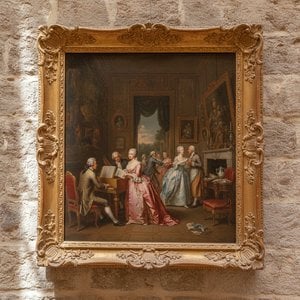
Wilhelm Ferdinand Bendz: A Brief Biography
- Born: March 20, 1804, Odense, Denmark
- Died: November 14, 1832, Vicenza, Austrian Empire (present-day Italy)
- Nationality: Danish
- Movement: Danish Golden Age
Early Life and Artistic Training
- Bendz was born in Odense on the island of Funen. At a young age, he demonstrated artistic talent and was sent to Copenhagen for formal training.
- From 1820 to 1825, he studied at the Royal Danish Academy of Fine Arts under Christoffer Wilhelm Eckersberg, a pivotal figure in Danish painting.
- In 1825, Bendz attempted to win the prestigious gold medal for history painting but was unsuccessful. Subsequently, he focused on portraits and genre scenes.
- He likely absorbed influences from contemporary German painting, particularly the Munich School, which impacted his artistic style.
Career Highlights and Artistic Development
- Following graduation, Bendz exhibited regularly at Charlottenborg, gaining recognition for his works. The Royal Painting Collection acquired several of his paintings, including "Model Class at the Art Academy," "A Young Artist Looking at a Sketch Through a Mirror," and “A Sculptor Working with a Live Model.”
- He served as an assistant in Eckersberg's studio, undertaking tasks like reconstructing historical paintings and creating copies.
- In 1830, Bendz received a travel scholarship that allowed him to journey through Southern Europe. He spent approximately a year in Munich, a vibrant artistic center at the time.
- His most significant work from this period is "Artist in the Evening at Finck's Coffee House in Munich," a group portrait showcasing his evolving style and observational skills.
Artistic Style and Influences
- Influences: Bendz was heavily influenced by Christoffer Wilhelm Eckersberg, adopting his emphasis on direct observation, precise rendering, and clarity of composition. The Munich School also played a role in shaping his artistic vision.
- Style Characteristics: His paintings are characterized by sophisticated lighting, complex compositions, and realistic portrayals of everyday life, particularly scenes involving artists and their colleagues. He excelled at depicting indoor settings with careful attention to light and shadow.
- Technical Virtuosity: Bendz demonstrated technical virtuosity in his depictions of light sources and the resulting shadows, adding depth and realism to his works.
Legacy and Historical Significance
- Despite a relatively short career cut short by his early death at age 28, Wilhelm Ferdinand Bendz is remembered as one of the most talented artists of his generation.
- His paintings offer valuable insights into the artistic circles and daily lives of Danish artists during the Golden Age.
- Bendz’s ability to blend portraiture, genre scenes, and allegorical elements showcases his ambition and artistic versatility.
- Key works like "Artist in the Evening at Finck's Coffee House in Munich" continue to be admired for their technical skill and intimate portrayal of artistic life.
Pitanja i odgovori
Mogu li da pregledam dela umetnika Wilhelm Ferdinand Bendz prema paleti boja?
Stranica Preko palete boja grupiše dela umetnika Wilhelm Ferdinand Bendz prema njihovim paletama boja.
Mogu li da istražim dela umetnika Wilhelm Ferdinand Bendz prema kolorističkom spektru?
Stranica Spektralni indeks organizuje dela umetnika Wilhelm Ferdinand Bendz prema boji.
Kako mogu pratiti rad umetnika Wilhelm Ferdinand Bendz godinu po godinu?
Stranica Hronologija dela umetnika prikazuje dela umetnika Wilhelm Ferdinand Bendz poređana hronološki, godinu po godinu.