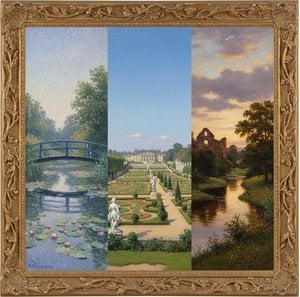
Wendy Spooner emerges as a contemporary voice in the tradition of British watercolor painting, though to categorize her solely within that lineage feels limiting. Her work isn’t simply *about* landscapes or flowers; it's an evocation of feeling – a quiet contemplation of nature’s beauty and its profound impact on the human spirit. Spooner’s paintings are born from deep observation, not just of the visual world but also of the subtle shifts in light, atmosphere, and emotional resonance that imbue a scene with life. While biographical details remain intentionally sparse, allowing her art to speak for itself, it's clear that her connection to the natural world is deeply personal and forms the core of her artistic practice. Spooner’s journey began with a fascination for the delicate interplay of color and form, evolving into a distinctive style characterized by layered washes, intricate details, and a luminous quality that draws the viewer in. Her paintings aren't reproductions of reality but rather interpretations – memories filtered through emotion and rendered with exquisite sensitivity.
The Language of Light and Flora
Spooner’s subject matter often centers around gardens, fields, and woodlands—familiar landscapes imbued with a sense of tranquility and nostalgia. She doesn’t strive for photorealistic accuracy; instead, she focuses on capturing the *essence* of a place, the feeling it evokes. Her floral studies are particularly captivating, moving beyond simple botanical representation to explore the symbolic weight of individual blooms. A single poppy might represent remembrance, while a cluster of wildflowers could signify joy and abundance. This subtle symbolism adds another layer of depth to her work, inviting viewers to engage with the paintings on an emotional level. The artist’s technique is masterful, employing traditional watercolor methods but pushing their boundaries through experimentation with layering and glazing. She builds up color gradually, allowing each wash to dry before adding subsequent layers, creating a sense of depth and luminosity that is both captivating and ethereal. Her use of light is particularly noteworthy – it isn't merely depicted; it *becomes* the subject, illuminating forms and casting long shadows that dance across the canvas.
Influences and Artistic Development
While Spooner’s style is distinctly her own, echoes of earlier British watercolorists can be discerned in her work. The delicate precision of Beatrix Potter and the atmospheric landscapes of J.M.W. Turner seem to resonate within her paintings, though she avoids direct imitation. She draws inspiration not only from historical art but also from poetry, literature, and music—sources that inform her emotional approach to painting. Her early work exhibited a more traditional representational style, gradually evolving towards the looser, more expressive forms seen in her current pieces. This development wasn’t a sudden shift but rather a natural progression, driven by a desire to capture not just what she saw but also how it *felt*.
Early experimentation with oil painting provided a foundation in color theory.
A deep appreciation for vintage botanical illustrations influenced her attention to detail.
Travels through the British countryside fostered a lifelong connection to nature.
Themes of Memory and Place
Recurring themes within Spooner’s oeuvre include memory, place, and the passage of time. Her paintings often depict scenes that feel both familiar and dreamlike—landscapes imbued with a sense of nostalgia and longing. She isn't interested in capturing a specific moment in time but rather in evoking a feeling associated with a particular place or experience. This emphasis on emotional resonance is what sets her work apart. The artist’s use of muted colors and soft edges contributes to this dreamlike quality, creating paintings that feel both intimate and expansive. Her gardens aren't idealized paradises but rather reflections of the natural world—imperfect, wild, and full of life. They are places where time seems to slow down, allowing for quiet contemplation and a deeper connection to nature.
A Contemporary Legacy
Wendy Spooner’s work represents a refreshing take on the British watercolor tradition. She isn't simply preserving a historical style but rather evolving it—infusing it with her own unique sensibility and emotional depth. Her paintings have garnered recognition from collectors and art enthusiasts alike, drawn to their quiet beauty and evocative power. While she shies away from self-promotion, allowing her work to speak for itself, Spooner’s influence is steadily growing within the contemporary art world. Her ability to capture the essence of a place—to evoke feeling through color and form—is what makes her paintings so compelling. As our lives become increasingly fast-paced and disconnected from nature, Spooner’s work serves as a gentle reminder of the beauty that surrounds us—a call to slow down, observe, and appreciate the simple wonders of the natural world.
Embark on a visual journey through the serene beauty of gardens and parks in fine art. Discover how master artists capture nature's tranquility through impressionistic blooms and classical landscapes to bring timeless elegance into your home collection.
Discover the ethereal beauty of watercolor through an art-historical lens. Master the delicate balance of light, fluidity, and pigment to capture the luminous essence of nature, inspired by the legendary techniques of the Old Masters and Impressionist greats.