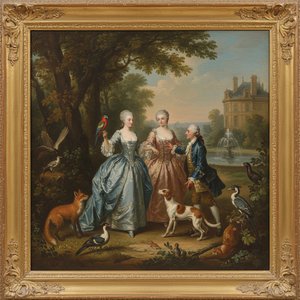
Adriaen van der Werff: A Courtier’s Painter of Intrigue and Grace
Born in Rotterdam in 1659, Adriaen van der Werff emerged from a family steeped in the artistic traditions of the Dutch Golden Age. While his father, Eglon van der Neer, was a respected drapery painter known for his meticulous detail and ability to capture the texture of fabrics, young Adriaen quickly distinguished himself with an aptitude for portraiture – a genre that would define his career and ultimately secure his place as one of the most celebrated artists of his era. His early training involved mastering the intricacies of clothing and composition under van der Neer’s tutelage, laying the groundwork for his later success in depicting figures with remarkable realism and elegance.
Van der Werff's artistic journey took him beyond Rotterdam, first to Düsseldorf where he honed his skills and established a studio. It was here that he began to develop his signature style – a refined blend of Baroque influence and a subtle sensuality that would captivate the European aristocracy. He wasn’t merely a recorder of likenesses; he possessed an uncanny ability to imbue his subjects with personality, capturing their moods and gestures with remarkable precision. This talent proved particularly valuable when he was summoned to the court of Johann Wilhelm, Elector Palatine, in 1703, where he quickly ascended to the position of official court painter – a prestigious honor that afforded him unparalleled access to the wealthy and influential circles of Europe.
- Early Works & The Medici Connection: Van der Werff’s early commissions included portraits for the prominent Medici family in Florence, Italy. These works showcased his burgeoning talent and established his reputation as a skilled portraitist capable of capturing the grandeur and sophistication of the Italian aristocracy.
- Royal Patronage: His appointment as court painter to the Elector Palatine marked a turning point in his career. He produced numerous portraits of members of the royal family, including Prince John Churchill, later the 1st Duke of Marlborough, and Gian Gastone de’ Medici, Grand Duke of Tuscany. These commissions not only provided him with financial security but also exposed his work to a wider audience.
- A Master of Detail: Van der Werff's meticulous attention to detail is evident in every brushstroke. He skillfully rendered fabrics, jewelry, and hairstyles, creating portraits that are both visually stunning and remarkably lifelike.
The Court Painter Extraordinaire
Van der Werff’s career reached its zenith during his tenure as court painter to the Elector Palatine and later the Grand Duke of Tuscany. He was renowned for his ability to capture the essence of his subjects, imbuing each portrait with a sense of dignity, power, and grace. His portraits were not simply representations of appearance; they were carefully constructed narratives that revealed the personalities and aspirations of those depicted.
His work during this period is particularly notable for its erotic undertones – a characteristic that has both fascinated and perplexed art historians. While some scholars have interpreted these depictions as evidence of Van der Werff’s libertine tendencies, others argue that they represent a sophisticated understanding of the interplay between beauty, desire, and social convention. Regardless of their precise meaning, these images demonstrate Van der Werff's willingness to explore the complexities of human relationships and challenge conventional notions of decorum.
The patronage he received from powerful figures like Marlborough and the Medici family allowed him to indulge in lavish commissions and amass a considerable fortune. He became one of the most sought-after portraitists in Europe, commanding high fees for his services and enjoying the admiration of his peers.
A Forgotten Master?
Despite his immense popularity during his lifetime, Van der Werff’s reputation suffered a decline in the 19th century. Critics accused him of lacking originality and of relying too heavily on established conventions. However, recent scholarship has begun to reassess his work, recognizing its enduring qualities and highlighting his significant contribution to the development of Dutch portraiture.
His ability to capture the nuances of human emotion, combined with his masterful technique, ensures that Van der Werff remains a vital figure in the history of art. The rediscovery of his oeuvre offers a fascinating glimpse into the world of European courts and the complex social dynamics of the 18th century – a world where art was both a reflection of power and a tool for shaping perceptions.
Legacy and Influence
Adriaen van der Werff’s influence extends far beyond his own artistic output. His brother, Pieter van der Werff, became his principal pupil and continued to develop the family's artistic legacy. The techniques and stylistic elements honed by Adriaen were passed down through generations, ensuring that the Van der Werff name remained synonymous with excellence in portraiture.
Furthermore, Van der Werff’s work served as a model for subsequent generations of artists, inspiring them to explore the possibilities of capturing human emotion and portraying subjects with both realism and elegance. His legacy continues to resonate today, reminding us of the enduring power of art to illuminate the complexities of human experience.