Теодор Жерико, 1791 – 1824

The 100 Most Famous Paintings by Теодор Жерико

The painting that made Теодор Жерико famous is Балса Медиузе (1818); it hangs in the Luvr, Pariz. Nymph and Satyr (Jupiter and Antiope) (1820) and The Oath of Brutus after the Death of Lucretia (1815) follow it in the hearts of collectors and museum visitors. Of the 183 works by Теодор Жерико in our catalogue, these 100 are the most admired, each presented with its date, its museum and what sets it apart.

Ranked by our popularity score, which combines the searches, visits and orders for each work. Updated октобар 2026. Every masterpiece on this page can be ordered as a museum-quality, hand-painted oil reproduction or a fine art print, at the size you choose.

Portrait of Теодор Жерико
Теодор Жерико · 1791 – 1824
Born · died
1791 – 1824, Руан
Movement
Romantic painting
Works in our catalogue
183
Most famous
Балса Медиузе (1818)
Most works at
Luvr

Теодор Жерико: the ten masterpieces

Балса Медиузе (1818) by Теодор Жерико
1

Балса Медиузе

1818 · Ulje na platnu · Luvr, Pariz

Monumentalno remek-delo Žana-Luja Andre Teodora Žerikoa više je od običnog prikaza pomorskog katastrofe; to je visceralna istraživanja ljudskog očaja, političkog skandala i uzvišene moći prirode. Završeno 1819. godine, ovo ogromno platno (491 x 716 cm) ovekovečuje jezivo posmrtno doba potapanja francuskog frigate Méduse 1816. godine, tragedije proizašle iz nesposobnosti i korupcije koja je šokirala čitavu Francusku.

Nymph and Satyr (Jupiter and Antiope) (1820) by Теодор Жерико
2

Nymph and Satyr (Jupiter and Antiope)

1820 · Acrylic On Canvas · Musée des Beaux-Arts et de la Céramique, Ruan

The Allure of the Divine Encounter: Géricault’s *Nymph and Satyr* Jean-Louis André Théodore Géricault's *Nymph and Satyr*, painted in 1819, isn’t merely a depiction of a mythological scene; it’s a profound exploration of desire, transgression, and the inherent tension between innocence and primal instinct. Born amidst the tumultuous backdrop of post-revolutionary France, Géricault, already recognized for his dramatic intensity, sought to capture not just a narrative but an emotional truth—a…

Lions in a Mountainous Landscape (1818) by Теодор Жерико
4

Lions in a Mountainous Landscape

1818 · Acrylic On Canvas · Metropoliten музеј у Њујорку, Њујорк

This vigorous painting of six lions in a remote, spectrally illuminated lair—possibly intended to evoke the Atlas Mountains of Morocco—is an extraordinary example of Gericault’s spontaneous handling of paint. Rather than applying finishing touches to make a polished cabinet picture, the artist left the painting in a state known as an esquisse, or sketch, a work prized by fellow artists for its strength of directly capturing a subject or effect.…

The Kiss (1822) by Теодор Жерико
5

The Kiss

1822 · Acrylic On Canvas · Музеј Тисен-Борнемиза, Madrid

Théodore Géricault's "The Kiss," painted in 1816, isn’t merely a depiction of lovers entwined; it’s a visceral embodiment of the burgeoning Romantic movement’s fascination with raw emotion, dramatic intensity, and the sublime. This arresting work, housed within the Thyssen-Bornemisza Museum in Madrid, transcends simple representation to become a profound meditation on passion, vulnerability, and the very essence of human connection. Géricault, already a figure known for his unflinching portrayals of…

Wounded Soldiers Retrating from Russia (1814) by Теодор Жерико
6

Wounded Soldiers Retrating from Russia

1814 · Acrylic On Canvas · Musée des Beaux-Arts, Ruan

A Symphony of Suffering: Géricault’s “Wounded Soldiers Retrating from Russia” Jean-Louis André Théodore Géricault's "Wounded Soldiers Retrating from Russia" is not merely a painting; it’s a visceral embodiment of the horrors and human cost of war, rendered with an unprecedented level of realism and emotional intensity for its time. Completed in 1814, this monumental canvas—measuring a commanding 250 x 206 cm—captures a pivotal moment during Napoleon's disastrous invasion of Russia,…

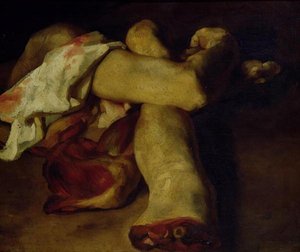
Study of Feet and Hands (1818) by Теодор Жерико
7

Study of Feet and Hands

1818 · Oil On Canvas · Musée Fabre, Montpelje

Jean-Louis André Théodore Géricault's "Study of Feet and Hands," painted in 1818, isn’t a grand statement of Romantic drama like his monumental “The Raft of the Medusa.” Instead, it offers a profoundly intimate glimpse into the artist’s meticulous process and a poignant meditation on the human form. This unassuming oil painting—measuring a modest 52 x 64 cm—is far more than just a preparatory sketch; it's a concentrated distillation of Géricault’s…

The Raft of the Medusa (detail) (1818) by Теодор Жерико
8

The Raft of the Medusa (detail)

1818 · Oil On Canvas · Luvr, Pariz

Jean-Louis André Théodore Géricault's "The Raft of the Medusa," a monumental detail from his 1818 painting, isn’t merely a depiction of shipwreck; it’s a visceral plunge into the depths of human suffering and political indictment. The scene, rendered with a dramatic intensity characteristic of Romanticism, captures the harrowing aftermath of the French frigate *Medusa*'s wreck off the coast of Mauritania in 1816. This disaster, largely attributed to the incompetence and…

The Wreck (1821) by Теодор Жерико
10

The Wreck

1821 · Oil On Canvas · Luvr, Pariz

Théodore Géricault's "The Wreck," painted in 1821, isn’t merely a seascape; it’s a visceral confrontation with the sublime—a raw depiction of humanity’s vulnerability against the overwhelming force of nature. Born amidst the turbulent currents of post-revolutionary France, Géricault, a figure both lauded and controversial within the burgeoning Romantic movement, channeled his own anxieties and the era's fascination with dramatic events into this monumental canvas. The painting immediately commands attention not…

More Теодор Жерико masterpieces, 11 to 100

The Horse Race (1816) by Теодор Жерико
#11

The Horse Race

1816 · Музеј Тисен-Борнемиза

Jean-Louis André Théodore Géricault's "The Horse Race," painted in 1816, isn’t merely a depiction of a sporting event; it’s a visceral embodiment of Romanticism’s core tenets – passion,…

Bring it home →
Swiss Guard and Wounded Veteran (1819) by Теодор Жерико
#12

Swiss Guard and Wounded Veteran

1819 · Luvr

Jean-Louis André Théodore Géricault's "Swiss Guard and Wounded Veteran," painted in 1819, is not merely a historical depiction; it’s a profound meditation on duty, sacrifice, and the lingering…

Order a reproduction →
Mazeppa (1823) by Теодор Жерико
#13

Mazeppa

1823 · Château de Chantilly

Théodore Géricault's "Mazeppa," painted in 1823, isn’t merely a depiction of a dramatic legend; it’s a visceral embodiment of Romantic turmoil—a raw exploration of suffering, resilience, and the…

Bring it home →
Two Horses (1809) by Теодор Жерико
#14

Two Horses

1809 · The Phillips Collection

Jean-Louis André Théodore Géricault's "Two Horses," painted in 1808-1809, isn’t merely a depiction of two magnificent animals; it’s a visceral exploration of movement, power, and the fleeting nature…

Bring it home →
A Turk (Mustapha) (1820) by Теодор Жерико
#15

A Turk (Mustapha)

1820 · Luvr

Jean-Louis André Théodore Géricault's "A Turk (Mustapha)," painted in 1820, is not merely a portrait; it’s a carefully constructed tableau of exoticism, melancholy, and the burgeoning Romantic sensibility…

Order a reproduction →
A Carabinier with his Horse (1814) by Теодор Жерико
#16

A Carabinier with his Horse

1814 · Musée des Beaux-Arts

In the quiet intensity of Jean-Louis André Théodore Géricault’s 1814 masterpiece, "A Carabinier with His Horse," we encounter more than a mere military portrait; we witness a profound…

Order a reproduction →
Riderless Horse Races (detail) (1817) by Теодор Жерико
#17

Riderless Horse Races (detail)

1817 · Luvr

A Moment Frozen in Time: Géricault’s “Riderless Horse Races” Jean-Louis André Théodore Géricault's "Riderless Horse Races (detail)" is not merely a depiction of a sporting event; it’s a…

Bring it home →
Boxers (1818) by Теодор Жерико
#18

Boxers

1818 · Château de Chantilly

A Tempestuous Vision: Géricault’s “Boxers” Jean-Louis André Théodore Géricault's "Boxers," completed in 1818, isn’t merely a depiction of a boxing match; it’s a visceral embodiment of Romanticism’s fascination…

Order a reproduction →
The Epsom Derby (1821) by Теодор Жерико
#20

The Epsom Derby

1821 · Luvr

Jean-Louis André Théodore Géricault's "The Epsom Derby," painted in 1821, isn’t merely a depiction of horse racing; it’s a visceral embodiment of Romanticism’s fascination with drama, movement, and…

Bring it home →
Three Lovers (1817) by Теодор Жерико
#22

Three Lovers

1817 · J. Paul Getty Museum

Théodore Géricault captured a private, feverish moment in Three Lovers. This small oil sketch, created about 1817–1820, offers a rare glimpse into the artist's more intimate preoccupations. It…

Order a reproduction →
Lion devouring a horse by Теодор Жерико
#26

Lion devouring a horse

Château de Chantilly

Théodore Géricault's "Lion Devouring a Horse," painted in 1819, isn’t merely a depiction of predatory action; it’s a visceral exploration of power, mortality, and the primal instincts that…

Bring it home →
Untitled (ARJCHM) by Теодор Жерико
#28

Untitled (ARJCHM)

Luvr

In the annals of art history, few works command the room with such visceral intensity as Théodore Géricault’s The Raft of the Medusa. This monumental oil on canvas…

Bring it home →
Portrait of a Young Man (1818) by Теодор Жерико
#32

Portrait of a Young Man

1818 · Minneapolis Institute of Art

A young man emerges from a deep, indistinct darkness, his presence felt through the sudden, sharp clarity of light hitting his features. He sits in a quiet, intimate…

Order a reproduction →
A study for a nude. (1801) by Теодор Жерико
#33

A study for a nude.

1801 · Narodni muzej u Varšavi

A study for a nude. emerges from the shadows as a powerful presence by Théodore Géricault. Created about 1801, this oil on canvas captures a singular moment of…

Bring it home →
Study of a Model (1818) by Теодор Жерико
#34

Study of a Model

1818 · J. Paul Getty Museum

This oil on canvas portrait study presents a close-up, three-quarter view of a Black man's head and shoulders. The subject is positioned slightly off-center, looking toward the viewer…

Commission a hand-painted copy →
The Martyrdom of Saint Peter (1814) by Теодор Жерико
#35

The Martyrdom of Saint Peter

1814 · Kunstmuseum Basel

The Martyrdom of Saint Peter is an oil on canvas by Théodore Géricault. Created about 1814, the work captures a moment of profound tension. The physical presence of…

Bring it home →
The Wreck (1824) by Теодор Жерико
#36

The Wreck

1824 · Luvr

In the annals of French Romanticism, few works command the visceral attention of Théodore Géricault’s The Wreck as profoundly as this haunting seascape. Painted in 1824, a year…

Commission a hand-painted copy →
Mater dolorosa, Copy after Ribera (1811) by Теодор Жерико
#38

Mater dolorosa, Copy after Ribera

1811 · Kunstmuseum Basel

Mater dolorosa, Copy after Ribera is a religious oil painting by the French artist Théodore Géricault. Created about 1811–1815, the work reflects the artist's engagement with the traditions…

Bring it home →
Lion in Repose by Теодор Жерико
#39

Lion in Repose

Walters Art Museum

Jean-Louis André Théodore Géricault’s “Lion in Repose,” painted circa 1820-1823, isn’t merely a depiction of an animal; it’s a profound meditation on power, vulnerability, and the very nature…

Order a reproduction →
Portrait of a Negro (1800) by Теодор Жерико
#71

Portrait of a Negro

1800 · Palácio Nacional da Ajuda

Dating from 1800, Jean-Louis André Théodore Géricault’s “Portrait of a Negro” is more than just a depiction of an individual; it’s a poignant statement born from the turbulent…

Bring it home →
Portrait d'homme (1825) by Теодор Жерико
#73

Portrait d'homme

1825 · Musée Fabre

Portrait d'homme is an oil on canvas work attributed to the French Romantic painter Théodore Géricault. While historically categorized under various titles, including a mistaken identification as a…

Commission a hand-painted copy →
Horses of the Auvergne (1822) by Теодор Жерико
#76

Horses of the Auvergne

1822 · University of Michigan Museum of Art

In the quiet, monochromatic depths of Théodore Géricault’s 1822 lithograph, Horses of the Auvergne, we are transported to a rugged, mist-shrouded corner of France. This evocative work serves…

Commission a hand-painted copy →
A Prancing Grey Horse (1812) by Теодор Жерико
#77

A Prancing Grey Horse

1812 · Burrell Collection

A single light grey horse occupies the center of this oil painting, captured in a rearing pose. The animal's body is angled vertically, its muscular flanks and neck…

Bring it home →
Sheet of Figure Studies (1818) by Теодор Жерико
#78

Sheet of Figure Studies

1818 · Courtauld Gallery

To gaze upon Jean-Louis André Théodore Géricault’s "Sheet of Figure Studies" is not merely to look at painted forms; it is to witness the very act of human…

Bring it home →
The Plaster Kiln (1823) by Теодор Жерико
#82

The Plaster Kiln

1823 · Luvr

In the quiet, brooding landscapes of nineteenth-century France, few works capture the raw, unvarnished essence of pastoral life as poignantly as Théodore Géricault’s “The Plaster Kiln.” Completed in…

Order a reproduction →

Теодор Жерико's paintings by period

The subjects Теодор Жерико painted most

The four subjects that return most often among these masterpieces, with the finest example of each.

Where to see Теодор Жерико's paintings

The 8 museums that hold the most of the paintings on this page.

Museum City Works by Теодор Жерико Paintings from this list
Luvr, ParizLuvr Pariz 20 Балса Медиузе, The Raft of the Medusa (detail), Leda and the Swan
Château de Chantilly, ŠantijiChâteau de Chantilly Šantiji 6 Mazeppa, Boxers, Lion devouring a horse
J. Paul Getty Museum, Los AnđelesJ. Paul Getty Museum Los Anđeles 3 Three Lovers, Study of a Model, The Race of the Riderless Horses
Narodni muzej u Varšavi, VaršavaNarodni muzej u Varšavi Varšava 3 Equestrian portrait of Wincenty Krasiński., A study for a nude., Study of a nude man
Burrell Collection, GlasgowBurrell Collection Glasgow 8 The Trumpeter of the Lancers of the Guard, A Prancing Grey Horse
Musée Fabre, MontpeljeMusée Fabre Montpelje 4 Study of Feet and Hands, Portrait d'homme
Petit Palais, ParizPetit Palais Pariz 3 The Scotsman, Italian Landscape with Tomb
Музеј Тисен-Борнемиза, MadridМузеј Тисен-Борнемиза Madrid 2 The Kiss, The Horse Race

Теодор Жерико, decade by decade: the defining painting of each

  1. 1800s
    Two Horses (1809) by Теодор Жерико
    Rank 14 / 100

    Two Horses

    Age 9 – 18 · The Phillips Collection

    Jean-Louis André Théodore Géricault's "Two Horses," painted in 1808-1809, isn’t merely a depiction of two magnificent animals; it’s a visceral exploration of movement, power, and the fleeting nature…

  2. 1810s
    Балса Медиузе (1818) by Теодор Жерико
    No. 1 of 100

    Балса Медиузе

    Age 19 – 28 · Luvr

    Monumentalno remek-delo Žana-Luja Andre Teodora Žerikoa više je od običnog prikaza pomorskog katastrofe; to je visceralna istraživanja ljudskog očaja, političkog skandala i uzvišene moći prirode. Završeno 1819. godine,…

  3. 1820s
    Nymph and Satyr (Jupiter and Antiope) (1820) by Теодор Жерико
    #2 of 100

    Nymph and Satyr (Jupiter and Antiope)

    Age 29 – 33 · Musée des Beaux-Arts et de la Céramique

    The Allure of the Divine Encounter: Géricault’s *Nymph and Satyr* Jean-Louis André Théodore Géricault's *Nymph and Satyr*, painted in 1819, isn’t merely a depiction of a mythological scene;…

Теодор Жерико's masterpieces: questions and answers

Which painting is Теодор Жерико best known for?Show the answer

Балса Медиузе (1818), Luvr, Pariz. Next come Nymph and Satyr (Jupiter and Antiope) (1820) and The Oath of Brutus after the Death of Lucretia (1815).

How old was Теодор Жерико when painting Балса Медиузе?Show the answer

27 years old: Балса Медиузе dates from 1818 and Теодор Жерико was born in 1791.

What are Теодор Жерико's ten greatest paintings?Show the answer

Балса Медиузе, Nymph and Satyr (Jupiter and Antiope), The Oath of Brutus after the Death of Lucretia, Lions in a Mountainous Landscape, The Kiss, Wounded Soldiers Retrating from Russia, Study of Feet and Hands, The Raft of the Medusa (detail), Leda and the Swan and The Wreck. The ranking above gives the year and the museum of each.

How many works did Теодор Жерико paint?Show the answer

Our catalogue lists 183 works by Теодор Жерико, dated from 1800 to 1824.

In which museums can I see Теодор Жерико's masterpieces?Show the answer

Most of them are in Luvr (Pariz), Château de Chantilly (Šantiji) and J. Paul Getty Museum (Los Anđeles). The table above lists the museums one by one.

When did Теодор Жерико paint the masterpieces?Show the answer

In 1810s: 67 of the 100 works on this page date from then, among them Балса Медиузе.

What are the first and last famous paintings of Теодор Жерико?Show the answer

The earliest on this page is Portrait of a Negro (1800), the latest The Wreck (1824).

What were Теодор Жерико's favourite subjects?Show the answer

Man (12), Portrait (9) and Horse (8), among the 100 works on this page.

Which technique did Теодор Жерико favour?Show the answer

Oil On Canvas: 25 of the 100 works on this page.

What art movement is Теодор Жерико part of?Show the answer

Romantic painting, as the paintings on this page show.

Which masterpieces by Теодор Жерико hang at the Luvr?Show the answer

Балса Медиузе, The Raft of the Medusa (detail) and Leda and the Swan are among the 14 works on this page held by the Luvr, Pariz.

Can I own a reproduction of a Теодор Жерико masterpiece?Show the answer

Yes. Every painting on this page can be ordered as a museum-quality, hand-painted oil reproduction or a fine art print, in the size you choose, from the painting's own page.

The life of Теодор Жерико

Живот у пламену романтизма

Жан-Луј Андре Теодор Жерико, име које одјекује духом француског романтизма, рођен је у свету на прагу драматичних промена. У Руану, Француској, 1791. године, његов рани живот се одвијао под ехо револуције и растућом таласом наполеоновских амбиција. Иако је наследио пристојан живот кроз породичне правне и пословне подухвате – укључујући предузеће за дуван – Жерикова судбина није била у закону или трговини, већ у области уметничког израза. Његова прва обука под Карлом Вернеом, мајстором енглеске спортске уметности, пробудила је у њему оштар поглед за анатомију и кретање, посебно видљив у његовим приказима коња. Међутим, касније студије са Пјером-Нарсисом Герином пружиле су му основу класичне композиције, иако је Жерикова немирна душа ускоро довела до тога да самостално тражи знање у светим сала Лувра.

Лувр као академија: дијалог са мајсторима

Од 1810. до 1815. године, Лувр је постао Жерикова права академија. Уроњен у радове старих мајстора – Рубенса, Тицијана, Веласкеза и Рембрандта – не само да је копирао њихове технике већ се ангажовао у дубоком дијалогу са њиховим уметничким филозофијама. Ово раздобље је било кључно за обликовање његовог карактеристичног стила, обележеног драматичним киароскуром, динамичном композицијом и интензивном емоционалношћу која га је издвојила од савременика. Он није само реплицирао; апсорбовао је суштину ових мајстора, интернализујући њихове приступе светлу, сенци и људском облику. Ова самоусмерена едукација неговала је јединствени уметнички глас, који је ускоро изазвао преовладајуће неокласичне конвенције. Његови рани радови, попут *Нападачког касира* (1812), већ су наговестили ову нову осетљивост, показујући смелост извршења и фасцинацију кретањем подсећајућу на енергична платна Рубенса. Наставио је да истражује коњске теме, усавршавајући своје вештине у приказивању моћи и грације коњева – тема која ће остати понављајући мотив током његове каријере.

Сплит Медузе: Монумент људској патњи

Жериково име је неодвојиво повезано са *Сплитом Медузе* (1818-1819), монументалним платном које надмашује чисто историјски приказ и постаје оштар оптужби за људску слабост и друштвену неправду. Инспирисан ужасном истинитом причом о бродолому француске фрегате *Медуза* 1816. године, где је немарност и некомпетентност довела до неизмерне патње путника, слика је визуелни портрет очаја, наде и безнађа. Жерико се посветио темељном истраживању, интервјуисао преживеле, проучавао лешеве у болницама, чак и конструисао модел рафта у стварној величини како би осигурао тачност. Резултат није само приказ трагедије; то је импресивно искуство које суочава гледаоце са сировом реалношћу људске патње. Композиција, изграђена око две пирамидалне структуре – једне која представља очај и смрт, а друга наду и потенцијално спасавање – ствара динамичку тензију која привлачи поглед преко платна. *Сплит Медузе* је био контроверзан након изложбе у Салону 1819. године, изазвавши политичке дебате и учврстивши Жерикову репутацију као смелог и неконвенционалног уметника. Утицај слике се протезао ван света уметности, постајући симбол владине некомпетентности и људске отпорности суочене са неизмерним тешкоћама.

Иза трагедије: војне теме и уметничко наслеђе

Иако *Сплит Медузе* остаје његово најславније достигнуће, Жериков уметнички излаз се протезао ван овог јединственог ремек-дела. Поново се враћао војним темама, видљиво у делима као што су *Рањени курасир* (1814) и *Дерби од Епсама* (1821), демонстрирајући фасцинацију драмом и експресивном силом. Ове слике откривају његово континуирано истраживање људских емоција под притиском, често фокусирајући се на физички и психолошки данак сукоба. Ушао је и у портретисање и литографију, додатно проширујући свој уметнички репертоар. Нажалост, Жериков живот је прекинут болешћу у доби од 32 године 1824. године, након година патње од повреда насталих јахањем и хроничне туберкулозне инфекције. Његова рана смрт лишила је свет уметности продигијалног талента, али његов утицај на касније генерације уметника – посебно Ежена Делакроа – био је дубок. Запамћен је као пионир романтизма, уметник који се усудио да се суочи са тешким истинама и угради своја дела моћном емоционалном резонанцом која наставља да очарава публику данас. Његова бронзана фигура лежи, четка у руци, на његовом гробу на гробљу Пер Лашез у Паризу, изнад рељефа који приказује ужасну сцену са *Сплита Медузе*, прикладан поклон уметнику који је посветио свој живот заробљавању сложености и противречности људског стања.

Кључне карактеристике и утицаји

  • Романтизам: Жерико се сматра једним од првих француских романтичних сликара, удаљавајући се од неокласичних идеала према интензивној емоцији и драматичном изразу.
  • Драматична композиција: Његове слике су познате по својим динамичним композицијама, често користећи дијагоналне линије и контраст светла и сенке за стварање осећаја кретања и напетости.
  • Реализам и истраживање: Жерико је био посвећен реализму, спроводећи опсежно истраживање – укључујући проучавање лешева и интервјуисање преживелих – како би осигурао тачност и емоционални утицај свог рада.
  • Утицај старих мајстора: Инспирисао се барокним мајсторима попут Рубенса, Тицијана и Веласкеза, усвајајући њихове технике за драматично осветљење и експресиван четкани рад.
  • Фокус на људској патњи: Његова уметност често приказује

All 183 works by Теодор Жерико →