Edvard Hoper, 1882 – 1967

The 100 Most Famous Paintings by Edvard Hoper

The painting that made Edvard Hoper famous is Nighthawks, Ноћњаци (1942); it hangs in the Art Institute of Chicago, Čikago. Automat (small) and Kuća pored železnice (1925) follow it in the hearts of collectors and museum visitors. Of the 366 works by Edvard Hoper in our catalogue, these 100 are the most admired, each presented with its date, its museum and what sets it apart.

Ranked by our popularity score, which combines the searches, visits and orders for each work. Updated октобар 2026.

Portrait of Edvard Hoper
Edvard Hoper · 1882 – 1967
Born · died
1882 – 1967, Njaki
Movement
Savremeni realizam
Works in our catalogue
366
Most famous
Nighthawks, Ноћњаци (1942)
Most works at
MoMA - Muzej moderne umetnosti

Edvard Hoper: the ten masterpieces

Nighthawks, Ноћњаци (1942) by Edvard Hoper
1

Nighthawks, Ноћњаци

1942 · Ulje na platnu · Art Institute of Chicago, Čikago

Edward Hopper's Nighthawks (1942) stands as an enduring emblem of twentieth-century American art and a poignant meditation on the pervasive sense of isolation that characterizes modern urban life. Painted during World War II, amidst anxieties about national identity and societal change, the canvas transcends its immediate historical context to resonate with viewers across generations.

Automat (small) by Edvard Hoper
2

Automat (small)

Acrylic On Canvas · Des Moines Art Center, Des Moines

Edward Hopper’s “Automat” (small), a deceptively simple depiction of a woman seated alone at a cafe table, is a masterclass in conveying the profound sense of solitude that characterized much of 20th-century American life. Painted during a period of rapid urbanization and social change, this work resonates with a quiet melancholy that speaks to the alienation inherent in modern existence. Hopper’s ability to capture fleeting moments of human experience –…

Kuća pored železnice (1925) by Edvard Hoper
3

Kuća pored železnice

1925 · Ulje na platnu · MoMA - Muzej moderne umetnosti, New York City

Introduction to Edward Hopper and His Work Edward Hopper, a renowned American artist, is celebrated for his captivating oil paintings that often depicted modern life in the early 20th century. One of his most notable works is "House by the Railroad," which is currently housed at the Museum of Modern Art (New York, United States). This painting, created in 1925, showcases Hopper's unique style and ability to evoke a sense…

Њујоршки филм (1939) by Edvard Hoper
4

Њујоршки филм

1939 · Akril na platnu · MoMA - Muzej moderne umetnosti, New York City

SlikaEdward Hopperova slika je melanholično ulje na platnu stvoreno 1939. godine. Trenutno je izložena u prestižnom Muzeju moderne umetnosti (MoMA) u Njujorku, Sjedinjene Države. Ovo remek-delo savršeno ilustruje Hopperovu jedinstvenu sposobnost da uhvati suštinu urbanog života, često se fokusirajući na teme izolacije i kontemplacije. Kompozicija i simbolikaSlika prikazuje ženu koja stoji sama ispred crvene zavese unutar pozorišta. Uronjena je u sopstveni svet, bilo da gleda nešto u ruci ili možda…

untitled (5560) by Edvard Hoper
5

untitled (5560)

Oil On Canvas · MoMA - Muzej moderne umetnosti, New York City

Edward Hopper's untitled (5560) is far more than a mere depiction of a roadside service station; it is a distilled essence of the American experience, a moment frozen in time that speaks volumes about human connection and the profound weight of isolation. Painted during the transformative years between 1942 and 1945, this monochrome masterpiece captures a scene familiar to the mid-century traveler—the late-night glow of artificial light illuminating a sparsely…

Early sunday morning Whitney Museum of American (1930) by Edvard Hoper
6

Early sunday morning Whitney Museum of American

1930 · Oil On Canvas · Whitney Museum of American Art, Njujork

Early Sunday Morning: A Portrait of Quietude Edward Hopper’s “Early Sunday Morning,” painted in 1930, isn't merely a depiction of a New York City street; it’s an arresting distillation of the anxieties and aspirations inherent in the American psyche during the Depression era. Executed in oil paint on canvas, this iconic piece exemplifies Hopper’s signature style – American Scene Painting—characterized by stark realism combined with a palpable sense of solitude…

Аутомат (1927) by Edvard Hoper
7

Аутомат

1927 · Ulje na platnu

"Automat": Pogled u Američku Usamljenost i Svetlost Edward Hopperova "Automat" (1927) nije samo slika; ona je poetski zapis o usamljenosti, svetlosti i tišini koji prožima život 20. veka u Americi. Ova remek-dela američkog realizma poziva nas da zakoračimo u sumorno osvetljen prostor, gde se žena sedi sama za okruglim stolom u automatu – popularnom tipu restorana samoposluživanja koji je obeležio rane godine 20. veka. Svetlost koja nežno miluje njeno lice…

Nedelja (1926) by Edvard Hoper
8

Nedelja

1926 · Ulje na platnu · The Phillips Collection, Vašington, D.C.

Nedelja: Utisci o Gradskoj Usamljenosti Edward Hopperova "Nedelja" nije samo slika; ona je trenutak zaleđen u vremenu, tihi dijalog između čoveka i grada. Nastala 1926. godine, ova kompozicija pripada pokretu Nove Realnosti, ali daleko prevazilazi pukotanje fotografske preciznosti. Ona nas poziva da se uronimo u atmosferu introspekcije i usamljenosti koja prožima urbanu scenu nedeljnog jutra. Pred nama se prostire scena: samotnija figura sedi na drvenoj klupi, ispred zatvorenih izloga, a…

Гас (1940) by Edvard Hoper
9

Гас

1940 · Ulje na platnu

Vremenski neprevaziđen prikaz američke samoće Edward Hopperovo delo „Gas“ (1940) predstavlja majstorsko istraživanje samoće i nostalgije, beležeći staromodnu benzinsku pumpu okupljenu mekom, prirodnom svetlošću. Ova upečatljiva slika poziva posmatrače u trenutak zamrznut u vremenu, gde je tišina ruralne Amerike gotovo opipljiva. Scena zrači osećajem introspekcije, čineći je neodoljivim dodatkom svakoj umetničkoj kolekciji ili unutrašnjem prostoru. Kompozicija i stil: Studija ravnoteže i kontrasta Hopperova kompozicija je pedantno uravnotežena, sa benzinskim pumpama…

Чоп Суи (1929) by Edvard Hoper
10

Чоп Суи

1929 · Ulje na platnu

„Chop Suey”, koje je Edvardo Hoper stvorio 1929. godine, je očaravajuće ulje na platnu koje poziva posmatrače u intimni, ali izolovani svet restorana iz 1920-ih. Ovo remek-delo predstavlja vrhunac Hoperovog prepoznatljivog stila, spajajući američki realizam sa suptilnim ekspresionističkim uticajima kako bi izazvao osećaj nostalgije i tihe introspekcije.

More Edvard Hoper masterpieces, 11 to 100

Kancelarija tokom noći (1940) by Edvard Hoper
#11

Kancelarija tokom noći

1940

"Kancelarija tokom noći": Pogled u Američki život iz sredine 20. veka Eduard Hoperova "Kancelarija tokom noći" (1940) nije samo slika; to je trenutak zaleđen u vremenu, pažljivo oslikana…

Лето (1943) by Edvard Hoper
#12

Лето

1943

Summertime – A Moment Suspended: Exploring Hopper’s “Summertime” Edward Hopper's "Summertime," painted in 1943 during the tumultuous backdrop of World War II, transcends a simple depiction of a…

Сунце у кантини (1958) by Edvard Hoper
#13

Сунце у кантини

1958 · Yale University Art Gallery

Hooperovo delo Sunlight in a Cafeteria (1958) predstavlja majstorski prikaz urbane samoće, izveden sa preciznošću i emocionalnom dubinom koja definišu njegov kultni stil. Ovo ulje na platnu, dimenzija…

Људи у сунцу (1960) by Edvard Hoper
#14

Људи у сунцу

1960

Srene momenat uhvaćen u vremenu Delo Edvarda Hopera, „Ljudi u suncu“, poziva posmatrače u mirnu scenu u kojoj pet osoba uživa u trenutku tihe odmore u pod nebeskim…

Јутар на Кејп Коду (1950) by Edvard Hoper
#15

Јутар на Кејп Коду

1950

Cape Cod Morning: Trenutak Tišine i Razmatranja u Delu Edwarda Hoppera Edward Hopperovo "Cape Cod Morning" nije samo slika; to je poetski trenutak, uhvaćen na platnu, koji nas…

Sobe za turista (1945) by Edvard Hoper
#16

Sobe za turista

1945 · Yale University Art Gallery

Remek-delo američkog realizma „Sobe za turiste” (1945) je očaravajuće umetničko delo Edvarda Hopera, čoveka poznatog po svojim upečatljivim prikazima modernog američkog života. Ova slika predstavlja vrhunac Hoperevog prepoznatljivog…

nighthawks (1942) by Edvard Hoper
#17

nighthawks

1942 · Art Institute of Chicago

A Window Into Loneliness: Exploring Edward Hopper’s Nighthawks Edward Hopper's "Nighthawks," completed in 1942 during the tumultuous backdrop of World War II, transcends mere representation; it embodies a…

Vagon sa kupeom C by Edvard Hoper
#18

Vagon sa kupeom C

„Vagon sa kupeom C” predstavlja suštinski primer Hopperove fascinacije samotnim figuralima u tranzitu. Slika prikazuje damu koja sedi sama u železničkom kupeu, licem okrenutu ka knjizi, dok joj…

Два Комедианта (1965) by Edvard Hoper
#19

Два Комедианта

1965

Edward Hopper’s 1965 painting, “Two Comedians,” nije samo prikaz dva čoveka na pozornici; to je pažljivo konstruisana meditacija o usamljenosti, proletnosti izvođenja i tišoj drami koja se krije…

New York Movie, MoMA, NY (1939) by Edvard Hoper
#21

New York Movie, MoMA, NY

1939

Filmska nepomičnost: Edward Hopperovo *New York Movie* (1939) New York Movie*, koja se nalazi u prestižnoj kolekciji Muzeja moderne umetnosti (MoMA), predstavlja suštinski primer Hopperove majstorske sposobnosti da…

Summer Evening (1947) by Edvard Hoper
#22

Summer Evening

1947

A Portrait of Quietude: Exploring Edward Hopper’s “Summer Evening” Edward Hopper's "Summer Evening" isn’t merely a depiction of a scene; it’s an exquisitely crafted meditation on human experience—a…

Hotel room (1931) by Edvard Hoper
#23

Hotel room

1931

The Poignant Stillness of a Private Moment In Edward Hopper’s 1931 masterpiece, Hotel Room, the viewer is invited into a sanctuary of profound introspection. The scene is deceptively…

Excursion into Philosophy by Edvard Hoper
#24

Excursion into Philosophy

A Quiet Drama: Unveiling Edward Hopper’s “Excursion into Philosophy” Edward Hopper's "Excursion into Philosophy" is a profoundly evocative work that encapsulates the core tenets of American Realism, offering…

The Cat Boat (1922) by Edvard Hoper
#25

The Cat Boat

1922 · Smithsonian American Art Museum

Edward Hopper's “The Cat Boat,” created in 1922, stands as a quintessential emblem of American Modernism—a deceptively simple scene imbued with profound psychological depth. More than just depicting…

Rooms By The Sea (1951) by Edvard Hoper
#26

Rooms By The Sea

1951

Rooms By The Sea: A Portrait of Quiet Contemplation Edward Hopper’s “Rooms by the Sea” transcends mere depiction; it's a distillation of mood, an embodiment of American Modernism’s…

Reclining Nude (1927) by Edvard Hoper
#27

Reclining Nude

1927

Introduction Reclining Nude, a watercolour painting by Edward Hopper, is a quintessential example of the artist's unique style and contribution to the New Realism movement. Created in 1927,…

Rooms by the Sea (1951) by Edvard Hoper
#28

Rooms by the Sea

1951

The Painting: A Representation of Serenity "CITE>Edward Hopper's 'Rooms by the Sea' (1951) is a masterpiece that embodies the essence of stillness and contemplation. The painting, available for…

House At Dusk (1935) by Edvard Hoper
#29

House At Dusk

1935

The Painting: An Overview "CITE>Edward Hopper:CITE>'s House At Dusk, created in 1935, is a quintessential example of the artist's ability to capture the essence of American life through…

Apoteka (1927) by Edvard Hoper
#30

Apoteka

1927 · Muzej finih umetnosti u Bostonu

Tihašnji trenutak u gradu: Istraživanje „Apoteke“ (Drug Store) Edvarda Hoppera iz 1927. godine „Apoteka“, naslikana je 1927. godine od strane američkog majstora Edvarda Hoppera, melanholičan prikaz urbanog života…

Sun on Prospect Street (Gloucester, Massachusetts) (1934) by Edvard Hoper
#31

Sun on Prospect Street (Gloucester, Massachusetts)

1934

Edward Hopper's "Sun on Prospect Street" isn't merely a depiction of a Gloucester street scene; it’s a distilled essence of early 20th-century American experience. Painted in 1934, during…

Woman in the Sun (1961) by Edvard Hoper
#32

Woman in the Sun

1961

A Moment Frozen in Light: Edward Hopper’s “Woman in the Sun” Edward Hopper's "Woman in the Sun," painted in 1961, isn’t merely a depiction of a nude figure;…

Second Story Sunlight (1960) by Edvard Hoper
#33

Second Story Sunlight

1960

A Moment Suspended: Unveiling Edward Hopper’s “Second Story Sunlight” Edward Hopper's 1960 oil on canvas, *Second Story Sunlight*, is a quintessential example of American Realism at its most…

Night Windows (1928) by Edvard Hoper
#34

Night Windows

1928 · MoMA - Muzej moderne umetnosti

A Window Into Solitude: Exploring Edward Hopper’s Night Windows Edward Hopper, a name synonymous with the quiet contemplation of modern existence, wasn't merely capturing landscapes; he was distilling…

New York Office (1962) by Edvard Hoper
#35

New York Office

1962

Edward Hopper’s “New York Office,” painted in 1962, transcends mere depiction; it embodies the very essence of modern solitude—a feeling profoundly familiar to viewers grappling with the complexities…

Office in a Small City (1953) by Edvard Hoper
#36

Office in a Small City

1953

In the vast gallery of American Realism, few works possess the haunting, cinematic stillness found in Edward Hopper’s 1953 masterpiece, Office in a Small City. To gaze upon…

City Roofs (1932) by Edvard Hoper
#37

City Roofs

1932

A Quiet Moment of Urban Existence Edward Hopper’s “City Roofs” (1932) is more than just a depiction of a cityscape; it's a poignant meditation on modern life, isolation,…

Self-Portrait (1930) by Edvard Hoper
#38

Self-Portrait

1930

This oil on canvas painting depicts a man wearing a brown hat and a blue shirt. He is shown with a serious expression, looking directly at the viewer.…

Monhegan Houses, Maine by Edvard Hoper
#39

Monhegan Houses, Maine

Uvod u američki realizam Edvard Hoper, istaknuti američki realista, poznat je po svojim očaravajućim uljanim slikama koje prikazuju urbane i ruralne pejzaže. Njegov jedinstveni stil bio je ključan…

Four Lane Road by Edvard Hoper
#40

Four Lane Road

Edward Hopper's "Four Lane Road," painted in 1956, isn’t merely a depiction of a roadside scene; it’s a distilled essence of the American experience – a poignant meditation…

Woman at Cafe Table (1907) by Edvard Hoper
#41

Woman at Cafe Table

1907 · Whitney Museum of American Art

Woman at Cafe Table: A Portrait of Urban Isolation Edward Hopper’s “Woman at Cafe Table,” painted in 1906-1907, stands as a quintessential emblem of New Realism and embodies…

First Row Orchestra (1951) by Edvard Hoper
#42

First Row Orchestra

1951 · Hirshhorn Museum and Sculpture Garden

A Portrait of Quiet Observation: Exploring Edward Hopper’s “First Row Orchestra” Edward Hopper's "First Row Orchestra," painted in 1951, transcends mere depiction; it embodies the very essence of…

House by the Railroad by Edvard Hoper
#43

House by the Railroad

In his 1925 masterpiece, House by the Railroad, Edward Hopper presents a scene that captures a profound sense of isolation through a meticulously controlled interplay of light and…

untitled (3714) by Edvard Hoper
#44

untitled (3714)

Edward Hopper's "Untitled (3714)," painted in 1942, isn’t merely a depiction of a diner interior; it’s a distilled essence of modern American loneliness. This deceptively simple scene—an elderly…

el palacio (1946) by Edvard Hoper
#45

el palacio

1946

Edward Hopper’s 1946 painting, “El Palacio,” isn’t merely a depiction of a city street; it’s a carefully constructed tableau of urban solitude and the quiet anxieties of modern…

the city (1927) by Edvard Hoper
#46

the city

1927

The City, painted by Edward Hopper in 1927, is a striking black and white depiction of early 20th-century American urban life. This artwork isn't merely a representation of…

rooms by the sea by Edvard Hoper
#47

rooms by the sea

Edward Hopper’s Rooms by the Sea is a painting from 1951 that depicts an interior space with a doorway opening toward the ocean. The scene features a room…

The Camel's Hump (1931) by Edvard Hoper
#49

The Camel's Hump

1931

Edward Hopper's "The Camel’s Hump," painted in 1931, isn’t merely a depiction of a mountain range; it’s a distilled essence of American loneliness and the quiet drama unfolding…

the el station by Edvard Hoper
#50

the el station

In the quiet, heavy atmosphere of Edward Hopper’s “The El Station,” we are invited into a moment suspended in time, where the bustling energy of the American metropolis…

Dawn in Pennsylvania (1942) by Edvard Hoper
#51

Dawn in Pennsylvania

1942

A Solitary Glimpse: Dawn in Pennsylvania by Edward Hopper Edward Hopper’s *Dawn in Pennsylvania*, painted in 1942, isn't merely a depiction of a railroad station; it’s a distilled…

Corn Hill (1930) by Edvard Hoper
#52

Corn Hill

1930

Edward Hopper's "Corn Hill," painted in 1930, isn’t merely a depiction of a rural landscape; it’s a poignant meditation on isolation and the quiet dignity of human existence…

tramp steamer (1908) by Edvard Hoper
#53

tramp steamer

1908

A Storm-Tossed Soul: Edward Hopper’s “Tramp Steamer” Edward Hopper's "Tramp Steamer," painted in 1908, isn’t merely a depiction of a ship at sea; it’s a profound meditation on…

Self Portrait, , Whitney Museum of American (1930) by Edvard Hoper
#54

Self Portrait, , Whitney Museum of American

1930

Edward Hopper's "Self Portrait," painted in 1930, isn’t merely a depiction of an artist; it’s a distilled essence of the anxieties and quietude that defined much of early…

Rocks at the Fort Gloucester (1924) by Edvard Hoper
#55

Rocks at the Fort Gloucester

1924

Edward Hopper's 1924 painting, “Rocks at the Fort Gloucester,” is more than just a landscape; it’s a quiet meditation on human presence within the vastness of nature and…

Morning sun, Columbus Museum of Art, Columbus, (1952) by Edvard Hoper
#56

Morning sun, Columbus Museum of Art, Columbus,

1952

A Window into Quietude: Exploring Edward Hopper’s “Morning Sun” Edward Hopper's "Morning Sun," painted in 1952, isn’t merely a depiction of a room; it’s an encapsulation of the…

Study of a Seated Woman (1899) by Edvard Hoper
#57

Study of a Seated Woman

1899

Edward Hopper's "Study of a Seated Woman," rendered in 1899, isn’t merely a depiction of a figure; it’s a distilled essence of late 19th-century American introspection. This intimate…

Portrait Of Orleans by Edvard Hoper
#58

Portrait Of Orleans

WahooArt offers exquisite hand-painted reproductions of Edward Hopper's "Portrait of Orleans," allowing you to bring this iconic work of American art into your home or office. Each reproduction…

sun empty room by Edvard Hoper
#59

sun empty room

Edward Hopper's "Sun in an Empty Room," painted in 1963, isn’t merely a depiction of a vacant room; it’s a distilled essence of modern American isolation and the…

The Long Leg (1930) by Edvard Hoper
#60

The Long Leg

1930

A Quiet Drama on the Waves: Edward Hopper’s *The Long Leg* (1930) Edward Hopper's *The Long Leg*, painted in 1930, is more than just a seascape; it’s a…

Bridle Path (1939) by Edvard Hoper
#61

Bridle Path

1939

Bridle Path: A Portrait of Quietude in Modern America Edward Hopper’s “Bridle Path,” painted in 1939, stands as a quintessential emblem of American Realism—a genre that sought to…

night windows by Edvard Hoper
#62

night windows

In the quietude of a dimly lit room, where the boundaries between the interior soul and the external world begin to blur, lies the profound essence of Edward…

Hotel by a Railroad (1952) by Edvard Hoper
#63

Hotel by a Railroad

1952

Edward Hopper's "Hotel by a Railroad," painted in 1952, isn’t merely a depiction of an interior scene; it’s a carefully constructed meditation on loneliness, isolation, and the subtle…

Queensborough-Bridge (1913) by Edvard Hoper
#64

Queensborough-Bridge

1913

In the vast landscape of American modernism, few images capture the quiet tension of urban existence as poignantly as Edward Hopper’s Queensborough Bridge. Painted in 1913, this monumental…

paris street by Edvard Hoper
#65

paris street

In the quiet corners of Edward Hopper’s “Paris Street,” we encounter more than just a cityscape; we find a profound meditation on the human condition. Painted in 1926,…

cape cod morning by Edvard Hoper
#66

cape cod morning

In the quietude of an early summer morning, Edward Hopper captures a moment that feels both profoundly intimate and hauntingly distant. Cape Cod Morning is not merely a…

sunday by Edvard Hoper
#67

sunday

The Painting and Its Context Sunday, a painting by Edward Hopper, is a quintessential representation of modern American life in the early 20th century. Created in 1926, this…

Evening Wind by Edvard Hoper
#68

Evening Wind

Edward Hopper’s “Evening Wind,” executed in 1930, stands as a quintessential emblem of American Modernism—a deceptively simple image brimming with psychological depth and masterful artistic execution. More than…

naslovljeno (7523) by Edvard Hoper
#69

naslovljeno (7523)

Pogled u moderni život: Edward Hopperovo naslovljeno (7523) društveno okupljanje Ovo očaravujuće delo autora Edward Hopper, pod privremenim naslovom „naslovljeno (7523)“, nudi upečatljiv prozor u društvene dinamike ranog…

People in the Sun (1960) by Edvard Hoper
#70

People in the Sun

1960

Edward Hopper's People in the Sun, completed in 1960, serves as a profound meditation on the human experience, capturing a sense of quietude and the pervasive feeling of…

The lee shore, private (1941) by Edvard Hoper
#71

The lee shore, private

1941

Edward Hopper's "The Lee Shore," painted in 1941, isn’t merely a depiction of a coastal scene; it’s a distilled essence of American loneliness and the subtle anxieties simmering…

Rocks and Sea (1919) by Edvard Hoper
#72

Rocks and Sea

1919 · Whitney Museum of American Art

A Moment Frozen in Azure The sea air feels heavy and salt-laden as the eye meets the deep, blue expanse of this landscape. In this 1919 scene, the…

Self Portrait by Edvard Hoper
#73

Self Portrait

Edward Hopper's "Self Portrait," painted between 1925 and 1930, isn’t merely a depiction of an artist; it’s a profound meditation on isolation, introspection, and the quiet dignity of…

Sheridan Theatre by Edvard Hoper
#74

Sheridan Theatre

Edward Hopper’s Sheridan Theatre, painted in 1937, isn't merely a depiction of an interior scene; it’s a carefully constructed tableau of loneliness and unspoken narratives. The painting immediately…

Freight Car at Truro by Edvard Hoper
#75

Freight Car at Truro

In the vast, sweeping landscape of American art, few images capture the heavy, cinematic silence of a moment quite like Edward Hopper’s Freight Car at Trurol. Painted in…

Lighthouse at Two Lights (1929) by Edvard Hoper
#76

Lighthouse at Two Lights

1929

Edward Hopper’s Lighthouse at Two Lights, completed in 1929, presents a striking visual meditation on the interplay between light and shadow. The composition features a tall lighthouse situated…

summer interior (1909) by Edvard Hoper
#77

summer interior

1909

Edward Hopper’s Summer Interior, painted in 1909, presents a scene of profound stillness within a domestic setting. The composition centers on a young woman positioned on the floor…

cape cod evening by Edvard Hoper
#78

cape cod evening

In the quiet corners of American Modernism, few images resonate with as much profound, whispered intensity as Edward Hopper’s Cape Cod Evening. At first glance, the painting presents…

rooms for tourists by Edvard Hoper
#80

rooms for tourists

A Quiet American Narrative: Exploring Edward Hopper’s “Rooms for Tourists” Rooms for Tourists, painted in 1945 by the master of American Realism, Edward Hopper, is a captivating study…

Južnokarolinsko jutro by Edvard Hoper
#81

Južnokarolinsko jutro

Delo Edvarda Hopera, „Južnokarolinsko jutro“, nastalo 1955. godine, predstavlja dirljiv prikaz afroameričke žene po imenu Dina, koja stoji ispred svog doma u Čarlstonu, Južna Karolina. Ovo remek-delo ulja…

Intermission (small) by Edvard Hoper
#82

Intermission (small)

Edward Hopper’s Solitary Stage: Unpacking “Intermission” Edward Hopper's "Intermission" (1963) isn’t merely a painting; it’s a distilled moment of American solitude, a poignant tableau captured with the artist’s…

untitled (7096) by Edvard Hoper
#83

untitled (7096)

Edward Hopper’s “Untitled (7096),” a painting rendered in the twilight hours, isn’t merely a depiction of a pharmacy storefront; it’s a distilled essence of 20th-century American loneliness. Completed…

Eleven AM by Edvard Hoper
#84

Eleven AM

Edward Hopper, a master of American realism, possessed an uncanny ability to distill the essence of modern life – its quiet desperation, its pervasive loneliness, and its fleeting…

New York Pavements, (1924) by Edvard Hoper
#85

New York Pavements,

1924

Edward Hopper's "New York Pavements," painted in 1924, stands as a quintessential emblem of American Modernism—a deceptively simple depiction that speaks volumes about the anxieties and quiet contemplations…

Lighthouse and Building, Portland by Edvard Hoper
#86

Lighthouse and Building, Portland

Edward Hopper’s Luminous Solitude: Exploring “Lighthouse and Building” Edward Hopper's "Lighthouse and Building," painted in 1927, isn’t merely a depiction of a coastal scene; it’s a masterful distillation…

Circle Theatre by Edvard Hoper
#87

Circle Theatre

In the quiet, heavy atmosphere of Edward Hopper’s "Circle Theatre," we are invited to witness more than just a street corner in a bustling metropolis; we are invited…

Room in Brooklyn (1932) by Edvard Hoper
#88

Room in Brooklyn

1932 · Muzej finih umetnosti u Bostonu

Edward Hopper's "Room in Brooklyn," painted in 1932, isn’t merely a depiction of an interior space; it’s a distilled essence of American loneliness and the quiet contemplation that…

Seven A.M. (1948) by Edvard Hoper
#90

Seven A.M.

1948

In the quiet, early hours of a mid-century morning, Edward Hopper’s "Seven A.M." invites us into a space where time seems to hold its breath. Painted in 1948,…

The City (1927) by Edvard Hoper
#91

The City

1927

A Quiet Vision of Urban Life: Edward Hopper’s “The City” (1927) Subject and Composition: “The City” presents a strikingly composed street corner scene, a quintessential example of Edward…

First Row Orchestra (1951) by Edvard Hoper
#92

First Row Orchestra

1951

A Moment Frozen in Time: Edward Hopper’s “First Row Orchestra” Edward Hopper's "First Row Orchestra," painted in 1951, isn’t merely a depiction of an evening at the theater;…

House with big pine by Edvard Hoper
#93

House with big pine

The painting depicts a white house featuring a black roof and a large chimney positioned on its side. Two windows are visible within the structure. The setting includes…

Valley Of The Seine (1908) by Edvard Hoper
#94

Valley Of The Seine

1908

Edward Hopper's "Valley Of The Seine," painted in 1908, isn’t merely a landscape; it’s a distilled essence of early 20th-century America – a poignant tableau of solitude and…

Ryder's House (1933) by Edvard Hoper
#95

Ryder's House

1933

Edward Hopper’s “Ryder’s House,” completed in 1933, stands as a quintessential emblem of American Realism during the Depression era. More than just a depiction of a simple farmhouse…

Intermission by Edvard Hoper
#96

Intermission

Edward Hopper’s Intermission, painted in 1963, isn't merely a depiction of a theater lobby; it’s a meticulously crafted tableau of human isolation and the poignant beauty of unspoken…

Gas, Moma, NY (1940) by Edvard Hoper
#97

Gas, Moma, NY

1940

Edward Hopper’s “Gas,” painted in 1940 and currently residing at MoMA (Museum of Modern Art), isn't merely a depiction of a roadside gas station; it’s a masterful distillation…

Cape Cod Morning (1950) by Edvard Hoper
#98

Cape Cod Morning

1950

In the vast landscape of American modernism, few images resonate with as much profound stillness as Edward Hopper’s 1950 masterpiece, Cape Cod Morning. This striking canvas serves as…

Room for tourists, Yale University Art Gallery, (1945) by Edvard Hoper
#99

Room for tourists, Yale University Art Gallery,

1945

A Quiet American Night: Exploring Edward Hopper’s “Room for Tourists” “Room for Tourists,” painted in 1945 by master realist Edward Hopper, is more than just a depiction of…

Eleven A.M. (1926) by Edvard Hoper
#100

Eleven A.M.

1926

Edward Hopper’s “Eleven A.M.” (1926) is more than just a depiction of a woman in a room; it’s a meticulously crafted meditation on the quiet loneliness inherent within…

Edvard Hoper's paintings by period

The subjects Edvard Hoper painted most

The four subjects that return most often among these masterpieces, with the finest example of each.

Where to see Edvard Hoper's paintings

The 8 museums that hold the most of the paintings on this page.

Museum City Works by Edvard Hoper Paintings from this list
MoMA - Muzej moderne umetnosti, New York CityMoMA - Muzej moderne umetnosti New York City 4 Kuća pored železnice, Њујоршки филм, untitled (5560)
Whitney Museum of American Art, NjujorkWhitney Museum of American Art Njujork 10 Early sunday morning Whitney Museum of American, Woman at Cafe Table, Rocks and Sea
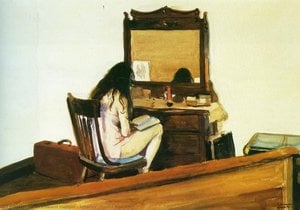
Art Institute of Chicago, ČikagoArt Institute of Chicago Čikago 3 Nighthawks, Ноћњаци, nighthawks, Interior (Model Reading)
Yale University Art Gallery, HartfordYale University Art Gallery Hartford 3 Сунце у кантини, Sobe za turista
Muzej finih umetnosti u Bostonu, BostonMuzej finih umetnosti u Bostonu Boston 3 Apoteka, Room in Brooklyn
Hirshhorn Museum and Sculpture Garden, Vašington, D.C.Hirshhorn Museum and Sculpture Garden Vašington, D.C. 3 First Row Orchestra
Smithsonian American Art Museum, Vašington, D.C.Smithsonian American Art Museum Vašington, D.C. 2 The Cat Boat
Des Moines Art Center, Des MoinesDes Moines Art Center Des Moines 1 Automat (small)

Edvard Hoper, decade by decade: the defining painting of each

  1. 1890s
    Study of a Seated Woman (1899) by Edvard Hoper
    No. 57 of 100

    Study of a Seated Woman

    Age 8 – 17

    Edward Hopper's "Study of a Seated Woman," rendered in 1899, isn’t merely a depiction of a figure; it’s a distilled essence of late 19th-century American introspection. This intimate…

  2. 1900s
    Woman at Cafe Table (1907) by Edvard Hoper
    #41 of 100

    Woman at Cafe Table

    Age 18 – 27 · Whitney Museum of American Art

    Woman at Cafe Table: A Portrait of Urban Isolation Edward Hopper’s “Woman at Cafe Table,” painted in 1906-1907, stands as a quintessential emblem of New Realism and embodies…

  3. 1910s
    Queensborough-Bridge (1913) by Edvard Hoper
    No. 64 of 100

    Queensborough-Bridge

    Age 28 – 37

    In the vast landscape of American modernism, few images capture the quiet tension of urban existence as poignantly as Edward Hopper’s Queensborough Bridge. Painted in 1913, this monumental…

  4. 1920s
    Kuća pored železnice (1925) by Edvard Hoper
    #3 of 100

    Kuća pored železnice

    Age 38 – 47 · MoMA - Muzej moderne umetnosti

    Introduction to Edward Hopper and His Work Edward Hopper, a renowned American artist, is celebrated for his captivating oil paintings that often depicted modern life in the early…

  5. 1930s
    Њујоршки филм (1939) by Edvard Hoper
    Rank 4 / 100

    Њујоршки филм

    Age 48 – 57 · MoMA - Muzej moderne umetnosti

    SlikaEdward Hopperova slika je melanholično ulje na platnu stvoreno 1939. godine. Trenutno je izložena u prestižnom Muzeju moderne umetnosti (MoMA) u Njujorku, Sjedinjene Države. Ovo remek-delo savršeno ilustruje…

  6. 1940s
    Nighthawks, Ноћњаци (1942) by Edvard Hoper
    No. 1 of 100

    Nighthawks, Ноћњаци

    Age 58 – 67 · Art Institute of Chicago

    Edward Hopper's Nighthawks (1942) stands as an enduring emblem of twentieth-century American art and a poignant meditation on the pervasive sense of isolation that characterizes modern urban life.…

  7. 1950s
    Сунце у кантини (1958) by Edvard Hoper
    #13 of 100

    Сунце у кантини

    Age 68 – 77 · Yale University Art Gallery

    Hooperovo delo Sunlight in a Cafeteria (1958) predstavlja majstorski prikaz urbane samoće, izveden sa preciznošću i emocionalnom dubinom koja definišu njegov kultni stil. Ovo ulje na platnu, dimenzija…

  8. 1960s
    Људи у сунцу (1960) by Edvard Hoper
    No. 14 of 100

    Људи у сунцу

    Age 78 – 85

    Srene momenat uhvaćen u vremenu Delo Edvarda Hopera, „Ljudi u suncu“, poziva posmatrače u mirnu scenu u kojoj pet osoba uživa u trenutku tihe odmore u pod nebeskim…

Edvard Hoper's masterpieces: questions and answers

Which painting is Edvard Hoper best known for?Show the answer

Nighthawks, Ноћњаци (1942), Art Institute of Chicago, Čikago. Next come Automat (small) and Kuća pored železnice (1925).

How old was Edvard Hoper when painting Nighthawks, Ноћњаци?Show the answer

60 years old: Nighthawks, Ноћњаци dates from 1942 and Edvard Hoper was born in 1882.

What are Edvard Hoper's ten greatest paintings?Show the answer

Nighthawks, Ноћњаци, Automat (small), Kuća pored železnice, Њујоршки филм, untitled (5560), Early sunday morning Whitney Museum of American, Аутомат, Nedelja, Гас and Чоп Суи. The ranking above gives the year and the museum of each.

How many works did Edvard Hoper paint?Show the answer

Our catalogue lists 366 works by Edvard Hoper, dated from 1899 to 1965.

In which museums can I see Edvard Hoper's masterpieces?Show the answer

Most of them are in MoMA - Muzej moderne umetnosti (New York City), Whitney Museum of American Art (Njujork) and Art Institute of Chicago (Čikago). The table above lists the museums one by one.

When did Edvard Hoper paint the masterpieces?Show the answer

In 1920s: 15 of the 100 works on this page date from then, among them Kuća pored železnice.

What are the first and last famous paintings of Edvard Hoper?Show the answer

The earliest on this page is Study of a Seated Woman (1899), the latest Два Комедианта (1965).

What were Edvard Hoper's favourite subjects?Show the answer

Solitude (46), Isolation (35) and Urban landscape (25), among the 100 works on this page.

Which technique did Edvard Hoper favour?Show the answer

Oil On Canvas: 35 of the 100 works on this page.

What art movement is Edvard Hoper part of?Show the answer

Savremeni realizam and American realism, as the paintings on this page show.

Which masterpieces by Edvard Hoper hang at the MoMA - Muzej moderne umetnosti?Show the answer

Kuća pored železnice, Њујоршки филм and untitled (5560) are among the 4 works on this page held by the MoMA - Muzej moderne umetnosti, New York City.

The life of Edvard Hoper

Tišina američke scene

Edvard Hoper je rođen u Njaku, Sjedinjene Američke Države. Svoje rane godine proveo je posmatrajući svet istodobnim i nepokolebljivim pogledom, navikom koja je počela još u detinjstvu kroz pedantno datirane i potpisane skice. Iako su njegovi roditelji sugerisali praktičniji put kroz komercijalnu ilustraciju, njegova pažnja ostala je usmerena ka visokoj umetnosti. Studirao je u Školi umetnosti u Njujorku kod Vilijama Merita Čejsa i Roberta Henrija. Te godine naučile su ga tehničkoj veštini neophodnoj za prikazivanje sveta onakvim kakav jeste – neukrasnim i iskrenim. Nije tragao za prolaznim potezima impresionista koje je sretao u Parizu; umesto toga, razvio je način gledanja koji je favorizovao mir i nepomičnost trenutka nasuprot pokretu gomile.

Njegov rad se često fokusira na svakodnevno, na ono što je obično. Posmatrao je kuće, restorane, kancelarije i hotelske sobe, skidajući suvišne detalje kako bi otkrio duboku emocionalnu istinu scene. U delu Kuća pored železnice (1925), jednostavna kompozicija otkriva osećaj misterije i izolacije. Svetlost i senka za njega nisu bile samo sredstva za opisivanje prostora, već način za stvaranje atmosfere. Precizno prikazivanje senke na zidu ili način na koji svetlost pada na prozor postalo je njegov način komuniciranja psihološkog stanja svojih subjekata.

Svetlost i urbani enterijer

Način na koji svetlost ulazi u prostor predstavlja centralnog lika u njegovim slikama. U delu Nighthawks (1942), oštra fluorescentna svetlost restorana kasno u noć seče kroz tamu napuštene urbane ulice. Figure unutra su fizički blizu, ali deluju izgubljeno u sopstvenim mislima, potpuno odvojene jedna od druge. Taj osećaj anonimnosti u prepunom gradu postao je njegova stalna tema. Hoper je uspešno uhvatio napetost boravka samog u javnom prostoru, osećaj koji odjekuje u delima kao što su Automat i Kancelarija u malom gradu. Bio je fasciniran načinom na koji veštačka svetlost komunicira sa prirodnom tamom noći.

Njegova supruga, Džozefin Nivison Hoper, bila je njegova stalna prisutna figura. Bila je umetnica i često mu je služila kao model, a njeno prisustvo se oseća u karakterizaciji mnogih njegovih ženskih figura. Zajedno su živeli skromnim životom, često provodeći leta u Novoj Engleskoj, što je snažno uticalo na pejzaže koje je slikao. Njegovi prikazi američkog pejzaža, bilo da su ruralni ili urbani, često naglašavaju određenu surovost ili prazninu. Bilo da je reč o benzinskoj pumpi pored puta u delu Gas (1940) ili tihoj sobi u hotelu, subjekat je uvek presek fizičkog mesta i privatnog, unutrašnjeg iskustva.

Nasleđe posmatranja

Hoperov uticaj proteže se u vizuelni jezik filma i književnosti. Njegova sposobnost da kroz kompoziciju stvori osećaj psihološke napetosti primećena je kod mnogih koji proučavaju način na koji se priče prenose putem slika. Njegova dela se nalaze u vodećim svetskim muzejima, u kolekcijama kao što su Muzej američke umetnosti Whitney i Muzej lepih umetnosti u Bostonu. On nije težio velikim istorijskim narativima; svoju temu je pronalazio u tišim uglovima svakodnevnog života, pretvarajući običan prozor ili prolaznog stranca u studiju ljudskog stanja. Njegov rad ostaje studija tišine koja postoji između ljudi.

All 366 works by Edvard Hoper →