Борис Кустодијев, 1878 – 1927

Борис Кустодијев: 100 najpoznatijih slika

Maslenica (1916) je najpoznatije delo umetnika Борис Кустодијев. Moscow in 1905 (1905) i Женскост трговаца (1912) su sledeća dva dela koja svet najbolje poznaje. Od 847 dela umetnika Борис Кустодијев u našem katalogu, izdvajamo ovih 100 koja kolekcionari i posetioci muzeja najčešće posmatraju, uz navođenje godine, muzeja i priče o svakom od njih.

Rangirano prema našem koeficijentu popularnosti, koji kombinuje pretrage, posete i porudžbine za svako delo. Ažurirano октобар 2026. Svako remek-delo na ovoj stranici može se naručiti kao ručno oslikana uljana reprodukcija muzejskog kvaliteta ili kao umetnička štampa, u dimenzijama koje odaberete.

Portret Борис Кустодијев
Борис Кустодијев · 1878 – 1927
Rođen · umro
1878 – 1927, Астрахан
Pokret
Realism
Radovi u našem katalogu
847
Najpoznatije
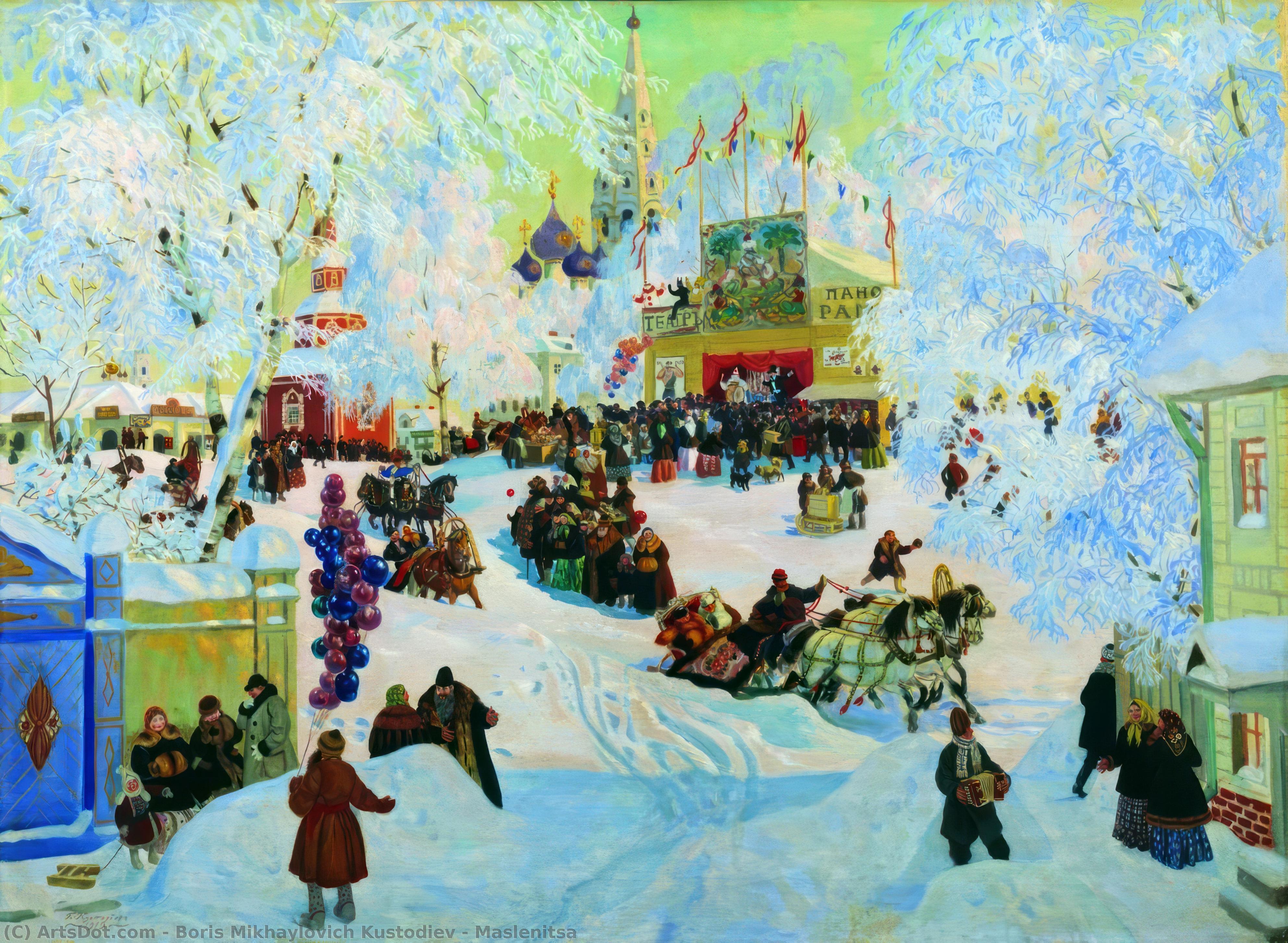
Maslenica (1916)
Najviše dela u
Tretyakovljeva galerija

Top 10: najpoznatija dela umetnika Борис Кустодијев

Maslenica (1916) čiji je Борис Кустодијев
1

Maslenica

1916 · Ulje na platnu

Gledati prikaz Maslenice Borisa Mihajlovića Kustodijeva znači trenutno biti prebačen u srce davne, živopisne Rusije. Ova slika obuhvata više od obične sezonske proslave; ona otelovljuje samu dušu zajedničke radosti koja opstaje uprkos oštrom zimskom hladu. Scena se odvija pod pokrivačem netaknutog snega, ali atmosfera vibrira neporecivom, živom energijom. Čovek gotovo može čuti smeh koji odjekuje snežnim ulicama dok se figure kreću — živopisni kontrapunkt tihoj veličini padašnjih pahulja.

Moscow in 1905 (1905) čiji je Борис Кустодијев
2

Moscow in 1905

1905 · Oil On Canvas

To stand before this depiction of Moscow in 1905 is not merely to observe a painting; it is to confront a moment suspended between vibrant life and utter collapse. Boris Mikhailovich Kustodiev, master chronicler of the Russian spirit, has captured a scene steeped in revolutionary fervor and palpable chaos. The canvas throbs with an energy that speaks of upheaval—a city caught in the violent currents of history. One cannot look…

Женскост трговаца (1912) čiji je Борис Кустодијев
3

Женскост трговаца

1912 · Ulje na platnu

Stajati ispred prikaza kao što su „Trgovačke žene” znači zakoračiti direktno u živopisni, bogato teksturirani tapiserija ruskog života početka 20. veka. Ova slika beleži mnogo više od običnog okupljanja žena; ona sačuvava trenutak usredven u vremenu—tableau vivant drugarstva i tihe porodične drame koja se odvija uz ambijent urbane arhitekture. Scena pulsira gotovo opipljivom energijom, sugerišući šaputljiva razgovora i zajedničke tajne među prijateljicama koje uživaju na otvorenom. Kustodijev majstorski uokviruje ovu…

Pancake Tuesday in a Village. Maslenitsa (1916) čiji je Борис Кустодијев
4

Pancake Tuesday in a Village. Maslenitsa

1916 · Oil On Canvas

To gaze upon this vibrant depiction of Maslenitsa is to be instantly transported to the heart of rural Russia during the cusp of spring. Boris Mikhailovich Kustodiev masterfully captures not merely a scene, but a palpable moment of communal joy and enduring cultural resilience. The air itself seems thick with the music emanating from the young man playing the accordion, a focal point radiating warmth against the crisp, snowy backdrop.…

Portrait of V. Shishkov (1926) čiji je Борис Кустодијев
5

Portrait of V. Shishkov

1926 · Ink On Paper

The portrait of V. Shishkov, executed in 1926, presents a monochrome study of a seated man. The subject is positioned from the chest up, occupying the central space of the frame. He is depicted with a downward gaze, his head tilted slightly toward a stack of papers or books resting before him. The lighting originates from an elevated position to the left, casting distinct shadows beneath the chin and along…

S.P. Podyachev in his hut in the village Obolyaninove (1926) čiji je Борис Кустодијев
6

S.P. Podyachev in his hut in the village Obolyaninove

1926 · Graphite

A monochromatic study from 1926, this graphite and charcoal drawing captures S.P. Podyachev positioned before his dwelling in the village of Obolyaninove. The figure occupies the lower left, creating a visual anchor against the rustic architecture of the hut. Trees frame the upper right corner, providing a sense of depth through overlapping forms and varying line density. The composition balances the human presence with the natural and built environment, reflecting…

Portrait of Y.E. Kustodieva (1926) čiji je Борис Кустодијев
7

Portrait of Y.E. Kustodieva

1926 · Lithograph

In this 1920 oil on canvas, we find ourselves within a private, domestic sphere that feels both intimate and profoundly staged. The subject, Y.E. Kustodieva, is seated with a serene grace, her presence anchoring a room filled with the textures of a refined life. There is a stillness here, a sense of a moment suspended in the soft, diffused light of a Russian interior. The composition draws the eye toward…

Bolshevik čiji je Борис Кустодијев
8

Bolshevik

Oil On Canvas

In the evocative oil on canvas titled Bolshevik, the legendary Russian master Boris Mikhailovich Kustodiev invites viewers into a poignant moment of collective human experience. The scene unfolds within a biting, snow-swept landscape, where the chill of winter is palpable through the artist's masterful brushwork. At the heart of this composition stands a solitary figure, a man anchored by the striking presence of a vibrant red umbrella. This splash of…

Portrait of a priest and a deacon (1907) čiji je Борис Кустодијев
9

Portrait of a priest and a deacon

1907 · Oil On Canvas

Two elderly Russian Orthodox monks sit side-by-side within a richly decorated interior, their presence anchoring a composition of quiet solemnity. The figures are rendered with a heavy emphasis on texture, utilizing thick impasto brushwork to define the weight of their robes and the patterned surfaces surrounding them. Deep blues, reds, and browns dominate the palette, creating a sense of warmth that contrasts with the stillness of the subjects. Light filters…

General Galkin Vransky (1903) čiji je Борис Кустодијев
10

General Galkin Vransky

Step closer to observe the presence of General Galkin Vransky. In this 1903 portrait, we encounter an elderly gentleman captured in a moment of profound stillness. The composition focuses our attention on his upper torso and head, set against a dark, indistinct background that pushes the figure toward us. There is a certain weight to his posture, a sense of authority held within the very lines of his uniform. The…

Ostatak rang liste Борис Кустодијев, od 11 do 100

Baker (1918) čiji je Борис Кустодијев
#12

Baker

1918

In the delicate, translucent layers of Boris Mikhailovich Kustodiev’s 1918 watercolor, "Baker," we are transported to a world that feels both intimately familiar and beautifully distant. This piece…

Naručite reprodukciju →
Horses in the storm (1918) čiji je Борис Кустодијев
#16

Horses in the storm

1918

In the turbulent landscape of 1918, Boris Mikhailovich Kustodiev captured a moment of raw, elemental power in his masterpiece, Horses in the Storm. This large-scale oil painting serves…

Unesite ga u svoj dom →
Portrait of Nikolay Rerich (1913) čiji je Борис Кустодијев
#25

Portrait of Nikolay Rerich

1913

This captivating portrait of Nikolay Rerich transports us directly into the atmosphere of early 1913 Russia. Boris Mikhailovich Kustodiev, an artist whose vision was deeply intertwined with the…

Unesite ga u svoj dom →

Motivi koje je Борис Кустодијев najčešće slikao

Četiri teme koje se najčešće pojavljuju među ovim remek-delima, sa najboljim primerom za svaku od njih.

Gde videti slike umetnika Борис Кустодијев

2 muzeja u kojima se nalazi najviše slika sa ove stranice.

Muzej Grad Radovi umetnika Борис Кустодијев Slike iz ovog spiska
Tretyakovljeva galerija, MoskvaTretyakovljeva galerija Moskva 6 Beauty
State Fine Arts Museum of The Republic of Kazakhstan, AlmatyState Fine Arts Museum of The Republic of Kazakhstan Almaty 1 General Galkin Vransky

Борис Кустодијев kroz decenije: jedno remek-delo za svaku

  1. 1890s
  2. 1900s
    Moscow in 1905 (1905) čiji je Борис Кустодијев
    Rang 2 od 100

    Moscow in 1905

    Godine 22 – 31

    To stand before this depiction of Moscow in 1905 is not merely to observe a painting; it is to confront a moment suspended between vibrant life and utter…

  3. 1910s
    Maslenica (1916) čiji je Борис Кустодијев
    #1 od 100

    Maslenica

    Godine 32 – 41

    Gledati prikaz Maslenice Borisa Mihajlovića Kustodijeva znači trenutno biti prebačen u srce davne, živopisne Rusije. Ova slika obuhvata više od obične sezonske proslave; ona otelovljuje samu dušu zajedničke…

  4. 1920s
    Portrait of V. Shishkov (1926) čiji je Борис Кустодијев
    5 od 100

    Portrait of V. Shishkov

    Godine 42 – 49

    The portrait of V. Shishkov, executed in 1926, presents a monochrome study of a seated man. The subject is positioned from the chest up, occupying the central space…

Slike umetnika Борис Кустодијев: često postavljana pitanja

Koja je najpoznatija slika umetnika Борис Кустодијев?Prikaži odgovor

Maslenica (1916). Sledeći su Moscow in 1905 (1905) i Женскост трговаца (1912).

U kojoj je godini Борис Кустодијев naslikao Maslenica?Prikaži odgovor

38 godina: Maslenica datira iz 1916, a Борис Кустодијев je rođen/a 1878.

Koja su 10 najpoznatijih slika umetnika Борис Кустодијев?Prikaži odgovor

Maslenica, Moscow in 1905, Женскост трговаца, Pancake Tuesday in a Village. Maslenitsa, Portrait of V. Shishkov, S.P. Podyachev in his hut in the village Obolyaninove, Portrait of Y.E. Kustodieva, Bolshevik, Portrait of a priest and a deacon i General Galkin Vransky. Gornji rang prikazuje godinu i muzej za svako od njih.

Koliko ima slika umetnika Борис Кустодијев?Prikaži odgovor

Naš katalog sadrži 847 dela umetnika Борис Кустодијев, datiranih od 1898 do 1926.

Gde mogu da vidim najpoznatija dela umetnika Борис Кустодијев?Prikaži odgovor

Većina njih se nalazi u Tretyakovljeva galerija (Moskva) i State Fine Arts Museum of The Republic of Kazakhstan (Almaty). U tabeli iznad su muzeji navedeni jedan po jedan.

U kom periodu je Борис Кустодијев naslikao/la svoje najpoznatije radove?Prikaži odgovor

U periodima 1910s: 46 od ukupno 100 dela na ovoj stranici datiraju iz tog vremena, od čega je Maslenica.

Ko je najranije i najnovije poznato delo umetnika Борис Кустодијев?Prikaži odgovor

Najstarije delo na ovoj stranici je iz Seated Model (1898), a najnovije iz Portrait of V. Shishkov (1926).

Koje je motive Борис Кустодијев slikao?Prikaži odgovor

Men (26), Famous people (26) i Portraits (26), od ukupno 100 dela na ovoj stranici.

Na čemu je Борис Кустодијев slikao i kojim sredstvima?Prikaži odgovor

Oil On Canvas: 12 od ukupno 100 dela na ovoj stranici.

Kojem umetničkom pravcu pripada umetnost autora Борис Кустодијев?Prikaži odgovor

Realism, kao što pokazuju slike na ovoj stranici.

Gde mogu da kupim reprodukciju Борис Кустодијев?Prikaži odgovor

Da. Svaku sliku sa ove stranice možete naručiti kao ručno oslikano ulje na platnu muzejskog kvaliteta ili kao umetnički print, u veličini koju odaberete, direktno sa stranice te slike.

Борис Кустодијев: biografija

Early Life, Family and Training

The story of Boris Mikhailovich Kustodiev begins in Astrakhan, Russia, where he was born on March 7, 1878. His early years were shaped by a sudden and heavy silence in the household; his father, a man of deep intellect who taught philosophy, history, and logic, passed away when Boris was only one year old. This loss left the family to navigate the complexities of life without him, and the boy grew up in a home where the presence of the merchant class was felt daily. Living in a rented wing of a wealthy merchant's house, he watched the customs and the lively, often loud, traditions of the provincial people unfold right before his eyes. These early observations of the local way of life would eventually find their way onto his canvases.

His path toward the arts was not a direct one. Between 1893 and 1896, he spent his time studying within a theological seminary, a setting far removed from the colorful markets of his childhood. However, a different calling was already taking hold. He sought out private art lessons in Astrakhan from Pavel Vlasov, a man who had himself studied under Vasily Perov. Under Vlasov's guidance, the young student began to transform his observations of the world into deliberate strokes of paint. This foundational training provided the technical discipline necessary for the ambitions that would soon lead him away from the provincial quietude of Astrakhan and toward the great centers of learning.

Studies at the Imperial Academy of Arts

Upon arriving in St. Petersburg, Kustodiev entered the Imperial Academy of Arts, where his formal training would shape the very foundation of his vision. From 1896 to 1903, he immersed himself in the rigorous discipline of the academy, seeking to master the nuances of form and light. It was here that he came under the guidance of Ilya Repin, a teacher who possessed a keen eye for emerging talent. Repin saw something special in the young man's approach and recognized his potential early in his studies. This mentorship was not merely academic; it was a practical apprenticeship that allowed Kustodiev to witness the complexities of large-scale composition firsthand. He was even invited to serve as an assistant to Repin, contributing to a monumental commemorative painting that required immense technical skill and patience.

His curiosity extended beyond the brush and the canvas. Kustodiev sought to understand the physical weight of his subjects, leading him to study sculpture under Dmitry Stelletsky. This training in three dimensions likely informed the sense of presence and volume found in his later figures. He also turned his attention to the precision of line and the delicate art of etching, seeking instruction from Vasiliy Mate. By moving between the study of sculpture, the technicality of etching, and the grand traditions of painting, he built a versatile toolkit. He was a student of many facets, absorbing the diverse methods of the academy to prepare for a life spent translating the spirit of his homeland into color and form.

Travels and Artistic Development

In 1904, a grant from the Imperial Academy of Arts allowed him to step beyond the borders of Russia. He traveled through France and Spain, seeking to understand the light and forms of the West. These excursions were not mere sightseeing; they were essential encounters that expanded his vision. He later found himself in Italy, Austria, and Germany, absorbing the diverse atmospheres of Europe. Each landscape and city added a new layer to his understanding of composition and color.

As his hands moved across the canvas, his style began to weave together several distinct influences. He drew heavily from Realism, maintaining a keen eye for the tangible details of life, yet he increasingly embraced the flowing, decorative lines of Art Nouveau. His work also carried the light-filled qualities of Impressionism and the deeper, more suggestive moods of Symbolism. This blend allowed him to move beyond simple representation, seeking instead to capture the essence of the subjects he encountered.

  • The Fair (1906)
  • The Sleigh (1910)
  • The Beautiful Woman (1915)

Key Works and Artistic Themes

His brush often sought the pulse of the Russian people, finding deep meaning in the customs of the merchant class and the rhythms of rural life. In 1906, he captured the bustling energy of a fair, a scene filled with movement and color. This interest in the social fabric of his homeland continued as he observed the quiet, intimate moments of childhood, such as in his 1907 depiction of a boy with a teddy bear. He possessed a particular talent for portraying the dignity of those who lived through the changing tides of the era, focusing on the character and presence of the common folk.

The atmosphere of traditional celebrations also found a place on his canvases. His 1916 painting of Maslenitsa portrays the joy of the Pancake Week festival, filled with the spirit of a communal celebration. He also turned his gaze toward the land itself, as seen in his 1914 work, Harvest, which captures the light and labor of the fields. These scenes were never mere observations; they were attempts to grasp the very soul of a nation through its most familiar sights.

As his life progressed, his depictions of the merchant class grew even more profound. In 1918, he produced The Merchant's Wife, a work that demonstrated his command of Russian realism. That same year, he painted The Merchant, further exploring the lives and textures of this specific social group. Through these works, he sought to recreate the beauty and the strength of the Russian spirit, even as the world around him underwent immense transformation.

Later Years and Resilience

The year 1916 brought a profound change to Kustodiev’s existence when he was struck with paraplegia. This sudden affliction confined him to a wheelchair for the remainder of his life, a physical limitation that fundamentally altered his daily reality. Yet, rather than allowing his suffering to silence his creative spirit, he met this adversity with a remarkable tenacity. He continued to paint prolifically, turning his gaze toward the canvas even as his physical world grew smaller. There was a certain defiance in his persistence, a refusal to let illness dictate the boundaries of his imagination.

As his physical strength waned, his brushwork seemed to gain a new kind of intensity. His later works moved toward a more decorative approach, characterized by an intensified joyfulness and a palette of colors that felt more vivid than those of his earlier years. It was as if he sought to recreate the beauty and light of the world he could no longer physically traverse. This period of his life produced works that celebrated the simple, festive pleasures of Russian life with a renewed sense of energy. His ability to find such brightness amidst personal hardship remains a central part of his story.

Legacy and Historical Significance

The influence of Boris Mikhailovich Kustodiev reached far beyond the canvas, as he moved through the shifting tides of the Modernist period. He was a man of many disciplines, finding success as a draughtsman and a stage designer, while his skill in book illustration allowed him to shape the visual language of literature. His ability to capture the inner workings of a person through psychological portraiture ensured that his subjects felt present and alive, rather than mere likenesses. Even as the political landscape of Russia underwent profound transformations, he remained deeply connected to the creative community, eventually joining the Association of Artists of Revolutionary Russia in 1923.

His life reached its end on May 28, 1927, leaving behind a body of work that reflected the complex spirit of his era. He did not merely observe the world; he interpreted the customs and characters of his homeland with a specific, focused intent. By blending his talents in various media, he helped define a particular aesthetic that resonated with the changing social structures of the early twentieth century. His presence in the art world was felt through both his public exhibitions and his private, meticulous studies of the human soul.

Where to See the Works Today

To encounter the spirit of his brushwork, one must travel across the vast landscapes of the former empire, where his canvases remain scattered in various repositories. In the city of Saint Petersburg, the Brodsky House Museum preserves his presence, offering a glimpse into the intimate atmosphere he once inhabited. For those seeking his connection to the southern regions, the Astrakhan State Picture Gallery holds several of his works, keeping his memory alive in the very lands that shaped his early perceptions of the merchant class.

His reach extends far beyond these central hubs, reaching into the heart of diverse territories. In the Kramskoy Museum of Fine Arts in Voronezh, his paintings continue to speak to those who walk its halls. The geographic spread of his legacy is quite vast, as seen in the collections held in distant cities. For instance, the State Art Museum of Uzbekistan in Tashkent keeps his 1918 painting, The Merchant, within its walls. Similarly, the National Gallery of Armenia in Yerevan preserves Evening Journey, a work from 1918, ensuring that his vision of Russian life remains accessible to a wide audience across many borders.

Sva 847 dela umetnika Борис Кустодијев →