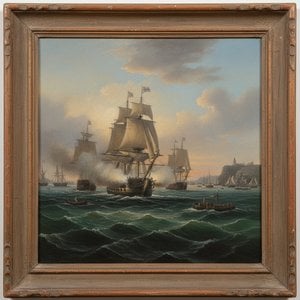
Thomas Milton (1743 – 27 February 1827): The Quiet Master of Irish Landscapes
Thomas Milton, a British engraver born in Bristol in 1743, remains an artist whose output is notable for its subtlety and meticulous detail. Despite the considerable fame enjoyed by his father, John Milton—a marine painter celebrated for capturing dramatic seascapes—Thomas pursued a distinctly different artistic path, focusing primarily on landscape engraving and producing exquisitely rendered views of Ireland. His career spanned several decades, culminating in his death in 1827 at the age of eighty-four, leaving behind a substantial body of work that continues to fascinate scholars and collectors alike.
Milton’s formative years were spent under the tutelage of William Woollett, a respected engraver who instilled in him a disciplined approach to technique and fostered an appreciation for classical aesthetics. This influence is evident throughout Milton's oeuvre—characterized by a remarkable fidelity to original drawings and a masterful command of tonal gradation—reflecting Woollett’s emphasis on capturing atmospheric perspective and conveying the emotional resonance of natural scenes. Early commissions brought him into contact with prominent artists and publishers, establishing him as a respected figure within the London engraving community.
The cornerstone of Milton's artistic reputation rests upon his monumental series of views of Irish estates, begun in 1783 and completed in 1793. Collaborating with William Ashford, John James Barralet, Francis Wheatley, and others—artists whose drawings served as inspiration for the project—Milton produced twenty-four plates depicting castles, mansions, and picturesque landscapes across Ireland. These engravings captured not merely visual representations but also a sense of grandeur and serenity, reflecting the aspirations of Irish landowners during the Enlightenment era. The series cemented Milton’s position as Ireland's foremost landscape engraver and secured his place in art history.
Beyond Ireland, Milton undertook commissions for biblical illustrations, notably engraving Philip James de Loutherbourg’s depiction of Noah’s Flood for Thomas Macklin’s Bible edition. This ambitious undertaking demanded considerable skill and patience—a testament to Milton’s unwavering dedication to craft—resulting in a series of powerfully expressive plates that conveyed the drama and pathos of the biblical narrative. Furthermore, his work appeared in celebrated Shakespeare editions overseen by John Boydell and George Kearsley, demonstrating his versatility as an engraver and solidifying his contribution to literary culture.
Milton’s prolific output extended beyond these prominent projects; he engraved over 200 plates for Rees's Cyclopædia, primarily focusing on natural history subjects—a field that captivated him throughout his life. His meticulous attention to detail and unwavering commitment to accuracy ensured that his engravings served as invaluable resources for scientific inquiry and artistic inspiration. Thomas Milton’s legacy endures not merely as a craftsman of exceptional skill but also as an artist who quietly shaped the visual landscape of his time, leaving behind a body of work that continues to inspire admiration for its beauty and intellectual rigor.