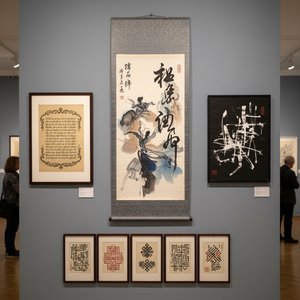
Rachid Koraïchi: Life and Art
Early Life and Education
Born in Ain Beida, Algeria in 1947, Rachid Koraïchi’s artistic journey was deeply rooted in his upbringing within a Sufi family of Quranic scholars and copyists. This familial background instilled in him an early fascination with scripts and symbols, which would become central to his later work. He received his initial art education at the École des Beaux-Arts in Algeria, where he honed his skills in calligraphy. Seeking further artistic development, Koraïchi continued his studies at the École des Arts Décoratifs and the École des Beaux-Arts in Paris.
Influences and Artistic Development
Koraïchi’s work is profoundly influenced by his Sufi heritage, imbuing it with a spiritual dimension. He views writing not merely as communication but as a sacred act charged with meaning. This belief translates into the extensive use of Arabic calligraphy alongside glyphs from other languages in his art. His artistic development saw him experimenting with diverse media, moving beyond traditional painting to embrace ceramics, textiles, installation art, and metallurgy.
Artistic Style and Themes
Rachid Koraïchi’s style is characterized by a unique synthesis of calligraphy, abstraction, and spirituality. His work often explores themes of language, cultural identity, memory, and the human condition. He frequently collaborates with local artisans, integrating traditional techniques into his contemporary creations. This collaborative approach reflects his commitment to preserving cultural heritage while pushing artistic boundaries.
Major Achievements and Exhibitions
- Exhibited widely internationally, showcasing his diverse body of work.
- Participated in the Venice Biennale in 2001, gaining significant international recognition.
- His work was featured at the Museum of Modern Art (MoMA) in New York in 2006.
- Pieces are held in prestigious collections, including the National Museum of African Art, Washington D.C.
Historical Significance and Legacy
Rachid Koraïchi stands as a significant figure in contemporary art, particularly within the context of Islamic and African modernism. His innovative use of calligraphy transcends mere aesthetics, transforming it into a powerful medium for exploring spiritual and cultural themes. He is often associated with the Transvangarde movement, though his work maintains a distinct identity rooted in his Algerian heritage and Sufi beliefs. Koraïchi’s legacy lies in his ability to bridge artistic traditions, fostering dialogue between cultures and inspiring future generations of artists.
Pitanja i odgovori
Koliko je umetničkih dela autora Rachid Koraïchi dostupno za pregled?
Možete pregledati 1 umetničkih dela dela umetnika Rachid Koraïchi na stranici Sva umetnička dela.
Koji dela umetnika Rachid Koraïchi imaju najviše pregleda?
Postoji Statistika stranica za Rachid Koraïchi, koja prikazuje statistiku o umetnikovim delima na ovaj veb-sajt.
Gde se mogu pronaći dela umetnika Rachid Koraïchi grupisanom prema ključnim rečima?
Da biste pronašli dela umetnika Rachid Koraïchi na određenu temu, koristite stranicu Preko ključnih reči ovog umetnika, koja grupiše dela prema ključnim rečima.