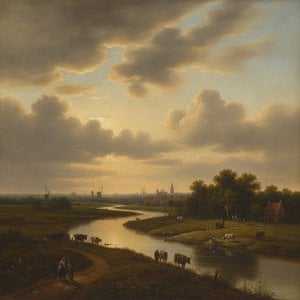
Pieter Harmansz Verelst: A Window into Dutch Golden Age Life
Pieter Harmansz Verelst (c. 1618 – November 1668) stands as a pivotal figure in the Dutch Golden Age, celebrated for his masterful genre paintings that captured the essence of everyday life with remarkable precision and emotional depth. Born in Dordrecht, Netherlands, Verelst’s artistic journey unfolded against the backdrop of a flourishing cultural landscape—a period marked by unprecedented economic prosperity and intellectual curiosity—influencing his stylistic choices and thematic concerns profoundly.- Early Life & Training:
- Notable Influences:
- Career Highlights:
- Style & Technique:
- Legacy & Historical Significance:
Early Life & Training
Information regarding Verelst’s formative years remains somewhat sparse, primarily gleaned from records pertaining to his apprenticeship under Frans Hals and Daniël Mijnhof. These masters instilled in him a dedication to anatomical accuracy and realistic portrayal—skills that would become hallmarks of his oeuvre. Hals' influence particularly emphasized the importance of capturing psychological nuance alongside physical likeness, shaping Verelst’s approach to portraiture and contributing to his ability to convey emotion effectively.Notable Influences
Verelst’s artistic sensibilities were undeniably shaped by the prevailing stylistic currents of the era. The Baroque aesthetic—characterized by dramatic lighting, opulent ornamentation, and theatrical compositions—provided inspiration for many of his works. However, Verelst transcended mere imitation, integrating Baroque elements with a humanist sensibility rooted in observation and empathy. He drew heavily from Caravaggio’s use of chiaroscuro, employing stark contrasts between light and shadow to heighten emotional impact and create a sense of immediacy. Furthermore, the meticulous realism championed by Rubens—particularly evident in his depictions of landscapes—influenced Verelst's attention to detail and compositional balance.Career Highlights
Verelst’s career spanned several decades during which he produced an impressive body of work encompassing portraits, genre scenes, and still lifes. He gained considerable renown for his depictions of interiors—particularly those portraying domestic life—where he meticulously rendered furniture, fabrics, and tableware with astonishing realism. His market scenes captured the vibrant energy of bustling marketplaces, populated by lively characters engaged in commerce and social interaction. Among his most celebrated commissions were portraits of prominent figures from Dordrecht’s civic elite, demonstrating his technical prowess and artistic sensitivity.Style & Technique
Verelst's distinctive style was characterized by a commitment to anatomical precision combined with an expressive use of color and light. He meticulously studied human anatomy—a practice encouraged by the humanist ideals prevalent during his time—resulting in figures rendered with remarkable accuracy and dynamism. His masterful manipulation of chiaroscuro—borrowed from Caravaggio—created dramatic visual effects that conveyed mood and emotion powerfully. Verelst’s palette was rich and varied, reflecting his keen observation of nature and his ability to capture subtle tonal nuances. He employed glazing techniques—applying thin layers of translucent paint over underlying colors—to achieve luminous surfaces and enhance the depth of his compositions.Legacy & Historical Significance
Pieter Harmansz Verelst’s contribution to Dutch art history is undeniable. His genre paintings offer invaluable insights into the daily lives, customs, and social dynamics of seventeenth-century Holland—providing a window into the cultural values and intellectual debates of the era. He stands alongside Hals and Rembrandt as one of the most accomplished artists of his generation, embodying the humanist spirit that defined the Dutch Golden Age. Today, Verelst’s works continue to captivate audiences with their beauty, realism, and emotional resonance—affirming his enduring legacy as a master of genre painting and a testament to the transformative power of observation and artistic skill.Pitanja i odgovori
U kom gradu i državi je rođen/a Pieter Harmansz Verelst?
Pieter Harmansz Verelst je rođen/a u gradu Dordrecht, u državi Netherlands.
Mogu li da istražim dela umetnika Pieter Harmansz Verelst prema kolorističkom spektru?
Radove umetnika Pieter Harmansz Verelst možete istražiti prema boji na njegovoj stranici Spektralni indeks.
Koje je boje Pieter Harmansz Verelst najčešće koristio/la?
Kolorit dela umetnika Pieter Harmansz Verelst prikazan je na njegovoj stranici Genom palete.