Paweł Susid: Architect of Geometric Commentary
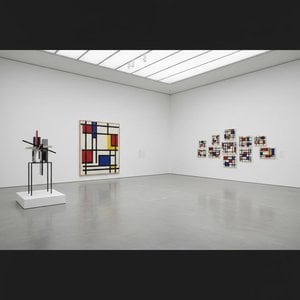
Born in Warsaw, Poland, in 1952, Paweł Susid’s artistic journey is one defined by a deliberate and often playful interrogation of art itself. Initially trained at the Faculty of Painting at the Academy of Fine Arts in Warsaw – an institution that profoundly shaped his approach – Susid has evolved into a singular voice within contemporary Polish art, recognized for his distinctive use of simple geometric forms, bold colors, and incisive textual commentary. His work isn’t merely about depicting subjects; it's about constructing dialogues between the visual and the verbal, inviting viewers to actively engage with the underlying ideas and historical context embedded within each piece.
Susid’s early career was marked by a conscious rejection of traditional representational painting. Influenced by movements like New Objectivity and Minimalism, he began experimenting with rudimentary shapes – squares, circles, triangles – as building blocks for his compositions. These forms, often rendered in vibrant, saturated hues, are not intended to be aesthetically pleasing in the conventional sense. Instead, they serve as vehicles for conveying complex concepts, frequently addressing issues of art history, the commercialization of art, and social commentary. As he himself has stated, “I found any form of competing with photography or film with the ever-deforming hand pretentious,” shifting his focus to a more conceptual approach.
The Language of Geometry and Text
A defining characteristic of Susid’s work is the integration of text alongside his geometric abstractions. These inscriptions, frequently short, aphoristic statements, act as crucial components of the artwork, providing context, critique, or simply a wry observation on the art world. The texts are not merely decorative; they are integral to the meaning of the piece, often challenging viewers to consider the artist’s perspective and the broader cultural landscape. Early works, such as “I Confuse Stażewski with Strzemiński,” exemplify this approach, utilizing a seemingly simple geometric arrangement to explore the complex legacies of two influential Polish avant-garde artists. The title itself highlights the core theme: a deliberate confusion intended to provoke thought about artistic lineage and interpretation.
The artist’s process is meticulously controlled. He employs stencilling techniques, ensuring precision and repeatability in his geometric forms. This systematic approach contrasts sharply with the perceived spontaneity of traditional painting, further emphasizing the conceptual nature of his work. Susid's use of color is equally deliberate, often employing high-contrast combinations to create visual impact and draw attention to the underlying structure of the composition. The bold colors aren’t chosen for their beauty but for their ability to amplify the message conveyed through form and text.
Recognition and Legacy
Paweł Susid's work has garnered significant recognition within Poland and internationally. He has exhibited extensively in galleries and museums across the country, including a notable presentation at the MOCAK Museum of Contemporary Art in Krakow, where his pieces were described as “communicaes referring to the surrounding reality.” His art has been featured in collections such as the ING Polish Art Foundation’s, demonstrating its enduring appeal and critical acclaim. Awards like the Jan Cybis Award (2001) and nominations for the *Polityka* Passport Award further solidify his position as a leading figure in contemporary Polish art.
Beyond individual exhibitions, Susid's work has contributed to broader discussions about the role of art in society. His willingness to engage with complex issues – from politics and religion to the commercialization of art – demonstrates a commitment to using his artistic practice as a platform for critical reflection. His legacy lies not just in the creation of visually striking geometric abstractions, but also in his innovative approach to combining form and text, prompting viewers to question assumptions about art’s purpose and value. He continues to live and work in Warsaw, consistently producing works that challenge and intrigue.
Notable Works
- “I Confuse Stażewski with Strzemiński” (1988): A seminal piece demonstrating the artist’s signature approach – simple geometric forms combined with a deliberately confusing inscription, prompting reflection on artistic history.
- Various works exploring the art market and its dynamics: Susid frequently uses his canvases as platforms for commentary on the commercial aspects of the art world, often employing humorous or ironic statements.
- “Gobelin tkany ręcznie na podstawie pracy Bez tytułu przez tkaczki ze Spółdzielni Koronka – Bobowa” (2022): An example of his continued engagement with contemporary themes and artistic traditions, utilizing a traditional textile technique within a geometric framework.