Early Life and Formation in Foligno
Niccolò di Liberatore, better known as Niccolò da Foligno or L’Alunno—a moniker bestowed upon him by Giorgio Vasari due to a misreading of an inscription identifying him as “Nicholas, alumnus of Foligno”—was born around 1430 in the vibrant Umbrian town of Foligno, Italy. His artistic journey began within the familial sphere, apprenticing under his father-in-law, Pietro di Giovanni Mazzaforte. This early training laid a foundational understanding of painting techniques and established connections within the local artistic community. While details of his initial works remain scarce, it’s believed he absorbed the prevailing Umbrian style—characterized by its gentle forms, devotional sincerity, and clear narrative focus—while simultaneously encountering influences from Florence through association with Benozzo Gozzoli, a pupil of Fra Angelico who briefly worked in the region. However, the extent of Gozzoli's direct impact remains debated; their styles diverge significantly, suggesting more of a contemporary relationship than a master-pupil dynamic.
A Blossoming Career and Regional Commissions
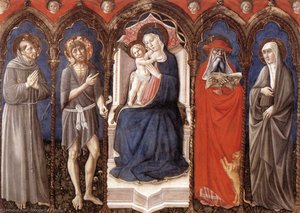
By 1457, Niccolò’s talent had begun to assert itself. His earliest surviving signed panel, *The Virgin and Child Enthroned with Saints*, originally the central element of a polyptych commissioned for San Francesco in Deruta, reveals a burgeoning artistic voice. This work exemplifies the Umbrian aesthetic—a harmonious composition, delicate coloration, and an earnest portrayal of religious figures. Throughout the 1460s, Niccolò secured increasingly prominent commissions, often collaborating with Pietro di Giovanni Mazzaforte. A notable example is the polyptych for San Francesco in Cagli (1465), bearing only Niccolò’s signature, indicating a growing independence and recognition of his skills. His reputation extended beyond Umbria, evidenced by works such as a polyptych for Sant'Angelo in Montelpare (1466) now housed in the Pinacoteca Vaticana, and a triptych created for San Severino in 1468.
The “Alunno” Identity and Mature Style
A pivotal moment in Niccolò’s biographical narrative arrived with the commission of the polyptych for San Nicolò in Foligno (1492). An inscription on one of the predella panels, reading “Nicholaus Alunnus Fulginiae,” inadvertently led Giorgio Vasari to dub him L’Alunno—a name that would endure through art historical literature. This period marks a consolidation of Niccolò's mature style. His paintings are characterized by a refined elegance, balanced compositions, and an increasingly sophisticated use of color and light. While rooted in the Umbrian tradition, his work demonstrates a growing awareness of contemporary developments in other Italian centers, particularly the subtle naturalism emerging from Florence and the more elaborate decorative elements found in Bologna.
Legacy and Influence
Niccolò da Foligno’s influence extended through his family. After 1480, he collaborated with his son, Lattanzio di Nicolò, who continued to develop his father's style. Even after Niccolò’s death in 1502, Lattanzio carried on his artistic legacy, completing works begun by his father and establishing himself as a respected painter in his own right. While not achieving the widespread fame of contemporaries like Perugino or Pinturicchio—artists Vasari also mistakenly associated with Niccolò’s tutelage—Niccolò da Foligno played a crucial role in shaping the artistic landscape of Umbria during the Renaissance. His paintings, imbued with devotional sincerity and refined artistry, continue to captivate viewers with their beauty and grace. He represents a vital link between the earlier Umbrian masters and the evolving styles of the High Renaissance, leaving behind a body of work that reflects both regional traditions and the broader currents of Italian art.