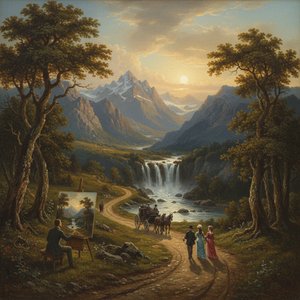
Ni Tian: Bridging Scholar and Landscape in Late Qing China
Ni Tian (倪田, 1855-1919) stands as a pivotal figure in the transition of Chinese painting from traditional literati styles to the burgeoning modern landscape movement of the late Qing Dynasty. Born Baotian in Jiangsu province, he later established himself in Shanghai, a city rapidly becoming a hub for artistic innovation and cosmopolitan exchange. Unlike many of his contemporaries who rigidly adhered to established conventions, Ni Tian skillfully blended elements of scholar painting—known as *shan shui*—with a keen observation of daily life and a burgeoning interest in capturing the ephemeral beauty of the natural world. His work offers a poignant glimpse into a society grappling with profound change, reflecting both the lingering traditions of the past and the tentative embrace of modernity.
Ni Tian’s early artistic training likely involved studying classical literati painting, characterized by its emphasis on ink washes, sparse brushstrokes, and evocative symbolism. These traditional styles often depicted mountains and water—representing spiritual concepts rather than literal landscapes—and were frequently associated with the intellectual pursuits of scholar-officials. However, Ni Tian quickly distinguished himself through his incorporation of figures into his landscape compositions. Unlike the solitary scholar traditionally found in *shan shui*, Ni Tian’s subjects are often engaged in everyday activities: farmers tending their fields, fishermen casting their nets, or women gathering flowers. This shift introduced a sense of immediacy and human connection to the genre, moving it beyond purely philosophical contemplation.
The Shanghai School, to which Ni Tian belonged, was particularly influential in shaping his artistic development. This group of artists, largely comprised of expatriates and native Chinese who had settled in Shanghai, embraced Western techniques while retaining a distinctly Chinese aesthetic sensibility. They experimented with brighter colors, looser brushwork, and a more direct approach to depicting the world around them. Ni Tian’s work exemplifies this synthesis—his landscapes are rendered with vibrant hues and dynamic compositions, yet retain the subtle elegance and understated beauty characteristic of traditional literati painting.
The Palette of Daily Life
Ni Tian's most distinctive contribution lies in his masterful depiction of rural life. He wasn’t simply painting picturesque scenes; he was meticulously observing and portraying the rhythms and textures of daily existence. His paintings, such as “The Local Color of the Fields,” are filled with details that invite viewers to step into the world he captured on paper. The careful rendering of plowed fields, weathered farm implements, and the humble figures of rural laborers speaks volumes about the lives of ordinary people in late Qing China.
His use of color is particularly noteworthy. Unlike the muted tones often found in traditional *shan shui*, Ni Tian employed a wider range of hues—greens, yellows, browns, and blues—to create a sense of vibrancy and depth. He skillfully layered washes of ink to suggest light and shadow, capturing the subtle variations of texture and tone that define the natural world. The paintings are not merely representations of landscapes; they are imbued with a palpable sense of atmosphere and mood.
Furthermore, Ni Tian’s depictions of figures—often rendered in simple, elegant brushstrokes—are remarkably expressive. He captured their postures, gestures, and expressions with subtle grace, conveying a sense of dignity and resilience. These figures aren't idealized; they are presented as real people engaged in honest labor, reflecting the social realities of the time.
Themes of Transition and Reflection
Ni Tian’s work reflects the broader cultural and political currents of late Qing China—a period marked by rapid modernization, foreign influence, and growing social unrest. The artist's shift towards depicting everyday life can be interpreted as a response to these changes, a way of preserving and celebrating the traditions of rural communities in the face of encroaching modernity.
His paintings also offer a poignant commentary on the relationship between nature and humanity. Ni Tian’s landscapes are not simply beautiful vistas; they are imbued with a sense of melancholy and reflection. The solitary figures often seem lost or adrift, suggesting a profound sense of displacement in a rapidly changing world. His work invites viewers to contemplate the fragility of human existence and the enduring power of nature.
Legacy and Influence
Ni Tian’s influence on subsequent generations of Chinese landscape painters is undeniable. He helped to popularize the depiction of figures within *shan shui*, paving the way for later artists such as Yun Ban and Zhang Daqian. His innovative use of color, his meticulous attention to detail, and his ability to capture the essence of rural life established him as a master of the genre.
Today, Ni Tian’s paintings are exhibited in museums and private collections around the world, serving as a testament to his artistic vision and enduring legacy. His work continues to resonate with viewers who appreciate its beauty, its emotional depth, and its profound reflection on the human condition. He remains a vital link between the traditions of Chinese painting and the challenges of modernity.