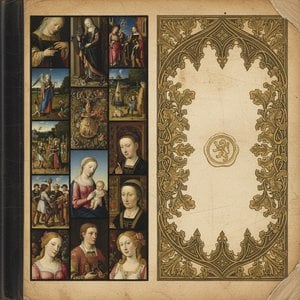
The Dawn of Netherlandish Mastery
In the twilight of the fourteenth century, a transformative energy began to pulse through the workshops of Flanders, signaling the end of the medieval era and the slow, luminous birth of the Northern Renaissance. At the heart of this artistic metamorphosis stood Melchior Broederlam, a painter whose name serves as a bridge between the stylized elegance of the International Gothic and the profound naturalism that would later define the Early Netherlandish school. Born in the historic city of Ypres around 1350, Broederlam emerged not merely as a craftsman, but as a visionary who dared to infuse the sacred subjects of his age with an unprecedented sense of depth, atmosphere, and light.
Though much of his personal history remains shrouded in the mists of time, the traces of his journey are etched into the very fabric of his surviving masterpieces. It is believed that Broederlam’s formative years were shaped by a profound immersion in the artistic currents of Italy. By studying the Trecento masters—the pioneers of the Italian proto-Renaissance like Giotto—he absorbed the revolutionary concepts of spatial modeling and emotional weight. This exposure to the Florentine and Sienese traditions allowed him to bring a unique, rhythmic vitality back to the North, where he would blend the delicate, decorative grace of Gothic art with a burgeoning interest in the physical reality of the natural world.
A Courtly Legacy in Burgundy
Broederlam’s ascent was inextricably linked to the opulence and political might of the Burgundian Court. As the favored painter to powerful patrons such as Louis de Mâle, Count of Flanders, and later the formidable Philip the Bold, Duke of Burgundy, his work became a visual manifestation of ducal prestige. The court at Dijon was a crucible of talent, attracting the finest goldsmiths, sculptors, and painters of Europe, and within this vibrant atmosphere, Broederlam refined a style that was both regal and deeply spiritual.
His most enduring contribution to the history of Western art is found in the monumental Dijon Altarpiece. This breathtaking pair of panels, commissioned for the prestigious Charterhouse of Champmol, showcases his ability to command the viewer's gaze through a sophisticated use of chiaroscuro and landscape. In these works, one does not merely see religious figures; one witnesses a world where the divine intersects with the earthly. Through his pioneering use of oil painting techniques, Broederlam achieved a jewel-like luminosity and a meticulous attention to detail—from the rugged textures of rocky outcrops to the soft, atmospheric haze of distant horizons—that would set the standard for generations of Flemish masters.
The Architect of a New Vision
The historical significance of Melchior Broederlam lies in his role as an innovator of perspective and technique. While he remained rooted in the symbolic language of the Gothic tradition, his experiments with atmospheric perspective—the method of making distant objects appear paler and bluer to simulate depth—marked a departure from the flattened, two-dimensional compositions of his predecessors. He was among the first to treat the landscape not merely as a decorative backdrop, but as an active, breathing participant in the narrative of the painting.
His influence can be traced through the lineage of the great Netherlandish painters, acting as a vital precursor to the technical perfection achieved by Jan van Eyck. By integrating the sculptural solidity learned from masters like Claus Sluter with the fluid grace of the International Gothic style, Broederlam helped forge a new visual vocabulary. His legacy is one of transition and triumph: he took the flickering candlelight of the Middle Ages and fanned it into the brilliant, enduring flame of the Northern Renaissance, forever altering the way humanity perceives the sacred through the lens of the natural world.
Pitanja i odgovori
Mogu li da pregledam dela umetnika Melchior Broederlam prema medijumu?
Da biste pronašli sva dela umetnika Melchior Broederlam u određenoj tehnici, posetite stranicu Svi mediji na profilu umetnika.
Gde se mogu pronaći dela umetnika Melchior Broederlam klasifikovana prema temi?
Stranica Atlas tema mapira dela umetnika Melchior Broederlam prema subjektu.
U kojim je umetničkim pravcima Melchior Broederlam stvarala/stvarao?
Umetnički pravci u kojima je Melchior Broederlam stvarao možete videti na stranici Svi umetnički pravci, koja grupiše dela prema pokretu.