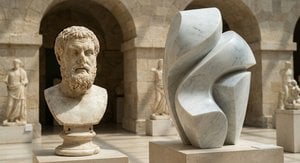
Martín Soto Climént: Minimal Gestures, Maximal Resonance
Martín Soto Climént is a Mexican conceptual sculptor born in Mexico City (1977) who has rapidly gained recognition for his distinctive approach to artmaking—a deliberate reduction of form coupled with an astute consideration of context. His work isn’t about grand statements; rather, it's rooted in subtle shifts and balances achieved through the repurposing of commonplace materials like vintage clothing and household objects, transforming them into contemplative explorations of perception and materiality.
Early Life & Artistic Formation
Soto Climént’s artistic journey began at UNAM (Universidad Nacional Autónoma de México), where he earned a Bachelor's Degree in Industrial Design in 1996. This foundational training instilled within him a meticulous attention to detail and an understanding of spatial relationships—qualities that would prove invaluable as he pursued his postgraduate studies in Visual Arts at UNAM in 2015, culminating in a Master’s degree. These formative experiences cemented his belief in the power of conceptual art to provoke dialogue and challenge conventional notions of beauty.
Distinctive Artistic Style & Recurring Themes
Soto Climént's sculptural practice is characterized by its austere elegance. He eschews elaborate ornamentation, favoring instead minimalist gestures that focus on recontextualization—bringing seemingly insignificant items into unexpected gallery spaces. This technique isn’t merely decorative; it’s a deliberate strategy to disrupt our habitual ways of seeing and interpreting the world around us. Recurring themes in his oeuvre include balance (both physical and conceptual), nostalgia for forgotten textures and forms, and an ongoing investigation into how objects communicate meaning beyond their inherent qualities. His work subtly echoes influences from artists like Diego Rivera and Thomas Cole—masters who skillfully employed symbolism to convey complex ideas within deceptively simple compositions.
Notable Exhibitions & Recognition
Soto Climént’s sculptures have garnered critical acclaim and appeared in prestigious venues internationally, including Museo Nacional de San Carlos (Mexico City), Palais de Tokyo (Paris), Museo Contemporáneo de Monterrey, Halle für Kunst (Lunenburg), Australia Centre Hong Kong and Galerie Perrotin. His pieces—such as “Todo comienza en otra parte,” “Under the immortal skin,” “ZONA MACO Sur,” “Temazcal” and “Paradise”—have been lauded for their originality and ability to elicit profound contemplation. The artist’s inclusion in Frieze Art Fair solidified his position within the contemporary art landscape, demonstrating a commitment to pushing artistic boundaries while maintaining an unwavering focus on materiality and conceptual rigor.
Contemporary Relevance & Artistic Legacy
Martín Soto Climént's contribution to contemporary sculpture lies in his ability to distill complex ideas into strikingly understated forms. He exemplifies the ethos of “less is more,” prioritizing precision and thoughtfulness over grand spectacle. By elevating everyday objects—fragments of history and memory—to the level of artistic contemplation, he invites viewers to reconsider their relationship with the familiar and to appreciate the hidden resonances within seemingly unremarkable materials. His work continues to inspire artists and curators alike, securing his place as a pivotal voice in shaping the visual culture of our time.