A Pioneer of Slovak Modernism: The Life and Legacy of Martin Benka
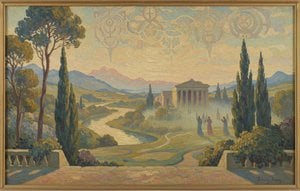
Martin Benka, born in 1888 in the small village of Kostolište (then Kiripolec) near Malacky, Slovakia, stands as a monumental figure in the development of modern Slovak painting. He wasn’t merely an artist; he was a cultural architect, deeply invested in forging a visual identity for a nation seeking to define itself. His life story is one of humble beginnings blossoming into a prolific career dedicated to capturing the essence of Slovakia – its landscapes, its people, and its spirit. Benka's early years were steeped in practicality. He began his artistic journey not with oils and canvases, but as an apprentice house painter from 1903 to 1906 in Hodonín, followed by journeyman years in Vienna until 1909. This foundational training instilled a meticulousness and understanding of materials that would later inform his work, even as he moved beyond purely decorative applications. A pivotal encounter with journalist Jan Josef Langner proved transformative; recognizing Benka’s nascent talent, Langner provided financial support enabling him to study landscape painting at the private school of Alois Kalvoda in Prague from 1909-1913. This period exposed him to Impressionistic techniques and a burgeoning appreciation for natural exuberance, setting the stage for his unique artistic voice.From Prague Studios to National Identity
Benka established himself in Prague in 1914, but the shadow of World War I led him to seek refuge with friends in Miloňovice. His first independent exhibition in Rohatec in 1915 marked a crucial step towards recognition. The interwar years saw his return to Prague and increasing involvement with the Association of Slovak Artists, founded in 1920. This period was characterized by extensive travel throughout Slovakia, a deliberate immersion into the heartland that would become the defining subject matter of his art. He wasn’t simply *depicting* landscapes; he was searching for the soul of Slovakia, seeking to distill its character onto canvas. His style evolved dramatically during this time, moving away from earlier influences towards a monumental romanticism imbued with pathos and national pride. He aimed to portray heroic Slovak peasants set against dramatic mountain backdrops, fostering a sense of collective identity and self-confidence in a newly formed nation. Key works like *Sokol Reunion* (1926) and the *Motif from Ružomberok* series (1925–1928) exemplify this period – powerful depictions of communal life and the rugged beauty of the Orava region, landscapes he first explored in 1913.A Multifaceted Artist: Beyond Painting
While celebrated as a painter, Benka’s artistic reach extended far beyond the canvas. He was a true polymath – an illustrator, graphic artist, art teacher, and even a skilled craftsman. From 1940 to 1941, he served as Professor of drawing and painting at the Slovak University of Technology in Bratislava, playing a vital role in establishing formal art education within the country. His commitment to design was equally significant. He co-founded the conservative artistic group Trojštít in Martin in 1942 and created between forty and sixty different fonts, blending folk art elements with his love for nature. This dedication to typography reflects a holistic approach to visual culture, believing that every aspect of the environment should be aesthetically considered. Remarkably, he also designed book illustrations, stamps, exlibris, sgraffito, banknotes, and even constructed thirteen unique “cubist” violins inspired by Slovak folk ornaments – each instrument a testament to his boundless creativity.Legacy and Recognition: A National Treasure
Benka’s contributions were formally recognized in 1953 when he was bestowed with the title of "National Artist" by Czechoslovakia. In 1958, he received a country home, studio, and gallery near Martin, provided at state expense – a tangible acknowledgement of his importance to Slovak culture. His autobiography, *Za umením* (For Art), published in the same year, offered valuable insights into his artistic philosophy and life experiences. He bequeathed over 5,200 works of art, correspondence, and his personal library to the state upon his death in 1971, with the stipulation that his studio house be transformed into a museum – now known as The Martin Benka Museum. His participation in international exhibitions, including multiple appearances at the Venice Biennale (1926, 1934, 1942, 1954) and a silver medal at the 1937 Paris World's Fair for *Landscape near Terchová*, brought his work to a global audience. Benka’s enduring legacy lies not only in the beauty of his paintings but also in his unwavering dedication to capturing and celebrating the unique spirit of Slovakia, solidifying his position as the founder of Modernist 20th-century Slovak painting and a true national treasure. He sought to synthesize people and mountains, believing that music – particularly Beethoven and Mozart – resonated with the vastness of the land and the power of its inhabitants.Pitanja i odgovori
Gde je i kada je rođen/a Martin Benka?
Martin Benka je rođen/a u gradu Košice godine 1888.
Otkud je Martin Benka?
Martin Benka je rođen/a u Slovakia.
Mogu li da istražim dela umetnika Martin Benka prema kolorističkom spektru?
Radove umetnika Martin Benka možete istražiti prema boji na njegovoj stranici Spektralni indeks.