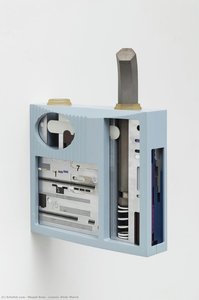
A Sculptor of Transformed Realities: The World of Magali Reus
Magali Reus, born in 1981 in the Hague, Netherlands, is a contemporary sculptor whose work resonates with a quiet power—a subtle disruption of the everyday. Living and working in London, she has carved out a distinctive space for herself within the art world by transforming familiar objects into enigmatic forms that challenge our perceptions of function, materiality, and meaning. Reus doesn’t simply *create* sculptures; she orchestrates encounters with things we think we know, stripping them of their assumed roles and presenting them anew, imbued with a strange, compelling presence. Her practice is rooted in a deep material intelligence, a sensuous understanding of how substances interact and communicate, coupled with a precise compositional grammar that lends her work an air of both rigor and grace.
Early Development & Influences
Reus’s artistic journey wasn't one of immediate declaration but rather a gradual unfolding. She avoids pinpointing singular influences, instead describing her process as a continuous accumulation of observations—a gathering of images, textures, and objects encountered in the world around her. This inherent curiosity is palpable in her work; it’s a refusal to accept surfaces at face value, an insistence on probing beneath the veneer of utility. While she doesn't employ readymade objects directly, each element within her sculptural assemblages is meticulously fabricated, often through a blend of industrial and traditional craft techniques. This deliberate choice—to *make* rather than simply *find*—is crucial to understanding her approach. It allows for a level of control over texture, color, and form that transcends mere appropriation, enabling her to imbue each piece with a unique character. The tension between the slick precision of manufacturing processes and the slow, deliberate labor of handiwork is a recurring theme in her oeuvre, creating a dynamic interplay between the mechanical and the human touch.
Themes & Techniques: A Language of Disruption
At the heart of Reus’s work lies an exploration of systems—systems of production, circulation, and meaning. She often focuses on vessels or receivers of useful action, objects designed for a specific purpose, then subtly alters them, stripping away their functionality to reveal something else entirely. This act of transformation isn't about destruction but rather about liberation; it’s about allowing these objects to shed their prescribed roles and enact a different kind of image. Her sculptures frequently appear frozen in transition—caught mid-function, undergoing restoration, or succumbing to ruin. This sense of ambiguity is deliberate, inviting viewers to project their own interpretations onto the work. Reus masterfully employs repetition and layering, creating visual rhythms that echo the patterns found in industrial processes and natural systems. The inclusion of typefaces and artists’ books further expands her repertoire, connecting her sculptural forms to a larger network of symbols and ideas. Her recent works demonstrate a deepening interest in ecology and the tensions between constructed nature, high technology, and the impact of human activity on the environment.
Major Achievements & Recognition
Reus’s career has been marked by a steady ascent, punctuated by significant solo exhibitions at prestigious institutions including the South London Gallery, Bergen Kunsthall in Norway, and the Museum Beelden Aan Zee in The Hague. Her first major UK museum solo exhibition, *Particle of Inch* at The Hepworth Wakefield in 2015, established her as a compelling voice within contemporary sculpture. She has also participated in numerous group exhibitions internationally, showcasing her work alongside other leading artists. In 2015, she was awarded the prestigious Prix de Rome, and in 2018, she was nominated for The Hepworth Prize for Sculpture—further solidifying her reputation as a significant figure in the field. Her participation in FRONT International: Cleveland Triennial for Contemporary Art in 2022 brought her work to a wider audience, highlighting her ability to engage with complex themes of environmental consciousness and interspecies communication.
Historical Significance & Ongoing Dialogue
Magali Reus’s contribution to contemporary art lies not in offering definitive answers but rather in posing compelling questions—questions about the nature of objects, the systems that govern our lives, and our relationship with the material world. Her work resonates with a broader dialogue surrounding post-object art, challenging traditional notions of authorship and originality. By meticulously crafting each element of her sculptures, she asserts a level of control over form and meaning that distinguishes her from artists who rely on appropriation or readymade objects. She is not simply commenting on the world; she is actively intervening in it, reshaping our perceptions through subtle yet powerful acts of transformation. Her ongoing exploration of materiality, repetition, and ambiguity continues to inspire and provoke, establishing her as a vital voice within contemporary sculpture and beyond.
Autor: Uredništvo WahooArt.com
Kviz o umetnosti
Svako pitanje ima samo jedan tačan odgovor.
Pitanje 1:
Where was Magali Reus born?
Pitanje 2:
What is a prominent theme explored in Magali Reus's sculptural work?
Pitanje 3:
Which of the following institutions has exhibited Magali Reus’s work?
Pitanje 4:
In her recent works, Reus demonstrates an increased interest in:
Pitanje 5:
Magali Reus was awarded the Arnaldo Pomodoro Sculpture Prize in which year?
Master the nuances of three-dimensional art with our expert guide. Explore sculptural history, from Phidias to Neoclassicism, and learn to evaluate materiality, form, and technique like a true connoisseur. Elevate your collection with profound insights into the world of sculpture.