Early Life, Family and Training
Ludwig Dill was born on February 2, 1848, in Gernsbach, Germany. He was the only son of the Tax Assessor for the Grand Duchy of Baden. His early years involved several moves as the family relocated, eventually settling in Stuttgart in 1862. This period of transition shaped the environment in which he began to develop his interests.
In 1872, he began studying architecture at the Polytechnic Institute in Stuttgart. This technical foundation provided a structured approach to form and space. However, his focus shifted toward the canvas. By 1874, he moved to the Academy of Fine Arts in Munich to pursue painting more seriously. He studied under Karl Theodor von Piloty and Otto Seitz, absorbing the methods of these instructors as he moved away from architectural drafting and toward the study of light and landscape.
Artistic Style and Venetian Influence
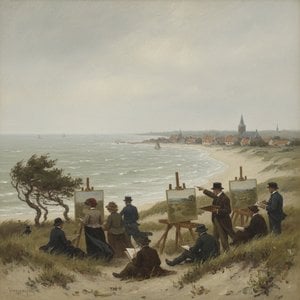
The way Dill approached a canvas often began with the influence of Adolf Heinrich Lier. He looked closely at how Lier handled landscapes, adopting a way of seeing that favored the way light settles over a scene. This focus on the atmosphere of a place led him toward the waters of Venice. He spent much of his time in Chioggia, watching the way the lagoon interacted with the light. His paintings from this period focus on the shifting colors of the water and the quiet presence of ships. He was a landscape and ship painter who sought to capture these fleeting moments through an impressionistic lens.
As his work progressed, the loose, light-filled brushstrokes of his earlier years began to settle into something more structured. This shift moved his style toward an ornamental stylization, where the natural forms of the landscape began to take on the flowing, decorative qualities of Art Nouveau. He was not merely recording a view; he was organizing it into patterns. This evolution in his technique coincided with his growing leadership in the Munich Secession, where he served as President from 1894 to 1899. His position in this movement reflected his commitment to moving away from rigid academic traditions in favor of a more expressive, modern approach to composition.
The New Dachau Artists' Colony
The landscape around Dachau held a specific pull for Dill. He was drawn to the way the terrain unfolded through its many moors and winding watercourses. In 1896, he bought a small house there, a place that would become a steady part of his life. He spent his summers in this area, working amidst the damp earth and the shifting light of the marshes.
This connection to the local terrain led to a shared creative space. Alongside Adolf Hölzel and Arthur Langhammer, Dill established a group known as "New Dachau." This was a place for experimentation, where the focus shifted toward more ornamental styles. The quiet, watery surroundings of the colony provided the backdrop for these evolving visual ideas.
Teaching and Later Life
In 1899, Dill moved into a teaching role at the Academy of Fine Arts in Karlsruhe. He stayed at the Academy for two decades, remaining there until 1919. During these years, his personal life underwent a quiet transition. After the death of his first wife in 1905, he married the painter Johanna Malburg four years later.
His connection to the landscape of Dachau remained a constant throughout his later years. The town recognized his presence and his contributions to the local artistic community by naming a street after him. In 1936, he was named an honorary citizen of Dachau. He spent his final years in Karlsruhe, where he died on October 24, 1940.
Notable Works and Collections
Dill’s canvases are held in several significant institutions, reflecting his long-standing presence in German art collections. The Bavarian State Painting Collections in Munich house several of his pieces, including Ponte San Andrea in Chioggia from 1893 and Winter Gardens from about 1930. His interest in the water and light of the Venetian lagoons is also represented by Sailboat and Fishing Boat at Chioggia, both held in the Munich collection.
Other works find their place in specialized galleries across Europe. The Staatliche Kunsthalle Karlsruhe in Carlsruhe contains Flooded Willow Fields in the Po Plain from 1900 and a Dutch Dune Landscape. In Munich, the Lenbachhaus holds In the White Moor, a work from 1915. Meanwhile, the Regional Gallery in Liberec in Liberice preserves The flooding.
His output also includes studies of maritime life and landscape, such as Fishing in the Lagoon and Fishing in the Venetian Lagoon. These works, along with Dutch Canal from 1880, show the steady development of his eye for atmospheric detail. His paintings of ships and boats, like Fishing Boats, continue to be part of the records of the Bavarian State Painting Collections.
Pitanja i odgovori
Postoji li hronološki pregled radova umetnika Ludwig Dill?
Karijera umetnika Ludwig Dill razvija se period po period na stranici Hronika: kroz horizontalnu vremensku liniju dela, grupisanih u poglavlja prema periodima stvaranja.
U kom gradu i državi je rođen/a Ludwig Dill?
Ludwig Dill je rođen/a u gradu Gernsbach, u državi Germany.
Pod kojim drugim imenima ili pseudonimima je poznat/a Ludwig Dill?
Ludwig Dill je poznat/a i pod imenom Ludwig Karl Frank Wilhelm Dill, Dill L., Prof. L. Dill, Professor Ludwig Dill, Lucwig [Ludwig] Dill.