A Renaissance Polymath: The Dual Legacy of Loyset Liédet
In the vibrant, intellectual tapestry of the fifteenth century, few figures embody the intersection of visual splendor and auditory harmony as profoundly as Loyset Liédet. A man whose life spanned the transformative era between the late Middle Ages and the burgeoning Renaissance, Liédet occupied a unique position in European culture. While history often struggles to categorize him—alternately labeling him a Flemish miniaturist, a French illuminator, or a master of polyphonic music—it is precisely this duality that defines his greatness. Born around 1420 in Hesdin, a region of Artois known for its industrious spirit, Liédet’s journey took him from the quiet scriptoria of France to the bustling, prestigious artistic hubs of Bruges, leaving behind a legacy that resonates through both the silent beauty of illuminated manuscripts and the complex melodies of Renaissance motets.
Liédat's early years were marked by a burgeoning mastery of the delicate art of illumination. Working initially in Hesdin, his early output reveals an artist deeply engaged with the prestigious commissions of the House of Valois-Burgundy. Between 1454 and 1460, he demonstrated his capacity for large-scale narrative work, producing dozens of intricate thumbnails for La Fleur des Histoires by Jean Mansel, a project commissioned by the formidable Philip the Good. During this formative period, Liédet’s hand was heavily influenced by the celebrated French illuminator Simon Marmion. This influence is visible in his early ability to capture light and form, yet even then, a distinct personality began to emerge—one characterized by an emerging boldness that would later define his mature style.
The Splendor of the Burgundian Court
As Liédet’s reputation grew, so did the scale of his ambitions. By 1468, he had migrated to Bruges, a cosmopolitan center of trade and art, where he officially joined the Guild of Saint Luke in 1469. It was here, under the patronage of the most powerful figures of the age, that his artistry reached its zenith. Liédet became a vital figure in the Burgundian court, working extensively for Charles the Bold. The sheer volume of his productivity during this time is staggering; historical records suggest that in a mere two-year span around 1470, he produced over 400 miniatures for the Duke. His mature aesthetic moved away from the subtle softness of his youth toward a more striking, almost theatrical palette. His works from this period are noted for their:
- Vibrant Color Palettes: The use of bright, occasionally gaunty colors that commanded attention on the parchment.
- Structural Form: Figures characterized by stiff-limbed elegance and heavily shaded faces, creating a sense of sculptural presence.
- Intricate Ornamentation: A meticulous approach to gilding and pigment preparation that elevated religious texts into precious objects of devotion.
This period of intense productivity solidified his status as one of the last great masters of the generation of Flemish illuminators who worked almost exclusively on commission for the nobility. His workshop, which likely operated on a significant scale, functioned as a crucible of Renaissance innovation, blending the traditional Gothic reverence for detail with the new, more humanistic focus on form and light.
A Symphony of Lines: The Musical Dimension
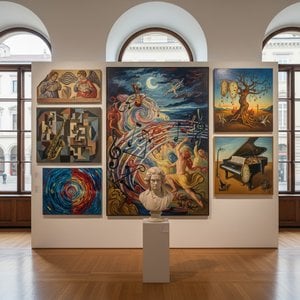
Yet, to view Loyset Liédet solely through the lens of the visual arts would be to ignore half of his soul. Parallel to his work with gold leaf and tempera was a profound devotion to the burgeoning tradition of polyphony. As a composer, Liédet was a pioneer of the early Renaissance vocal style, moving beyond the monophonic simplicity of Gregorian chant into the complex, interwoven textures of motets and madrigals. His musical compositions mirror his visual work: just as he layered colors and gold to create depth on a page, he layered melodic lines to create harmonic richness in sound.
His musical legacy is defined by a sophisticated understanding of counterpoint, where multiple independent melodies move in a carefully choreographed dance. This mastery of polyphony reflects the broader cultural shift of his era—a movement toward complexity, human expression, and the celebration of intricate structure. Whether through the silent, shimmering pages of the Codex Amiotanus or the resonant echoes of his vocal works, Liédet’s contribution to the Renaissance was a singular achievement in capturing the divine through both sight and sound.