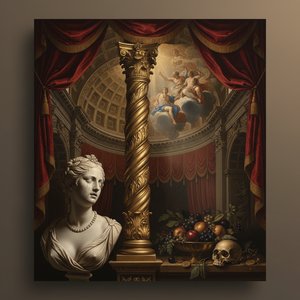
Lorenzo Ayli: The Baroque Sculptor of Emotion
Born in Reggio Emilia, Italy, around 1657, Lorenzo Ayli emerged as a significant figure within the vibrant artistic landscape of the late Baroque period. His life unfolded against a backdrop of intense religious fervor and burgeoning artistic innovation, shaping his distinctive style and leaving behind a legacy primarily defined by emotionally charged wooden sculptures, particularly those depicting scenes from the Bible and classical mythology. While overshadowed by some of his contemporaries during his lifetime, Ayli’s work has since been recognized for its profound sensitivity and masterful execution, revealing a sculptor deeply attuned to human experience.
Ayli's early artistic training remains somewhat shrouded in mystery, though it is believed he apprenticed under prominent sculptors in Parma, the city where he ultimately established his career. This formative period undoubtedly instilled within him a deep understanding of classical techniques and a reverence for the traditions of Italian sculpture. However, Ayli quickly developed a unique voice, characterized by an expressive dynamism rarely seen in his peers. He wasn’t merely replicating existing forms; he was imbuing them with palpable emotion – sorrow, joy, faith, doubt – capturing fleeting moments of human drama with remarkable precision.
Ayli's most celebrated work is arguably the “Madonna Addolorata” (Our Lady of Sorrows), a breathtakingly realistic depiction housed within the chapel to the left of the main altar in San Giacomo, Soragna. This sculpture exemplifies Ayli’s signature style: a deeply sorrowful Virgin Mary cradling the lifeless body of Christ. The folds of her garments are rendered with exquisite detail, conveying both vulnerability and strength. Her face is etched with grief, yet there's also an underlying sense of acceptance and profound love. The level of realism achieved – the texture of skin, the subtle nuances of expression – was revolutionary for its time, demonstrating Ayli’s exceptional skill in capturing the human form.
Beyond this iconic piece, Ayli produced a diverse range of works, including intricate relief sculptures and detailed carvings. He frequently employed wood as his primary medium, skillfully manipulating its grain and texture to achieve desired effects. His subjects spanned religious narratives – scenes from the life of Christ, depictions of saints, and allegorical representations of virtue and vice – alongside classical mythological figures. His ability to seamlessly blend Baroque dynamism with classical ideals is a testament to his artistic versatility.
The Influence of Parma and the Baroque Tradition
Ayli’s time in Parma proved crucial to the development of his artistic style. The city was a major center for Baroque art, boasting renowned sculptors like Giambologna and Bernini, whose works profoundly influenced the local artistic community. Ayli undoubtedly absorbed elements of this influential tradition – the dramatic lighting, the dynamic poses, the emphasis on emotional expression – but he skillfully integrated them into his own unique vision.
The Baroque period itself was characterized by a shift away from the more restrained aesthetics of the Renaissance. Artists were encouraged to embrace theatricality and emotion, seeking to evoke powerful responses in their viewers. Ayli perfectly embodies this spirit, utilizing dramatic compositions, rich colors (achieved through gilding and paint), and expressive gestures to create works that are both visually stunning and emotionally resonant.
Furthermore, the religious fervor of the era played a significant role in shaping Ayli’s artistic output. The Counter-Reformation demanded art that would inspire piety and reinforce Catholic doctrine. Ayli's sculptures, particularly those depicting scenes from the Bible, served as powerful visual narratives, conveying moral lessons and reinforcing faith.
Technique and Materials
Lorenzo Ayli’s mastery of wood carving was exceptional. He possessed an intimate understanding of the material’s properties – its grain, density, and ability to be shaped and polished. He skillfully exploited these qualities to create sculptures that were both structurally sound and aesthetically pleasing.
Ayli primarily worked with locally sourced hardwoods, carefully selecting pieces based on their suitability for his intended designs. He employed a variety of carving tools – chisels, gouges, knives – with precision and artistry. His attention to detail was remarkable, evident in the intricate folds of clothing, the delicate rendering of facial features, and the subtle nuances of expression.
Crucially, Ayli frequently utilized gilding and paint to enhance the visual impact of his sculptures. Gold leaf was applied to highlight certain areas – draperies, halos, or decorative elements – adding a sense of opulence and grandeur. Paint was used to create color variations and simulate textures, further enriching the sculptural surfaces.
Legacy and Historical Significance
Despite not achieving widespread fame during his lifetime, Lorenzo Ayli’s work has experienced a resurgence in appreciation in recent decades. His sculptures are now recognized as significant examples of Baroque art, showcasing a rare combination of technical skill, emotional depth, and artistic innovation.
Ayli's influence can be seen in the works of subsequent generations of Italian sculptors. His emphasis on expressive realism paved the way for later artists who sought to capture the complexities of human emotion through their art. His “Madonna Addolorata,” in particular, remains a powerful and moving testament to his artistic vision.
Today, Lorenzo Ayli’s sculptures are housed in museums and churches throughout Italy, offering viewers a glimpse into the soul of a remarkable artist who dedicated his life to capturing the beauty and sorrow of the human experience. His legacy continues to inspire artists and art lovers alike, reminding us of the enduring power of sculpture to evoke emotion and transport us to another time.