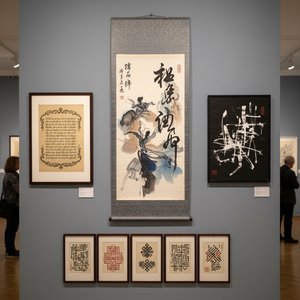
A Poet's Brushstroke: The Soul of Karasumaru Mitsuhiro
In the delicate intersection of political power and spiritual seeking, the life of Karasumaru Mitsuhiro (1579–1638) emerges as a luminous chapter in the early Edo period. Born into the refined atmosphere of Kyoto, Mitsuhiro was far more than a mere courtier; he was a master of the written word and a conduit for Zen philosophy. His existence was defined by a profound duality—navigating the high-stakes intrigues of the Japanese imperial court while simultaneously pursuing the quiet, internal landscapes of enlightenment. As a poet, calligrapher, and artist, his work serves as a bridge between the aristocratic elegance of the Heian tradition and the burgeoning spiritual vigor of the Tokugawa era.
Mitsuhiro’s early years were steeped in the rigorous aesthetic training required of the Kyoto nobility. He became a prominent figure within the circle of Emperor Go-Mizunō, an era where art was not merely decoration but a vital expression of political and spiritual legitimacy. Under the guidance of masters such as Hon’ami Kōetsu, Mitsuhiro helped spearhead a revival of classical aesthetics. This movement sought to breathe new life into the ancient Heian-period styles, blending them with a contemporary sensitivity. His calligraphy was characterized by an exquisite use of gold and silver ink upon color-dyed paper, creating a shimmering, tactile experience that mirrored the ephemeral beauty of the natural world.
The Zen Path in Ink and Verse
The true essence of Mitsuhiro’s artistry lies in his ability to translate complex Zen Buddhist parables into accessible, emotive visual poetry. His most enduring legacy is perhaps found in his interpretation of the Ten Oxherding Songs. Through these ten waka poems—short, thirty-one syllable verses—he meticulously charted the arduous journey of the soul. Each poem acts as a milestone in the seeker's progress, moving from the initial, frantic search for truth to the eventual, silent realization of oneness with the universe. In his hands, the calligraphy does not merely sit upon the page; it breathes with the rhythm of the spiritual struggle, using subtle variations in line weight and ink density to evoke the very emotions described in his verse.
This mastery of symbolism extended beyond mere text. Mitsuhiro possessed a rare talent for personalizing classical themes, subtly altering traditional wording and imagery to reflect his own philosophical insights. His work often utilized:
- Decorative Paper: The use of richly ornamented, color-dyed substrates that provided a vibrant stage for his ink.
- Metallic Accents: The strategic application of gold and silver leaf to signify the divine or the transcendent.
- Literary Allusion: A sophisticated layering of references to classical Japanese literature, creating a dialogue between the past and his present moment.
Legacy of a Courtly Visionary
Despite the political turbulence that marked his life—including periods of dismissal and reinstatement following the scandalous Inokuma Incident—Mitsuhiro’s artistic output remained a constant beacon of refinement. He functioned as a vital cultural emissary between the imperial court in Kyoto and the rising shogunate in Edo, ensuring that the sophisticated aesthetic values of the old aristocracy were woven into the fabric of the new era. His involvement in monumental projects, such as the construction of the Tōshogu Shrine at Nikko, further demonstrates his role as a custodian of Japan's spiritual and architectural grandeur.
Today, the works of Karasumaru Mitsuhiro, held in prestigious collections from the Metropolitan Museum of Art to the Harvard Art Museums, continue to captivate the modern observer. They offer more than just historical interest; they provide a meditative window into a time when art was a sacred pursuit. To encounter his calligraphy is to witness a moment of stillness captured in ink—a testament to a man who found, amidst the shifting tides of political fortune, an unshakeable harmony through the brush and the poem.
Pitanja i odgovori
U kom istorijskom periodu je stvarao/la Karasumaru Mitsuhiro?
Karasumaru Mitsuhiro je radila u periodu Early Modern. Ovaj period smešta umetnikov rad u istorijski kontekst.
Gde se mogu pronaći dela umetnika Karasumaru Mitsuhiro grupisanom prema umetničkim pravcima?
Umetnički pravci u kojima je Karasumaru Mitsuhiro stvarao možete videti na stranici Svi umetnički pravci, koja grupiše dela prema pokretu.
Kako da pronađem dela umetnika Karasumaru Mitsuhiro na određenu temu?
Stranica Preko ključnih reči umetnika Karasumaru Mitsuhiro grupiše njegova dela prema ključnim rečima.