The Enigmatic Bridge: Exploring the Art and Life of Joseph Bridge
Joseph Bridge (1845-1894) remains a quietly compelling figure in Victorian portraiture, an artist whose meticulous skill and subtle psychological insight produced works that continue to resonate with a quiet intensity. Born in Hanwood, Shropshire, into a family rooted in the burgeoning industrial landscape of England, Bridge’s artistic journey was shaped by both familial influences and a keen observation of the changing world around him. While not commanding the immediate fame of his contemporaries – figures like Alma-Tadema or William Bouguereau – Bridge carved out a distinctive niche through his evocative depictions of historical subjects, particularly aristocratic figures, imbued with a sense of dignified restraint.
Bridge’s early life provided a foundation for his artistic pursuits. His father, Joseph Bridge, was a shopkeeper and innkeeper, fostering an appreciation for detail and the rhythms of daily life. The family's location in Shropshire, a region steeped in history and folklore, undoubtedly contributed to his interest in portraying figures from the past. His formal training remains somewhat elusive; records suggest he may have studied briefly at the Royal Academy Schools, though much of his artistic development appears to have been self-directed, honed through diligent practice and an unwavering commitment to capturing the essence of his subjects.
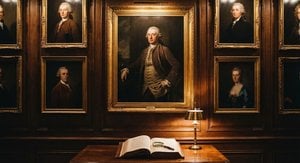
A pivotal moment in Bridge’s career arrived with a commission from Sir Baldwin Leighton, the 3rd Earl of Powis. This portrait, completed around 1883 (and now housed at the Fitzwilliam Museum), stands as arguably his most celebrated work. It exemplifies Bridge's signature style: a carefully constructed composition, rendered in meticulous detail, that captures not merely physical likeness but also an underlying sense of character and bearing. The Earl’s gaze is direct yet contemplative, his posture conveying both authority and a hint of melancholy – qualities Bridge masterfully translated onto canvas through subtle shifts in tone and the precise placement of features.
Beyond the Leighton portrait, Bridge produced a significant body of work encompassing a diverse range of historical subjects. He frequently depicted members of the landed gentry, capturing their formal attire and aristocratic bearing with remarkable accuracy. His portraits of Edward, Third Earl of Powis, and other prominent figures demonstrate his ability to convey status and personality through nuanced observation and skillful brushwork. Interestingly, Bridge’s artistic output also included a fascination with Egyptian themes, evident in several works that showcase his knowledge of ancient art and architecture. These pieces reveal a broader intellectual curiosity alongside his portraiture practice.
Bridge's technique is characterized by a restrained palette and a meticulous attention to detail. He favored a smooth, polished surface achieved through layering thin glazes of oil paint – a method that allowed him to build up complex tonal values and create a sense of depth and luminosity. His compositions are typically balanced and symmetrical, reflecting the formal conventions of Victorian portraiture. However, Bridge subtly deviates from these norms by incorporating elements of realism and psychological insight into his depictions, imbuing his subjects with a quiet dignity and emotional resonance.
Despite his evident talent and consistent output, Bridge’s career was marked by relative obscurity. The prevailing artistic tastes of the late 19th century favored more flamboyant and expressive styles, leaving little room for Bridge's quietly assured approach. His work remained largely confined to private collections and provincial galleries until relatively recently, when renewed interest in Victorian art has brought his portraits to wider attention. Today, Joseph Bridge is recognized as a significant, if understated, figure in the history of British portraiture – an artist whose meticulous skill and subtle psychological insight continue to captivate viewers with their quiet beauty and enduring appeal.
The Influence of Context: Industrial England and Victorian Portraiture
To fully appreciate Joseph Bridge’s artistic output, it's crucial to consider the broader context in which he worked – namely, the rapidly changing landscape of industrial England during the latter half of the 19th century. The era was marked by unprecedented technological advancements, urbanization, and social upheaval, profoundly impacting every aspect of life, including art. The rise of photography presented a significant challenge to traditional portrait painters, forcing them to justify their continued relevance in an age when images could be captured with remarkable speed and accuracy.
Bridge’s decision to focus on historical subjects – figures from the past – can be interpreted as a deliberate strategy for differentiating himself from the burgeoning field of photographic portraiture. By depicting individuals who had already been immortalized in paint, he positioned his work as an act of preservation and commemoration, rather than mere imitation. Furthermore, Victorian society placed immense value on lineage and social status, and portraits served as powerful tools for asserting one’s identity and demonstrating belonging within the established order. Bridge's meticulous rendering of aristocratic attire and poses reflected this cultural emphasis.
The influence of academic art traditions is also evident in Bridge’s work. He adhered to the conventions of classical portraiture, employing techniques such as chiaroscuro (the use of strong contrasts between light and dark) to create a sense of volume and drama. However, Bridge subtly subverts these conventions by imbuing his subjects with a degree of psychological complexity – a characteristic that distinguishes his work from more formulaic depictions of the wealthy elite.
Technique and Materials: A Master of Oil Paint
Joseph Bridge’s artistic practice was deeply rooted in traditional oil painting techniques. He demonstrated a profound understanding of color theory, light, and shadow, utilizing these principles to create works of remarkable realism and atmospheric depth. His palette was generally restrained, favoring muted tones and subtle gradations of value – a deliberate choice that contributed to the quiet dignity and understated elegance of his portraits.
Bridge’s technique involved layering thin glazes of oil paint upon one another, building up complex tonal values and creating a smooth, polished surface. This method allowed him to achieve remarkable detail and luminosity, capturing the subtle nuances of skin texture, fabric folds, and reflective surfaces. He was particularly adept at rendering fabrics – meticulously depicting the weave, drape, and sheen of luxurious materials such as velvet, silk, and lace.
The artist’s studio likely contained a range of pigments, including those derived from natural sources (such as ochre, umber, and sienna) and synthetic dyes. He would have employed brushes of varying sizes and shapes to apply his paint with precision and control. Bridge's meticulous approach suggests a dedication to craft and a deep appreciation for the transformative power of oil paint – a medium that allowed him to translate his observations into enduring works of art.
Legacy and Recognition: Rediscovering a Victorian Master
Despite enjoying limited recognition during his lifetime, Joseph Bridge’s work has experienced a resurgence in popularity in recent decades. Renewed interest in Victorian art, fueled by scholarly research and museum exhibitions, has brought his portraits to the attention of a wider audience.
The Fitzwilliam Museum in Cambridge holds several significant examples of Bridge's oeuvre, including the celebrated portrait of Sir Baldwin Leighton. These works are now widely exhibited and studied, contributing to a growing appreciation for Bridge’s artistic skill and psychological insight. Furthermore, his portraits have been featured in numerous publications and online resources, helping to disseminate knowledge of his work beyond academic circles.
Contemporary art historians increasingly recognize Joseph Bridge as a significant figure in the history of British portraiture – an artist who quietly challenged the conventions of his time while producing works of enduring beauty and emotional resonance. His meticulous technique, subtle psychological insight, and understated elegance continue to captivate viewers with their quiet dignity and timeless appeal. As research into his life and work continues, Joseph Bridge’s legacy as a master portraitist is sure to grow.