Early Life and Artistic Beginnings
John Milne Donald, born in the small coastal town of Nairn in 1819, emerged from a Scotland steeped in romantic ideals and a burgeoning appreciation for its own wild beauty. While details surrounding his formal artistic training remain somewhat elusive—a common fate for artists operating outside the established academic circles of the time—his early inclinations clearly pointed towards landscape painting. He spent formative years in Glasgow, initially apprenticed to a house-painter, a practical trade that nonetheless provided him with foundational skills in handling materials and observing light and shadow. This apprenticeship was coupled with diligent study at the Dilettanti Society, where he honed his abilities by copying masterworks, laying the groundwork for his own distinctive style.
A brief sojourn to Paris followed around 1840, during which Donald worked as a picture restorer at the Louvre. This experience undoubtedly exposed him to a wider range of European art and techniques, though it was upon his return to Britain that he truly began to forge his own path. He initially found employment in London, but the pull of the Scottish Highlands—and the landscapes of his youth—would prove irresistible.
The Highland Vision: A Developing Style
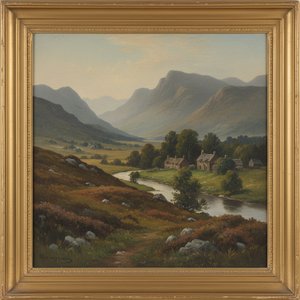
Donald’s artistic identity became inextricably linked with the depiction of Scotland's rugged terrain and rural life. Unlike some contemporaries who sought to impose grand, dramatic compositions onto nature, Donald’s approach was characterized by a quiet intimacy and meticulous observation. He wasn’t interested in portraying idealized vistas but rather in capturing the subtle nuances of light, atmosphere, and the everyday rhythms of Highland existence. His paintings often feature cattle grazing peacefully in verdant pastures, figures traversing rustic bridges, or tranquil canal scenes—subjects that resonated with a growing Victorian audience seeking solace and authenticity.
His work demonstrates an influence from artists like Sam Bough, who also focused on Scottish landscapes, but Donald developed a unique sensitivity to color and texture. He employed a warm palette, often favoring earthy tones and muted greens, which lent his paintings a sense of nostalgia and tranquility. The brushwork is generally smooth and detailed, though he wasn’t averse to using looser strokes to convey the movement of water or the density of foliage.
Themes and Techniques
Donald's canvases are imbued with a deep respect for the Scottish countryside and its inhabitants. He frequently depicted scenes from the Glenfruin area, becoming particularly known for his paintings of this evocative landscape. His work isn’t overtly political or moralizing; instead, it offers a gentle celebration of rural life and the beauty of nature.
Technically, Donald was a skilled oil painter, demonstrating proficiency in capturing atmospheric effects and rendering realistic details. He also worked in watercolor, though his oil paintings are generally considered to be his most significant achievement. His compositions often feature strong horizontal lines—the line of a riverbank, the crest of a hill—which create a sense of stability and harmony. The inclusion of figures, while not always central to the narrative, adds a human element to his landscapes, grounding them in everyday life.
Recognition and Legacy
Throughout his career, Donald exhibited at prestigious venues including the Royal Academy, the Royal Scottish Academy, and the Royal Glasgow Institute of Fine Arts. While he may not have achieved the widespread fame of some of his contemporaries, his work was well-received by critics and collectors alike. He established a reputation as a skilled and sensitive painter of Scottish landscapes, particularly admired for his ability to capture the unique atmosphere of the Highlands.
Donald’s untimely death in Glasgow in 1866 marked the end of a promising career. However, his paintings continue to be appreciated today for their quiet beauty, meticulous detail, and evocative portrayal of rural Scotland. His work offers a valuable glimpse into Victorian attitudes towards landscape and provides a lasting testament to the enduring appeal of the Scottish countryside.
Major Achievements
- Masterful Landscape Painting: Donald’s ability to capture the subtle nuances of light, atmosphere, and texture in his Highland landscapes remains highly regarded.
- Influence on Scottish Art: He exerted a substantial influence on subsequent generations of Scottish landscape painters, inspiring them to focus on their own unique environments.
- Glenfruin Series: His paintings of the Glenfruin area are particularly celebrated for their evocative portrayal of this iconic Scottish landscape.
- Exhibition Success: Regular exhibitions at prestigious art institutions, including the Royal Academy and the Royal Scottish Academy, established his reputation as a skilled artist.
Pitanja i odgovori
Gde se mogu pronaći dela umetnika John Milne Donald grupisanom prema umetničkim pravcima?
Radove umetnika John Milne Donald možete pregledati prema umetničkom pravcu na Svi umetnički pravci stranici umetnika.
Kako mogu pratiti radove umetnika John Milne Donald hronološki?
Stranica Hronologija dela umetnika prikazuje dela umetnika John Milne Donald poređana hronološki, godinu po godinu.
Mogu li da posetim virtuelni muzej dela umetnika John Milne Donald?
Moguća je i virtuelna poseta: stranica 3D galerija umetnika John Milne Donald predstavlja njegova dela u trodimenzionalnoj galeriji.