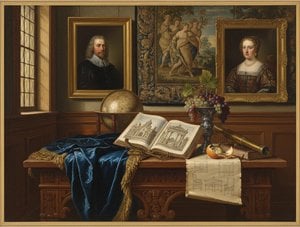
Johan de la Rocquette: A Dutch Portraitist of Refined Elegance
Johan de la Rocquette (1640 – 1694) stands as a testament to the flourishing artistic landscape of seventeenth-century Holland, specifically within the realm of portraiture. Born in Utrecht, Netherlands, his life’s trajectory unfolded against the backdrop of a period marked by scientific inquiry and burgeoning humanist ideals—influences that subtly shaped his distinctive artistic vision. While biographical details remain somewhat sparse compared to contemporaries like Rembrandt or Vermeer, available records reveal him as a diligent craftsman dedicated to capturing the essence of his subjects with meticulous precision and understated beauty.
- Early Life & Training: Precise information regarding Rocquette’s formative years is elusive. However, he apprenticed under Gerrit Dou, a prominent Leiden artist known for his masterful use of chiaroscuro—the dramatic interplay of light and shadow—a technique that would become a cornerstone of Rocquette's artistic style. This mentorship instilled in him a profound understanding of anatomical accuracy and compositional balance.
- Style & Technique: Rocquette’s oeuvre is characterized by a restrained palette, favoring muted tones and subtle gradations to create an atmosphere of serene contemplation. Unlike the flamboyant grandeur favored by some Baroque artists, his canvases convey a sense of quiet dignity and psychological depth. He skillfully employed chiaroscuro—inherited from Dou—to sculpt forms with light, emphasizing texture and conveying nuanced emotions through facial expressions and posture.
- Notable Works: Rocquette’s artistic legacy rests primarily on a handful of portraits that exemplify his stylistic prowess. “Portrait of Philippus Baldaeus and Gerrit Mossopotam,” executed in 1668, exemplifies his meticulous attention to detail and masterful rendering of drapery—a hallmark of Leiden portraiture at the time. The painting showcases Baldaeus’s dignified countenance and Mossopotam's contemplative gaze, bathed in soft light that illuminates their features with remarkable subtlety.
- Influence & Legacy: Rocquette’s work aligns closely with the Leiden School’s artistic ethos—a movement dedicated to naturalism and psychological realism. He contributed to a broader tradition of Dutch portraiture that prioritized capturing inner character alongside external appearance, reflecting the humanist values prevalent in the era. Though not as widely celebrated as some of his peers, Rocquette's paintings continue to resonate with viewers today due to their understated elegance and profound sensitivity to human emotion.
- Later Life & Death: Information about Rocquette’s later life is scarce. He remained active as an artist until his death in 1694, continuing to produce portraits that upheld the standards of Leiden artistic excellence. His contribution to Dutch art history resides not merely in individual paintings but in embodying a particular aesthetic sensibility—one rooted in observation, restraint, and a deep appreciation for human dignity.
Further Research: Ongoing scholarly efforts aim to illuminate Rocquette’s life and artistic output, bolstering our understanding of this significant figure within the Dutch Golden Age.