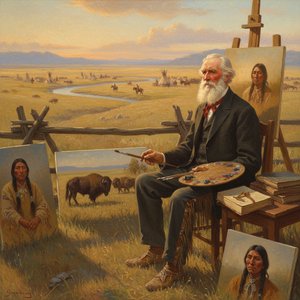
Jesse Walter Fewkes (1850 – 1930): Pioneer of Southwestern Archaeology and Ethnographic Photography
Jesse Walter Fewkes stands as a pivotal figure in the early development of American anthropology and archaeology, particularly concerning Native American cultures of the Southwest. Born in Newton, Massachusetts, in 1850, he embarked on a remarkable career marked by meticulous fieldwork, groundbreaking scientific observations, and contributions to visual documentation – notably through pioneering use of photography.
- Early Life & Education: Fewkes’s initial fascination with zoology at Harvard University laid the foundation for his broader intellectual pursuits. He pursued doctoral studies in marine zoology before shifting his focus to ethnological research, driven by a desire to understand and document the traditions of indigenous peoples inhabiting the American Southwest.
- Marriage & Family: Fewkes married Florence Gorges Eastman in 1883, forming a partnership that would endure until her untimely death in 1888. Subsequently, he wed Harriet Olivia Cutler in 1893, establishing a stable domestic life alongside his scientific endeavors.
- The Hemenway Expedition & Southwestern Archaeology: Fewkes’s career gained prominence with the Hemenway Southwestern Archaeological Expedition (1889), succeeding Frank Hamilton Cushing as leader. This expedition yielded invaluable insights into Zuni and Hopi culture, emphasizing meticulous observation of daily rituals and social structures. He championed a holistic approach to anthropological study, integrating ethnographic data with archaeological findings.
- Photographic Innovation: Fewkes’s commitment to recording cultural heritage extended beyond textual descriptions; he revolutionized ethnography by utilizing the nascent technology of photography. His expeditions to Puerto Rico and Haiti documented indigenous lifeways with unprecedented detail, capturing portraits and scenes that served as crucial visual records for posterity. Notably, he was among the first to employ a phonograph to record music from Native American communities, furthering understanding of their sonic traditions.
- Notable Achievements & Legacy: Fewkes conducted extensive excavations at Casa Grande Ruins National Monument in Arizona and Mesa Verde National Park in Colorado, uncovering evidence of ancient Pueblo civilizations. His meticulous documentation of these sites contributed significantly to the burgeoning field of Southwestern archaeology. Furthermore, his publications—including *Aborigines of Porto Rico and Neighboring Islands*—established him as a seminal voice in early anthropological scholarship, shaping perspectives on cultural heritage and indigenous knowledge.
Fewkes’s legacy resides not only in his scientific discoveries but also in his pioneering role as an ethnographer who harnessed the power of visual media to illuminate the complexities of Native American societies. His work continues to inspire researchers and educators alike, underscoring the importance of combining fieldwork observation with innovative methods of representation.