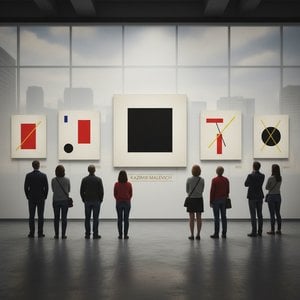
Jean Pougny: Pioneer of Suprematism and Beyond
Jean Albert Pougny (1892 – 1956) stands as a pivotal figure in Russian avant-garde art, embodying the dynamism and intellectual ferment of the early twentieth century. Born in Kuokkala, Finland—a region steeped in artistic tradition thanks to its connection with Cesare Pugni’s musical legacy—Pougny’s upbringing fostered an appreciation for creativity that would profoundly shape his artistic trajectory. His father, Albert Puni, was a cellist with the Mariinsky Orchestra, further cementing a familial commitment to artistic pursuits. From childhood, Ivan absorbed inspiration from Repin's tutelage and spent summers at Kuokkala amidst fellow artists—a formative experience that instilled in him an early fascination for landscape painting and observation of nature.
- Early Artistic Training: Pougny’s formal education began in Paris in 1909-10, where he attended the Académie Julian alongside luminaries like Matisse and Cézanne—artists whose stylistic innovations would become foundational to his own artistic explorations.
- The Suprematist Embrace (1915-1916): Pougny’s involvement with Kazimir Malevich’s Suprematism marks a watershed moment in art history. Together with fellow artists like Aleksandr Ekster, Liubov Popova and Ivan Kliun, he participated in the creation of “Tramway 5” and “0.10,” exhibitions that championed Malevich's radical geometric abstraction—a rejection of representational illusionism in favor of pure visual sensation.
- Cubist Influences (1915-1916): Simultaneously, Pougny wrestled with the complexities of Cubism, mirroring the stylistic debates prevalent at the time. He sought to synthesize disparate influences, demonstrating a remarkable adaptability within the evolving artistic landscape.
Collaboration and Artistic Output: From Verbovka Village Centre to Parisian Recognition
Pougny’s artistic endeavors extended beyond theoretical exploration; he actively engaged in practical projects. Notably, he collaborated with Malevich and Tatlin at Verbovka Village Folk Centre—a utopian experiment aimed at fostering communal creativity and addressing social concerns—producing works that reflected the spirit of the era. His Parisian years witnessed a shift toward Impressionistic techniques, influenced by artists like Bonnard and Vuillard, capturing fleeting moments of beauty and emotion with nuanced color palettes. He established himself as a respected illustrator for children’s books and collaborated extensively with “Niva” magazine, showcasing his versatility as an artist.
- The Parisian Atelier: Pougny's studio in Paris became a crucible of artistic innovation, attracting fellow artists and fostering intellectual discourse. He honed his craft, experimenting with diverse mediums—painting, sculpture, printmaking—and refining his distinctive visual language.
- Marriage and Family Life: Alongside his artistic pursuits, Pougny cultivated a fulfilling family life with Ksenia Boguslavskaya, raising children in Paris and nurturing an environment conducive to creativity and intellectual curiosity.
Legacy and Influence
Jean Pougny’s contribution to Russian art transcends mere stylistic experimentation; he embodies the broader humanist impulse of the avant-garde—a desire to redefine artistic expression in response to societal transformations. His unwavering commitment to abstraction, coupled with his sensitivity to color and form, cemented his place as a seminal figure in Suprematism and influenced subsequent generations of artists. Despite facing challenges during the turbulent years of Soviet repression, Pougny’s legacy persists through his enduring artworks—testaments to an artist who dared to envision a radically new aesthetic horizon. His work continues to inspire contemplation on the relationship between art and reality, solidifying his position as one of Russia's most important artistic voices.