János Vaszary: A Life in Hungarian Impressionism
Early Life and Education
- Born: November 30, 1867, in Kápósvar, Hungary.
- Vaszary came from a prominent Catholic family; his uncle was Kolos Ferenc Vaszary, the Archbishop of Esztergom.
- He began his artistic training at the Hungarian University of Fine Arts under János Greguss.
- In 1887, he continued his studies in Munich with Gabriel von Hackl and Ludwig von Löfftz, laying a foundation in traditional techniques.
Parisian Influences and Artistic Development
- A pivotal moment came after seeing the works of Jules Bastien-Lepage, prompting Vaszary to move to Paris in 1899.
- He enrolled at the Académie Julian, immersing himself in the vibrant Parisian art scene and embracing new artistic currents.
- While initially influenced by French Impressionism, he later engaged with the artists' colony in Nagybánya and explored Hungarian folk art. However, his core aesthetic remained rooted in French principles.
Key Works and Recognition
- Significant Achievement: In 1905, Emperor Franz Joseph purchased one of Vaszary’s paintings, “The Sharecropper,” marking a turning point in his career.
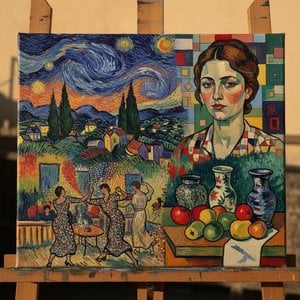
- His work often depicted scenes of everyday life, portraits, and landscapes, characterized by vibrant colors and expressive brushwork.
- Notable works include “The Morphinist”, “Woman Sitting in the Garden,” and “Gladioli”.
World War I and Later Years
- During World War I, Vaszary served as a correspondent on the Serbian front. This experience infused his imagery with greater drama and intensity.
- He returned to his Impressionist tendencies after another visit to Paris, demonstrating an ability to adapt and evolve his style.
- From 1920 until his retirement in 1932, he was a professor at the Hungarian University of Fine Arts, nurturing the next generation of artists.
Founding KÚT and Final Resting Place
- Activism: In 1924, Vaszary co-founded the “Képzőművészek Új Társasága” (New Society of Artists), known as “KÚT” (“fountain” in Hungarian).
- He was commissioned to create murals for the Biological Institute in Tihany in 1926.
- After retirement, he planned to settle permanently in Tata, Hungary, where he had a villa and frequently painted. However, he passed away suddenly in Budapest in 1939.
- He was ultimately laid to rest in Tata, which honors his legacy with a street and an elementary school named after him.
Historical Significance
- János Vaszary stands as a significant figure in Hungarian art history, bridging the gap between traditional academic training and modern Impressionist principles.
- His work reflects a unique blend of French influences and Hungarian identity, contributing to the development of a distinct national artistic voice.
- Legacy: He remains celebrated for his vibrant color palettes, expressive brushwork, and insightful depictions of everyday life.
Pitanja i odgovori
Mogu li da istražim dela umetnika János Vaszary putem ključnih reči?
Stranica Preko ključnih reči umetnika János Vaszary grupiše dela umetnika prema njihovim ključnim rečima.
Otkud je János Vaszary?
János Vaszary je rođen/a u Hungary.
Gde se mogu pronaći dela umetnika János Vaszary grupisanja po paleti boja?
Da biste pronašli dela umetnika János Vaszary u specifičnoj paleti boja, koristite stranicu Preko palete boja ovog umetnika.