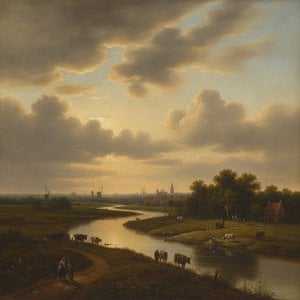
Jan Vermeer van Haarlem: The Quiet Master of Dutch Landscape
Jan Vermeer van Haarlem (1628 – 1691) stands as a singular figure within the illustrious tapestry of Dutch Golden Age painting, renowned not for dramatic narratives or heroic portraits but for an unparalleled sensitivity to light and atmosphere—a mastery that cemented his place among the most beloved artists of all time. Born in Haarlem, Netherlands, Vermeer’s artistic journey began under the tutelage of his father, Jan van der Meer I, a landscape painter who instilled in him a foundational understanding of capturing the beauty of the natural world. This formative influence would prove crucial to Vermeer's distinctive style and enduring legacy.- Early Life & Training: Vermeer’s childhood was marked by familial hardship; his father’s business struggled financially, impacting the family’s circumstances.
- Guild Membership & Marriage: He joined the Haarlem Guild of St. Luke in 1678, securing a stable livelihood and establishing himself as a respected professional artist. His marriage to Maria Thijs Dusart brought him into a prominent Haarlem family, further enriching his social life.
- Distinctive Style: His canvases are characterized by a serene stillness, achieved through masterful manipulation of light—particularly diffused sunlight—that illuminates domestic spaces or tranquil countryside vistas.
- Palette & Technique: He employed a muted palette dominated by earthy tones and subtle gradations of color, utilizing thin glazes layered upon glazes to create an illusionistic depth that captivated viewers. Vermeer’s technique—characterized by painstaking observation and meticulous brushwork—became synonymous with the Dutch landscape tradition.
- Major Achievements: His landscapes exemplify the Italianate style championed by Berchem, reflecting a fascination with classical ideals of harmony and proportion.
- Historical Significance: Vermeer’s influence extends far beyond his own lifetime, shaping subsequent generations of artists and establishing him as an icon of Dutch artistic excellence. His unwavering commitment to capturing the subtleties of light and atmosphere continues to inspire admiration and scholarly study today, securing his enduring place in art history.
Pitanja i odgovori
Mogu li da istražim dela umetnika Jan The Elder Vermeer Van Haarlem putem ključnih reči?
Stranica Preko ključnih reči umetnika Jan The Elder Vermeer Van Haarlem grupiše njegova dela prema ključnim rečima.
Gde je i kada je rođen/a Jan The Elder Vermeer Van Haarlem?
Jan The Elder Vermeer Van Haarlem je rođen/a u gradu Haarlem godine 1628.
Gde mogu da vidim dela umetnika Jan The Elder Vermeer Van Haarlem u 3D galeriji?
Moguća je i virtuelna poseta: stranica 3D galerija umetnika Jan The Elder Vermeer Van Haarlem predstavlja njegova dela u trodimenzionalnoj galeriji.