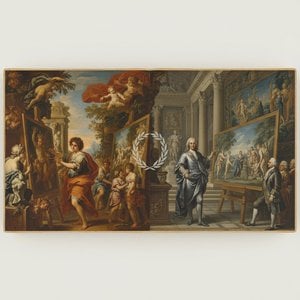
A Sculptor of Kings and a Bridge to Baroque
Jacques Sarazin, born in Noyon, France in 1592, occupies a fascinating position within the evolution of French sculpture. He wasn’t merely a craftsman executing commissions; he was a pivotal figure who absorbed the burgeoning Baroque style from his Roman sojourn and skillfully adapted it to the more restrained tastes of the French court, ultimately laying groundwork for the grandeur of Louis XIV's aesthetic. His journey began alongside his brother, both apprentices within the atelier of Nicolas Guillain in Paris – a foundation steeped in classical principles that would remain central to Sarazin’s artistic identity throughout his career. This early training instilled a reverence for form and proportion, qualities that would distinguish his work even as he embraced more dynamic Baroque elements.Roman Reverie and Artistic Forging
The year 1610 marked a turning point with Sarazin’s arrival in Rome. This wasn't simply a geographical relocation; it was an immersion into the heart of artistic innovation. Working under a French artist named Anguille, he quickly gained recognition, securing employment with Cardinal Aldobrandini at the Villa Aldobrandini in Frascati. It was here that Sarazin’s talent truly began to blossom. A particularly significant friendship formed with Domenichino, leading to collaborative projects like the high altar of Sant'Andrea della Valle – a testament to Sarazin’s growing skill and his ability to integrate seamlessly into established artistic circles. His versatility extended beyond large-scale collaborations; he demonstrated his mastery of stucco bas-reliefs for San Lorenzo in Miranda, showcasing a remarkable adaptability that would prove invaluable upon his return to France. The Roman experience wasn't merely about acquiring technique; it was about absorbing an atmosphere, understanding the power of dramatic composition and emotional expression – elements that would subtly infuse his later work.Parisian Triumph and Royal Patronage
Sarazin’s return to Paris in 1628 coincided with a fortunate marriage—a union with a niece of the prominent painter Simon Vouet. This connection proved instrumental, fostering a close artistic partnership that resulted in numerous prestigious commissions for hôtels particuliers and châteaux throughout the Île-de-France region, most notably at Maisons-Laffitte. To meet the demands of these ambitious projects, Sarazin established a large workshop, nurturing a team of skilled assistants including Gilles Guérin, Philippe de Buyster, and Gérard van Opstal – effectively creating a school of sculpture that would disseminate his style for generations to come. His success didn’t go unnoticed by the royal court. François Sublet de Noyers, a minister to Louis XIII and a discerning patron of the arts, recognized Sarazin's exceptional talent, leading to what is arguably his most celebrated achievement: the decoration of the great portal and dome of the western facade of the interior court of the Louvre.The Louvre’s Caryatides and Lasting Legacy
The caryatides adorning the attic level of the Louvre are not merely decorative elements; they represent a profound dialogue with classical antiquity, specifically Michelangelo's style. Sarazin didn’t simply copy; he interpreted, infusing the ancient forms with a distinctly French sensibility. This commission solidified his reputation as *the* sculptor of the era and demonstrated his ability to translate grand artistic visions into tangible reality. Beyond the Louvre, Sarazin continued to receive commissions from the Queen and actively championed the establishment of the Académie Royale de Peinture et de Sculpture – recognizing the importance of institutionalizing artistic training and elevating the status of artists within French society. His final major undertaking, the mausoleum for the heart of Prince de Condé in the Jesuit church of Rue Saint-Antoine, remained unfinished at his death in 1660, but was completed by his pupil, Pierre Le Gros the Elder, ensuring its lasting impact. Sarazin’s style—a harmonious blend of classical rigor and Baroque dynamism—defined a significant moment in French art history. He wasn't simply an artist *of* his time; he helped to *shape* it, leaving behind a legacy that continues to inspire awe and admiration centuries later. His work embodies the grandeur and sophistication of the French court, marking him as a true master of the Style Louis XIV.Pitanja i odgovori
U kom istorijskom periodu je stvarao/la Jacques Sarazin?
Jacques Sarazin je radila u periodu Early Modern. Ovaj period smešta umetnikov rad u istorijski kontekst.
Koliko je umetničkih dela autora Jacques Sarazin dostupno u katalogu?
Možete pregledati 8 umetnička dela dela umetnika Jacques Sarazin na stranici Sva umetnička dela.
Kako mogu pratiti radove umetnika Jacques Sarazin hronološki?
Dostupna je hronologija dela umetnika Jacques Sarazin: na stranici Hronologija dela, umetnikova dela su poređana prema datumu nastanka.