Isami Doi: A Pioneer of Hawaiian Abstract Expressionism
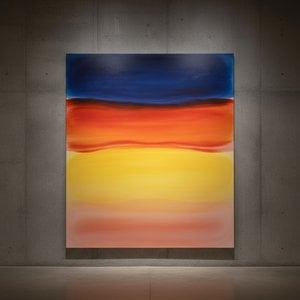
Isami Doi was a second generation Japanese American, born to immigrant parents who ran a general store on the island of Kauaʻi. His artistic training began at the University of Hawaiʻi (1921-23) but more significantly took shape in New York City (1923-38). There, Doi developed his painting and printmaking practices under Albert Bierstadt, whose landscapes profoundly impacted Doi’s early aesthetic sensibilities—a preference for muted tones and a focus on capturing the grandeur of nature. This formative period instilled in Doi a deep appreciation for observation and tonal harmony, qualities that would continue to permeate his oeuvre throughout his life. From 1923 until 1938, Doi resided in New York City, immersing himself in the vibrant artistic milieu of Greenwich Village and fostering collaborations with fellow printmakers and artists. He honed his skills at Columbia University, studying under Josef Albers and exploring the principles of color theory—a discipline that would later become central to Doi’s stylistic evolution. The influence of Bauhaus aesthetics is palpable in Doi's approach to design and composition, reflecting a broader interest in geometric abstraction and minimalist forms. During this time, Doi established himself as a respected educator, imparting his knowledge of printmaking and drawing to aspiring artists at NYU and fostering a generation of creative thinkers. A pivotal moment arrived in 1929 when Doi debuted his first solo exhibition at the Honolulu Museum of Art, showcasing fifteen prints depicting the dramatic landscapes of Kauaʻi—primarily painted in earthy hues reminiscent of Bierstadt’s style. These early works immediately garnered critical acclaim for their understated beauty and subtle erotic undertones, establishing Doi as a distinctive voice within the burgeoning Hawaiian art scene. He quickly gained recognition for his ability to convey emotion through tonal gradations and textural nuances, demonstrating an exceptional command of printmaking technique. Notably, Doi's jewelry designs for Mings Jewelers further solidified his reputation as a versatile artist—integrating sculptural elements with meticulous attention to detail. The mid-career phase witnessed Doi’s embrace of Greek and Roman symbolism—incorporating motifs such as centaurs, broken columns, and sphinxes into his prints and paintings. This stylistic shift signaled a deepening engagement with philosophical concepts and artistic traditions spanning centuries. The painting “Caucasian-Hawaiian,” housed in the Hawaii State Art Museum, exemplifies this trend—presenting a stylized Buddha figure as a visual representation of meditation—reflecting Doi’s spiritual quest for transcendence. As Doi matured artistically, his work transitioned towards pure abstraction, abandoning explicit symbols and focusing on capturing the essence of Kauaʻi's cliffs—which he regarded as repositories of profound spiritual energy. His final paintings in the 1960s abandoned all symbolic references altogether, returning to a simplified depiction of Kauaʻi’s coastline—characterized by bold horizontal brushstrokes and vibrant hues reminiscent of volcanic eruptions. These late works represent Doi's culmination of artistic exploration—expressing his unwavering devotion to nature and embodying the spirit of Hawaiian abstractionism. Isami Doi’s legacy extends beyond his individual artworks; he nurtured a thriving artistic community in Kauaʻi, inspiring countless artists to pursue their creative visions with courage and conviction. His enduring influence can be seen in the continuing dialogue between Hawaiian landscape painting and abstract expressionism—solidifying Doi's place as one of Hawaiʻi’s most important visual artists.- Notable Collections: Honolulu Museum of Art, Smithsonian American Art Museum, Nelson-Atkins Museum of Art, University of Michigan Museum of Art