A Visual Language of Faith and Form
ioannis sicuya, born in Metro Manila, Philippines in 1988, is a contemporary visual artist whose work resonates with a quiet power—a deliberate exploration of faith, architecture, and the subtle language of symbolism. His artistic journey began with formal training at the University of the Philippines Diliman’s Fine Arts program, where he graduated in 2009. However, his education extends far beyond academic walls; it is rooted in the rich cultural tapestry of his homeland and a deeply personal need to translate intangible beliefs into tangible form. Sicuya doesn't merely depict religious scenes or structures; he dissects them, reassembling their essence through a unique visual vocabulary that invites contemplation rather than dictating reverence.
Early Influences and Artistic Development
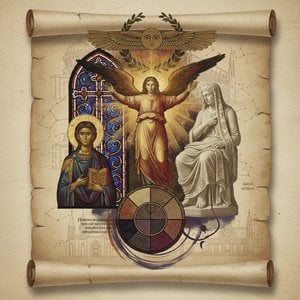
Growing up in the Philippines, a nation steeped in both indigenous spirituality and centuries of Catholic tradition, Sicuya was inevitably immersed in a world where the sacred and the everyday coexist. This early exposure fostered an acute sensitivity to visual cues—the ornate details of churches, the symbolic weight of religious iconography, and the inherent drama of devotional art. While acknowledging these foundational influences, Sicuya’s work quickly evolved beyond simple replication or imitation. He began experimenting with abstraction, layering textures and colors to create evocative atmospheres that hint at deeper meanings without explicitly revealing them. His technique is characterized by a meticulous attention to detail, often employing geometric patterns—particularly magic squares—as underlying structures for his compositions. These aren't merely aesthetic choices; they represent a deliberate attempt to encode hidden harmonies and spiritual principles within the artwork itself.
Themes of Architecture and Sacred Space
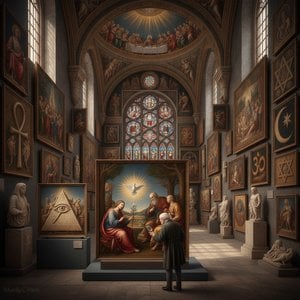
A recurring motif in Sicuya’s oeuvre is the depiction of architectural spaces, particularly churches and altars. However, these are rarely straightforward representations. He often fragments perspectives, isolates specific elements—a stained-glass window, a carved column, a section of an altar—and recontextualizes them within abstract compositions. This deconstruction serves to highlight the underlying geometry and symbolic order inherent in these structures. His series, Altar ng Pananam, for example, delves into the very heart of religious ritual, focusing on the objects and spaces that facilitate connection with the divine. The works aren’t about the grandeur of cathedrals but rather the intimate moments of devotion they contain. He strips away the superfluous ornamentation to reveal a core essence—a sense of stillness, contemplation, and the enduring human search for meaning.
Exhibitions and Recognition
While Sicuya maintains a relatively low profile, his work has garnered attention within the Philippine art scene. His participation in group exhibitions, such as ‘Picture Life’ at Tin-aw Gallery in Makati City in 2014, demonstrated his ability to connect with audiences through his nuanced and evocative imagery. These exhibitions provided a platform for showcasing his unique artistic vision and establishing him as a compelling voice within the contemporary Filipino art landscape. Beyond formal gallery settings, Sicuya's work resonates with collectors who appreciate its intellectual depth and emotional resonance. He is not an artist driven by spectacle or trend; he creates because of an undeniable internal urge—a need to translate his personal experiences and beliefs into a visual language that transcends cultural boundaries.
Historical Significance and Future Directions
ioannis sicuya’s contribution lies in his ability to bridge the gap between tradition and innovation. He doesn't reject the religious iconography of his upbringing but rather reinterprets it through a contemporary lens, employing abstract techniques and symbolic structures to create works that are both visually arresting and intellectually stimulating. His art serves as a reminder that faith is not static or monolithic; it is a dynamic force that evolves with each generation. As he continues to explore themes of architecture, symbolism, and the human condition, Sicuya’s work promises to offer further insights into the complexities of belief and the enduring power of visual expression. He represents a new wave of Filipino artists who are unafraid to engage with profound questions—artists who prioritize introspection over imitation and seek to create works that resonate with universal truths.