Helen Gerardia: Architect of Negative Space
Born in Ekaterinoslav, Russia – now Dnipropetrovsk – in 1903, Helen Gerardia’s artistic journey was one shaped by both a rich cultural heritage and the transformative experiences of immigration. Her early life, steeped in Russian traditions, provided a foundational understanding of color and form that would later inform her distinctive approach to abstraction. Moving to the United States as a child, she embraced American modernism, finding particular resonance with the burgeoning movements of Cubism and Abstract Expressionism. Gerardia’s career unfolded against a backdrop of significant artistic shifts, allowing her to navigate diverse influences while forging a uniquely personal style characterized by geometric precision and a masterful manipulation of negative space.
Gerardia's formal training began in 1947 at the Art Students League of New York, where she studied under Hans Hofmann, a pivotal figure in American art education. Hofmann’s emphasis on direct observation, simplified forms, and the importance of color theory profoundly impacted Gerardia’s artistic development. She subsequently honed her skills at the Hofmann School and the Brooklyn Museum of Art, absorbing key principles while simultaneously developing her own distinctive voice. This period marked a crucial transition as she moved away from representational art towards increasingly abstract compositions, laying the groundwork for her later success.
The Geometry of Perception
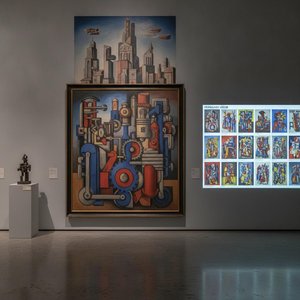
Gerardia’s artistic language is immediately recognizable through its rigorous geometric structures and deliberate use of negative space. She eschewed elaborate ornamentation or subjective expression in favor of a cool, analytical approach to form. Her paintings are not simply arrangements of shapes; they are carefully constructed diagrams that explore the relationships between positive and negative areas. This emphasis on negative space wasn’t merely an aesthetic choice but a fundamental element of her artistic philosophy – a way of revealing underlying structures and challenging conventional perceptions of reality. Her work often resembles architectural blueprints, meticulously planned compositions that invite viewers to contemplate the spatial relationships within each piece.
The influence of Cubism is evident in Gerardia’s fragmented forms and multiple perspectives, but she transcends mere imitation. She employs a more restrained palette – predominantly black and white – which amplifies the impact of her geometric arrangements. Her use of color, when present, is often subtle and carefully considered, serving to accentuate specific elements within the composition rather than dominating it. This restraint contributes to the sense of clarity and precision that characterizes her work.
Notable Works & Recognition
Among Gerardia’s most celebrated works are “Country Church” (1956), a lithograph depicting a rural landscape rendered in stark geometric forms, and several other abstract compositions exploring architectural motifs. “Ballerina” (1951), an oil on canvas, exemplifies her ability to capture movement and dynamism through the precise arrangement of shapes and lines. These pieces, along with numerous others, have been exhibited extensively throughout the United States and internationally, garnering critical acclaim for their intellectual rigor and visual impact.
Gerardia’s work was recognized by prominent institutions, including the Metropolitan Museum of Art, where her paintings were praised for their “good arrangement” and “visually pleasing” qualities. She also served as president of the American Society of Contemporary Artists from 1967 to 1969, demonstrating her leadership within the art community. Her dedication to promoting contemporary art solidified her position as a significant figure in the mid-20th century art scene.
Legacy and Influence
Helen Gerardia’s contribution to American abstract art lies not only in her distinctive visual style but also in her rigorous intellectual approach to composition. She demonstrated that abstraction could be both intellectually stimulating and aesthetically compelling, challenging viewers to engage with the underlying structures of form and space. Her emphasis on negative space continues to resonate with artists today, influencing generations of practitioners who seek to explore the possibilities of geometric abstraction.
Though she passed away in New York City in 1988, Gerardia’s legacy endures through her compelling body of work – a testament to her artistic vision and unwavering commitment to exploring the fundamental principles of art. Her paintings remain powerful examples of hard-edge abstraction, inviting viewers to contemplate the beauty and complexity of the world around us.
Pitanja i odgovori
Gde mogu pronaći statistiku o delima umetnika Helen Gerardia?
Statistika o delima umetnika Helen Gerardia dostupna je na njegovoj stranici Statistika.
Mogu li da proučim način na koji Helen Gerardia koristi boju u svim svojim delima?
Kolorit dela umetnika Helen Gerardia možete videti na njegovoj stranici Genom palete.
Postoji li 3D virtuelna obilaznica kroz dela umetnika Helen Gerardia?
Radove umetnika Helen Gerardia možete pogledati u 3D galeriji na stranici 3D galerija umetnika.