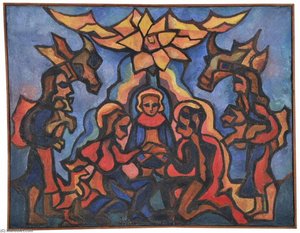
Gormand Johé (1905 - 1963): A Visionary of Rural France
Gormand Johé (1905 – 1963) remains an enigmatic figure in the annals of French Outsider Art, a painter whose intensely personal landscapes and still lifes offer glimpses into a world untouched by conventional artistic conventions. Born in Mâcon, Bourgogne, Johé’s life was marked by relative obscurity despite producing a prolific output of approximately 42 artworks—a testament to his unwavering dedication to his craft and an enduring fascination with the rhythms of rural existence. His work embodies the spirit of Art Brut, characterized by raw emotion, spontaneous execution, and a rejection of academic standards, establishing him as a pivotal voice within this influential artistic movement.
- Early Life & Artistic Beginnings: Little is known about Johé’s formative years beyond his birthplace and occupation as a farmer. Despite lacking formal training, he possessed an innate talent for observation and representation—skills honed through daily life amidst the landscapes of Bourgogne. His artistic journey began in earnest around 1930, driven by an impulse to capture the essence of his surroundings with uncompromising honesty.
- Style & Technique: Johé’s distinctive style is instantly recognizable: bold brushstrokes, vibrant colors—often dominated by earthy hues—and a deliberate disregard for perspective and proportion. He favored large canvases, immersing himself in the physicality of painting itself, applying pigment thickly onto surfaces with an almost sculptural gesture. His compositions frequently depict solitary figures engaged in simple activities—shepherds tending flocks, farmers harvesting crops—creating scenes imbued with palpable atmosphere and conveying profound emotional resonance.
- Influences & Inspirations: While Johé resisted categorization, his artistic sensibilities clearly drew inspiration from the Barbizon School painters—particularly Jean-François Millet—whose depictions of peasant life championed realism and humanist values. Furthermore, he exhibited a deep appreciation for music, evident in several paintings featuring musical instruments or evoking sonic landscapes—a connection that reflects broader cultural currents of the time.
- Notable Works: Among Johé’s most celebrated pieces are ‘Scène de rue,’ a dynamic portrayal of village life rendered with energetic brushwork and expressive color; ‘Le Coq de la paix,’ an arresting image capturing the symbolic significance of the rooster—a motif recurring throughout his oeuvre—and ‘Le berger des rêves Berger des Siècles’, which blends mythological imagery with musical references into a surreal landscape.
- Legacy & Significance: Gormand Johé’s contribution to Art Brut is undeniable, securing his place as one of France's foremost practitioners of this expressive artistic form. His uncompromising vision—rooted in direct experience and devoid of artifice—continues to inspire artists today, reminding us that profound beauty can emerge from the most unassuming subjects and mediums. He stands as a beacon for those who seek authenticity and emotional depth within their creative endeavors.
Exploring Art Brut: A Movement Defined by Radical Freedom
The emergence of Art Brut—French for “raw art”—represents a significant turning point in the history of 20th-century art, challenging established notions of artistic merit and elevating self-taught creativity to new heights. Artists like Johé rejected academic conventions, eschewing formal training and prioritizing intuition over technical skill—a deliberate act of defiance against prevailing cultural norms. This movement gained momentum in the aftermath of World War II, fueled by a growing interest in marginalized voices and unconventional expressions of emotion.
- Origins & Context: The term “Art Brut” was coined by Jean Dubuffet in 1947—a sculptor and painter who championed the artistic potential of individuals outside the mainstream art world—primarily those with mental disabilities or lacking conventional education. Dubuffet’s conviction that Art Brut possessed a unique spiritual dimension resonated deeply within intellectual circles, propelling it into international prominence.
- Characteristics & Aesthetics: Art Brut distinguishes itself through several key features: spontaneity, primitivism, textural richness, and emotional intensity. Artists embrace unconventional materials—often found objects or recycled scraps—and employ techniques that prioritize tactile sensation over meticulous precision. The resulting artworks convey a visceral immediacy—a raw honesty—that transcends stylistic considerations.
- Influence & Impact: Art Brut exerted considerable influence on subsequent generations of artists, fostering experimentation and encouraging a reconsideration of artistic boundaries. Its ethos of liberation from academic constraints paved the way for movements like Neo-Expressionism and Graffiti art—demonstrating its enduring legacy in contemporary visual culture.
Gormand Johé’s Artistic Vision: Landscapes as Expressions of Inner Truth
Johé's artistic practice was fundamentally driven by a desire to translate his subjective experience into tangible form—to capture the essence of rural Bourgogne not merely as it appeared visually, but as it felt emotionally. His landscapes are imbued with palpable atmosphere—a sense of solitude and contemplation—reflecting his profound connection to the natural world. The artist’s meticulous attention to detail—particularly in depicting textures and colors—reveals a remarkable sensitivity to materiality and contributes to the immersive quality of his paintings.
- Symbolism & Narrative: Recurring motifs—such as roosters, shepherds, and musical instruments—suggest symbolic layers beyond mere representation. These elements serve as conduits for conveying emotions—ranging from melancholy longing to joyous celebration—and invite viewers to engage in a dialogue with the artist’s inner world.
- Materiality & Technique: Johé's distinctive technique—characterized by thick impasto and bold brushstrokes—emphasizes the physicality of painting itself, mirroring the rhythms of rural life and reinforcing the artwork’s emotional impact. The artist’s deliberate disregard for perspective and proportion underscores his rejection of academic conventions—affirming Art Brut’s commitment to unfiltered expression.
Conclusion: An Enduring Legacy of Authenticity
Gormand Johé's artistic legacy extends far beyond the confines of Art Brut—serving as a powerful reminder that true creativity resides in embracing unconventional paths and prioritizing emotional honesty above all else. His uncompromising vision—rooted in direct experience and devoid of artifice—continues to inspire artists today, encouraging them to explore uncharted territories of visual language and to champion the transformative potential of self-taught artistry. Johé’s paintings stand as testament to the enduring power of raw emotion and the beauty found within simplicity—a timeless contribution to the history of Art Brut and a celebration of human creativity unbound by limitations.