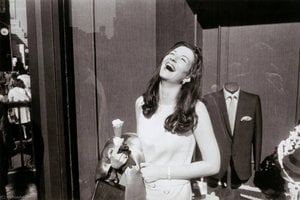
A Life Captured in Fleeting Moments
Garry Winogrand, born in New York City in 1928, wasn’t simply a photographer; he was a visual anthropologist of the American experience during the mid-20th century. His parents, immigrants from Budapest and Warsaw, instilled a sense of observing the world with fresh eyes – a quality that would define his artistic vision. Growing up in a working-class Jewish neighborhood in the Bronx provided an early education in the rhythms and complexities of urban life, laying the groundwork for a career dedicated to capturing its raw energy. Though he briefly pursued painting at City College of New York and Columbia University, it was a photojournalism class with Alexey Brodovitch at The New School that ignited his true passion. This wasn’t about crafting posed portraits or staged narratives; it was about being present, reacting to the unfolding drama of everyday existence, and freezing those moments in time. He supported himself through freelance work during the 1950s and 60s, honing his skills while navigating the commercial world of photography, but always returning to his personal projects – the heart of his artistic exploration.The Snapshot Aesthetic and Rise to Prominence
Winogrand’s photographic style was revolutionary in its seeming casualness. He rejected the formal constraints of traditional portraiture or landscape photography, embracing instead what became known as a “snapshot aesthetic.” Armed with a 35mm camera, he moved through crowds, anticipating moments and reacting instinctively. His images often feature tilted horizons, blurred figures, and unexpected compositions – imperfections that paradoxically contribute to their authenticity and immediacy. This wasn’t carelessness; it was a deliberate choice to mirror the chaotic, fragmented nature of modern life. He didn't seek to control the scene but rather to observe and record it as it unfolded. His early exhibitions, including his first solo show at Image Gallery in New York in 1959, began to attract attention, but it was his inclusion in the groundbreaking “New Documents” exhibition at MoMA in 1967 – alongside Diane Arbus and Lee Friedlander – that truly cemented his place within a new wave of documentary photography. This show challenged conventional notions of photographic truth and subjectivity, establishing Winogrand as a leading voice in a generation redefining the medium.Major Works: A Chronicle of American Life
Throughout his career, Winogrand produced a remarkable body of work that served as a visual chronicle of American society. The Animals (1969), a collection of photographs taken at the Central Park Zoo, explored the often-uncomfortable relationship between humans and animals, using the zoo as a microcosm for broader societal dynamics. Women Are Beautiful (1975), perhaps his most provocative series, captured women on the streets of New York with an unflinching gaze, challenging conventional notions of beauty and representation. Public Relations (1977) documented events specifically created for mass media consumption, offering a critical commentary on the spectacle of modern life. And Stock Photographs: The Fort Worth Fat Stock Show and Rodeo (1980) celebrated the vibrant energy and unique culture of a Texas cattle industry exposition. These projects weren’t simply collections of images; they were investigations into the social, political, and cultural forces shaping American identity.A Legacy Revealed: The Undiscovered Archive
Winogrand's untimely death in 1984 left behind an astonishing secret – an archive of approximately 2,500 rolls of undeveloped film. This vast collection remained hidden for decades, a testament to his prolific output and restless energy. The gradual processing and exhibition of this material has revealed further dimensions of his career, challenging existing interpretations and solidifying his reputation as one of the most important photographers of the 20th century. The sheer volume of work underscores Winogrand’s relentless pursuit of capturing the fleeting moments that define our existence. John Szarkowski, a renowned photography curator, famously called Winogrand "the central photographer of his generation," recognizing his profound influence on the development of street photography and his ability to capture the essence of American life with unparalleled honesty and insight. His work continues to inspire contemporary photographers, shaping their approaches to candid observation and exploring the complexities of public space. Winogrand didn’t just document the world; he forced us to see it anew – a legacy that endures today.Pitanja i odgovori
U kom gradu i državi je rođen/a Garry Winogrand?
Garry Winogrand je rođen/a u gradu New York City, u državi United States of America.
Mogu li da pregledam dela umetnika Garry Winogrand prema paleti boja?
Da biste pronašli dela umetnika Garry Winogrand u specifičnoj paleti boja, koristite stranicu Preko palete boja ovog umetnika.
Postoji li pregled svih motiva koje je Garry Winogrand naslikao/la?
Radove umetnika Garry Winogrand možete istražiti prema tematici na stranici Atlas tema ovog umetnika.