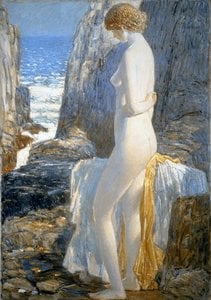
A Pioneer of American Impressionism: The Life and Art of Frederick Childe Hassam
Frederick Childe Hassam was an American Impressionist painter, noted for his urban and coastal scenes. Along with Mary Cassatt and John Henry Twachtman, he championed artistic independence and helped to establish Impressionism as a legitimate movement within the United States. His unwavering commitment to capturing light and color—traits that would define his entire oeuvre—secured his place among the most influential figures in American art history. Born in Boston on October 17, 1859, Hassam’s early life was marked by an innate fascination with drawing and painting. Unlike many aspiring artists of his time who pursued formal training abroad, Hassam honed his skills primarily through self-study and practical experience, initially honing his craft as an illustrator for publications like *Harper's Weekly* and *Scribner’s Monthly*. This formative period instilled in him a keen observational eye—a characteristic that would become central to his distinctive artistic style. He possessed a remarkable ability to distill complex visual information into simplified forms, prioritizing clarity of composition and tonal harmony above elaborate ornamentation.Early Career and Influences: From Illustration to Landscape Painting
Hassam’s initial professional endeavors focused on illustration work for periodicals, providing him with invaluable experience in capturing fleeting moments and conveying narrative through visual imagery. This early exposure to printmaking techniques—particularly etching—influenced his later artistic explorations and contributed to the development of his signature tonalist style. He drew inspiration from European Impressionists like Claude Monet and Edgar Degas, absorbing their innovative approaches to color and brushwork while simultaneously forging a path toward artistic expression that was uniquely American. Monet’s exploration of atmospheric effects—particularly the interplay of light and shadow—served as a guiding principle for Hassam's landscapes, encouraging him to prioritize tonal gradations over precise delineation. Similarly, Degas’s depictions of dancers—characterized by dynamic poses and subtle gestures—inspired Hassam’s interest in capturing movement and conveying emotion through visual form.The Urban Landscape: Capturing the Spirit of Modern New York
Hassam's artistic vision centered on portraying the vibrant energy of urban life, particularly New York City. He recognized that Impressionism could transcend mere topographical representation, transforming ordinary scenes into evocative expressions of mood and atmosphere. His paintings—such as *The Soaring Staircase* (1895) and *Fifth Avenue at Dusk* (1897)—capture the bustling activity of city streets with remarkable precision and sensitivity. Hassam skillfully employed color palettes that mirrored the changing light conditions, creating luminous compositions that conveyed a palpable sense of immediacy. He wasn’t merely documenting architectural structures; he was conveying the psychological impact of urban environments—the exhilaration of movement, the quiet contemplation of domestic interiors, and the social interactions that shaped daily life.Notable Achievements: Artistic Independence and Recognition
Hassam's unwavering dedication to artistic independence culminated in his involvement with “The Ten American Painters,” a collective founded in 1897 as a defiant assertion against the conservative biases of the Society of American Artists. This group—which included luminaries like John Henry Twachtman, Willard Leroy Metcalf, and Edmund Tarbell—challenged prevailing academic conventions and championed a more progressive aesthetic sensibility. Hassam served as the inaugural president of The Ten, solidifying his leadership role within the burgeoning American art scene. His commitment to portraying American subjects—particularly landscapes and urban vistas—earned him widespread acclaim and cemented his reputation as one of the foremost Impressionist painters of his era.Legacy: An Enduring Influence on Subsequent Artists
Frederick Childe Hassam passed away in East Hampton, New York, on August 27, 1935, leaving behind a prodigious artistic legacy that continues to inspire artists today. His pioneering exploration of tonalism—characterized by subtle gradations of color and meticulous attention to detail—established a distinctive stylistic tradition within American Impressionism. Hassam’s unwavering belief in capturing the essence of his time—the dynamism of urban life and the beauty of the natural world—remains profoundly relevant, reminding us that art can serve as both a reflection of history and a catalyst for creative innovation. His paintings—particularly those depicting American flags—stand as enduring symbols of patriotism and civic pride, securing his place among the most revered figures in American artistic heritage.Pitanja i odgovori
Gde mogu da vidim dela umetnika Фредерик Хассам u 3D galeriji?
3D galerija umetnika Фредерик Хассам je stranica koja prikazuje umetnikova dela u virtuelnoj trodimenzionalnoj galeriji.
Kako mogu pratiti radove umetnika Фредерик Хассам hronološki?
Radove umetnika Фредерик Хассам možete pogledati hronološkim redosledom na stranici Hronologija dela umetnika.
Mogu li da istražim dela umetnika Фредерик Хассам putem ključnih reči?
Stranica Preko ključnih reči umetnika Фредерик Хассам grupiše njegova dela prema ključnim rečima.