A Chicago Renaissance Man: The Life and Art of Frederic Clay Bartlett
Frederic Clay Bartlett, born in 1873 into a burgeoning era of American industrial prosperity, was more than simply an artist; he was a pivotal figure in establishing Chicago as a vibrant center for modern art. His story is one interwoven with the city’s own growth, from its dazzling display at the 1893 World's Columbian Exposition to its emergence as a haven for progressive artistic thought. Born into privilege – his father, Adolphus Clay Bartlett, was a leading figure in the hardware industry and originator of the True Value label – Frederic possessed both the means and the inclination to pursue a life dedicated to aesthetic exploration. While he received early education at St. Paul’s School in Concord, New Hampshire, and Harvard School for Boys in Chicago, it was the immersive experience of the 1893 Exposition that truly ignited his passion for fine art. This grand spectacle, with its Beaux-Arts architecture and international collection of masterpieces, served as a catalyst, prompting him to abandon formal academic pursuits at nineteen and embark on an artistic pilgrimage to Europe.
European Foundations and Return to the American Scene
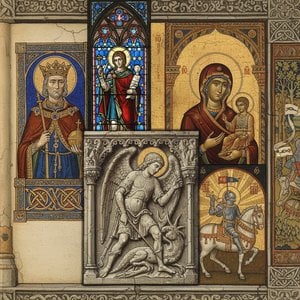
Bartlett’s European sojourn proved formative. He initially studied in Munich, Germany, before settling in Paris, where he honed his skills under the tutelage of Jean-Paul Laurens and later Edmond Aman-Jean and Raphaël Collin at École Collin. These masters instilled in him a strong foundation in drawing and painting techniques, while also exposing him to the evolving artistic currents of the time. The influence of Puvis de Chavannes, with his emphasis on monumental compositions and symbolic narratives, would particularly resonate in Bartlett’s later mural work. Returning to Chicago around 1900, he established a studio in the Fine Arts Building on Michigan Avenue, quickly gaining recognition for his talent. Early commissions, such as a portrait secured for just $75, signaled an immediate success, but it was his ambition that truly set him apart. He wasn’t content with merely replicating existing styles; Bartlett sought to create works of significant scale and artistic merit, leading him towards the realm of mural painting. His first major undertaking, a mural for Second Presbyterian Church in 1900, though tragically lost to fire, demonstrated his bold vision – an integration of fresco techniques depicting the Tree of Life and a heavenly choir rendered in a Byzantine style. This project foreshadowed his future endeavors, showcasing a willingness to embrace ambitious artistic challenges.
Murals, Patronage, and the Shaping of Chicago’s Artistic Identity
Bartlett's reputation as a muralist solidified with subsequent commissions. The stained-glass frieze he created in 1904 for the Frank Dickinson Bartlett Memorial Gymnasium at the University of Chicago – dedicated to his brother – depicted a medieval tournament procession, blending narrative storytelling with decorative artistry. However, it was the fifty ceiling panels he painted for the Michigan Room of the University Club of Chicago in 1909 that truly cemented his place as a leading artist in the city. These panels, executed with meticulous detail and a refined aesthetic sensibility, showcased his mastery of technique and his ability to create harmonious compositions. Beyond his own artistic production, Bartlett became a passionate advocate for modern art and a generous patron of contemporary artists. He was a founding member of the Arts Club of Chicago, an organization instrumental in introducing avant-garde ideas and fostering a vibrant artistic community. His discerning eye led him to amass an impressive collection of French Post-Impressionist and modernist works, which he generously shared with the Art Institute of Chicago through donations and support. This patronage played a crucial role in shaping the museum’s holdings and establishing its reputation as a leading institution for modern art.
A Legacy Beyond Canvas: Dorfred House and Enduring Influence
Bartlett's personal life was marked by both artistic fulfillment and domestic tranquility. He married Dora Tripp in 1898, and later Helen Louise Birch in 1919, fathering one son, Frederic Clay Bartlett Jr., who also pursued a career in the arts as an artist and musician. The family resided in "Dorfred House," a custom-designed Prairie Avenue home featuring a spacious studio and elegant reception rooms – a testament to Bartlett’s success and refined taste. This residence served not only as a private sanctuary but also as a gathering place for artists, intellectuals, and patrons of the arts. Frederic Clay Bartlett passed away in 1953, leaving behind a legacy that extends far beyond his paintings and murals. He was instrumental in transforming Chicago into a significant center for modern art, fostering an environment where creativity could flourish. His commitment to artistic innovation, coupled with his generous patronage, helped shape the city’s cultural landscape and continues to inspire artists and collectors today. His story is a reminder that true artistic impact lies not only in creating beautiful objects but also in nurturing the creative spirit of a community.
Influences and Artistic Style
Bartlett's artistic style was a unique synthesis of traditional techniques and modern sensibilities. While deeply rooted in the academic training he received in Europe, particularly the mural painting traditions championed by Puvis de Chavannes, he also demonstrated an openness to new ideas and movements. The World’s Columbian Exposition had exposed him to a diverse range of styles, from Impressionism to Symbolism, which subtly informed his work. His murals, while often employing classical compositional principles, were infused with a sense of decorative elegance and symbolic meaning. His art wasn't about radical experimentation; it was about refining existing forms and imbuing them with a contemporary spirit. This approach is also evident in his collecting habits – he favored artists who pushed boundaries while remaining grounded in aesthetic principles. He appreciated the luminosity of Monet, the structural rigor of Cézanne, and the expressive power of Van Gogh, recognizing their contributions to the evolution of modern art. Ultimately, Frederic Clay Bartlett’s legacy lies in his ability to bridge the gap between tradition and innovation, creating a body of work that is both visually captivating and historically significant.