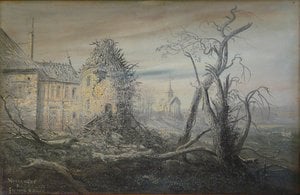
Fernand Combes, 1856 – 1943

11 najpoznatijih slika umetnika Fernand Combes

Slika koja je proslavila Fernand Combes je Vieux Paris, Quartier St Victor, La Rue Des Boulangers (1910). Paris, Carrefour Près Saint Germain Des Prés, des rues de l'Abbaye, Cardinal Lemoine, de Bourbon le Château, et de l'Echaudé St Germain (1910) i Paris, Port des Orfèvres, l'hiver, avec la Seine gelée (1910) slede nakon njih u srcima kolekcionara i posetilaca muzeja. Od 11 dela umetnika Fernand Combes u našem katalogu, ovih 11 su najcenjenija, a svako je predstavljeno sa datumom nastanka, muzejom i onim što ga izdvaja.

Rangirano prema našem koeficijentu popularnosti, koji kombinuje pretrage, posete i porudžbine za svako delo. Ažurirano новембар 2026. Svako remek-delo na ovoj stranici može se naručiti kao ručno oslikana uljana reprodukcija muzejskog kvaliteta ili kao umetnička štampa, u dimenzijama koje odaberete.

Portret Fernand Combes
Fernand Combes · 1856 – 1943
Rođen · umro
1856 – 1943, Les Herbiers
Pokret
Impressionism
Radovi u našem katalogu
11
Najpoznatije
Vieux Paris, Quartier St Victor, La Rue Des Boulangers (1910)

Fernand Combes: deset remek-delo

Još Fernand Combes remek-delo, od 11 do 11

Fernand Combes, iz godine u godinu: ključna dela

Od 1910 do 1925, 16 godina umetnosti Fernand Combes, godinu po godinu, kroz njene najlepše slike.

Remedela Fernand Combes: pitanja i odgovori

Po kojoj je slici Fernand Combes najpoznatiji/a?Prikaži odgovor

Vieux Paris, Quartier St Victor, La Rue Des Boulangers (1910). Sledeći su Paris, Carrefour Près Saint Germain Des Prés, des rues de l'Abbaye, Cardinal Lemoine, de Bourbon le Château, et de l'Echaudé St Germain (1910) i Paris, Port des Orfèvres, l'hiver, avec la Seine gelée (1910).

Koliko je godina imao/la Fernand Combes kada je slikao/la Vieux Paris, Quartier St Victor, La Rue Des Boulangers?Prikaži odgovor

54 godina: Vieux Paris, Quartier St Victor, La Rue Des Boulangers datira iz 1910, a Fernand Combes je rođen/a 1856.

Koja su deset najznačajnijih dela umetnika Fernand Combes?Prikaži odgovor

Vieux Paris, Quartier St Victor, La Rue Des Boulangers, Paris, Carrefour Près Saint Germain Des Prés, des rues de l'Abbaye, Cardinal Lemoine, de Bourbon le Château, et de l'Echaudé St Germain, Paris, Port des Orfèvres, l'hiver, avec la Seine gelée, Paris, Quartier St Paul, Rue Du Figuier, Scène Biblique (Moïse), Paysanne Sablaise, Honfleur, La Rue Gambetta, Mondement, Pérouges, Rue Des Princes i "Si Imprenabilis Pérouges Des Pérouges" Pérouges, Porte d'en Haut. Gornji rang prikazuje godinu i muzej za svako od njih.

Koliko je dela naslikao Fernand Combes?Prikaži odgovor

Naš katalog sadrži 11 dela umetnika Fernand Combes, datiranih od 1910 do 1925.

Kada je Fernand Combes naslikao svoja remek-dela?Prikaži odgovor

U periodima 1910: 4 od ukupno 11 dela na ovoj stranici datiraju iz tog vremena, od čega je Vieux Paris, Quartier St Victor, La Rue Des Boulangers.

Koja su prva i poslednja poznata dela Fernand Combes?Prikaži odgovor

Najstarije delo na ovoj stranici je iz Vieux Paris, Quartier St Victor, La Rue Des Boulangers (1910), a najnovije iz Sospel, Le Pont Vigie (1925).

Koji umetnički pravac zastupa Fernand Combes?Prikaži odgovor

Impressionism, kao što pokazuju slike na ovoj stranici.

Mogu li da posedujem reprodukciju remek-dela umetnika Fernand Combes?Prikaži odgovor

Da. Svaku sliku sa ove stranice možete naručiti kao ručno oslikano ulje na platnu muzejskog kvaliteta ili kao umetnički print, u veličini koju odaberete, direktno sa stranice te slike.

Život umetnika Fernand Combes

Early Life and Artistic Beginnings

Fernand Combes, born François Georges Fernand Combès in Les Herbiers, France, on August 4th, 1856, emerged from a rural landscape that would subtly yet profoundly shape his artistic vision. While initially pursuing studies at the École des Beaux-Arts in Paris, the rigid academic traditions of the time proved somewhat stifling for the burgeoning artist. Combes wasn’t drawn to grand historical narratives or mythological allegories; instead, he found himself captivated by the ephemeral beauty of everyday life and the shifting moods of nature. This inclination steered him away from direct competition within the Salon system and towards the nascent Impressionist movement, though his connection remained nuanced rather than a full embrace of its tenets. He sought to capture reality not through strict adherence to optical truth, but through an emotional resonance with the scenes before him.

The Parisian Years and Developing Style

Combes’s artistic journey truly blossomed during his time in Paris. The city itself became a primary subject, particularly its intimate corners and bustling street life. Unlike some of his contemporaries who focused on the glamorous boulevards, Combes often depicted quieter moments – winter scenes along the Seine, like Paris, Port des Orfèvres, l'hiver, avec la Seine gelée (1910), revealing a sensitivity to atmospheric conditions and the subtle play of light. These works demonstrate an Impressionistic leaning, characterized by loose brushwork and a focus on capturing fleeting impressions. However, Combes’s palette often retained a more traditional earthiness than the brighter hues favored by Monet or Renoir. He also explored scenes of provincial life, as seen in Honfleur, La Rue Gambetta (1913), showcasing his skill with monochrome drawings and an ability to convey realism and nostalgia.

Beyond Landscapes: Religious Themes and Diverse Subjects

While celebrated for his landscapes and Parisian streetscapes, Combes’s oeuvre extended beyond these familiar subjects. He engaged with religious themes, creating works like Scène Biblique (Moïse), revealing a depth of contemplation and narrative skill. This exploration suggests a broader intellectual curiosity and a willingness to tackle diverse artistic challenges. His versatility is further evidenced by his work in etching, engraving, and drawing, demonstrating a mastery of various techniques and a commitment to exploring different modes of visual expression. Combes wasn’t confined to a single style or subject matter; he possessed an adaptable talent that allowed him to navigate the complexities of the art world with quiet confidence.

Legacy and Historical Significance

Fernand Combes passed away in 1943, leaving behind a body of work that, while not as widely recognized as some of his Impressionist peers, offers a valuable insight into the artistic currents of late 19th and early 20th century France. He occupies an interesting position – a painter influenced by Impressionism but not wholly defined by it. His works provide a bridge between traditional academic painting and the more radical experiments of the avant-garde. Combes’s contributions lie in his ability to capture the essence of a place and moment with sensitivity and skill, imbuing his scenes with an emotional depth that resonates even today.
  • Key Characteristics: Impressionistic landscapes, Parisian street scenes, religious works, versatile technique (painting, etching, drawing).
  • Influences: École des Beaux-Arts training, Impressionist movement.
  • Major Achievements: Capturing the atmosphere of Paris and provincial France; exploring diverse subjects with skill and sensitivity.
His art continues to be appreciated for its quiet beauty, technical proficiency, and unique perspective on a pivotal era in French painting.